
(A Few) Questions Answered
Trying to figure out FC Cincinnati's center backs and some stray thoughts about potential transfer business.

Leagues Cup has come and gone, and even though FC Cincinnati won (then lost) against Liga MX opposition, this is as good a time as any to zoom out a little bit and grapple with some bigger Orange and Blue related questions. I solicited some suggestions at the end of last week's newsletter, and then on Bluesky and got some responses that got my mind turning.
I wasn't able to get to everything, so have plans for a part two of this series, so you asked something and it's not in here, stay tuned. Also, if there's anything else FCC related you'd like to see me try to make sense of, drop it the comments or get it to me in some other way, and I'll see what I can do.
Let's Talk Center Backs
From my vantage point in the Orange and Blue discourse bubble, debate over the team's center backs has occupied the most oxygen. There are a lot of moving parts on this subject, from on the field play, to roster construction and maximization, so here's a shot at trying to untangle some of it.
By the Numbers
Assessing defenders with data is much more complicated endeavor than other positions on the field. I've written about it fairly recently, but here's as brief of overview as I can give again.
The most common defensive statistics - think tackles, clearances, or interceptions - measure events when defenders are actively defending. But the best defenders might not be the ones who rack up the most counting stats for a couple major reasons. A good defender might not need to make an interception or tackle because they're already in a good position, resulting in the ball never being played in their general vicinity. Also, defenders playing on better teams will likely have fewer opportunities to do actual on-ball defending because their team dominates possession.
There are some publicly available attempted solutions to the first issue, like American Soccer Analysis' g-, which credits or debits defenders for how much danger occurs in their zones of responsibility, but defending remains a bit of a black box from a data perspective. ASA's net goals added (net g+) attempts to give a more complete view of what's happening on the field through a combination of the aforementioned g- paired with possession models.
The results have not been kind to FCC's central defenders in 2026. Nick Hagglund, somewhat surprisingly (and likely long-throw boosted), leads the way, just squeaking into the top ten among defenders who have played at least 400 minutes throughout the season. Miles Robinson ranks 54th out of 101 qualifying players, while the rest of FCC's center backs, Andrei Chirila, Samuel Gidi, Kyle Smith, and Matt Miazga are in the bottom quartile.
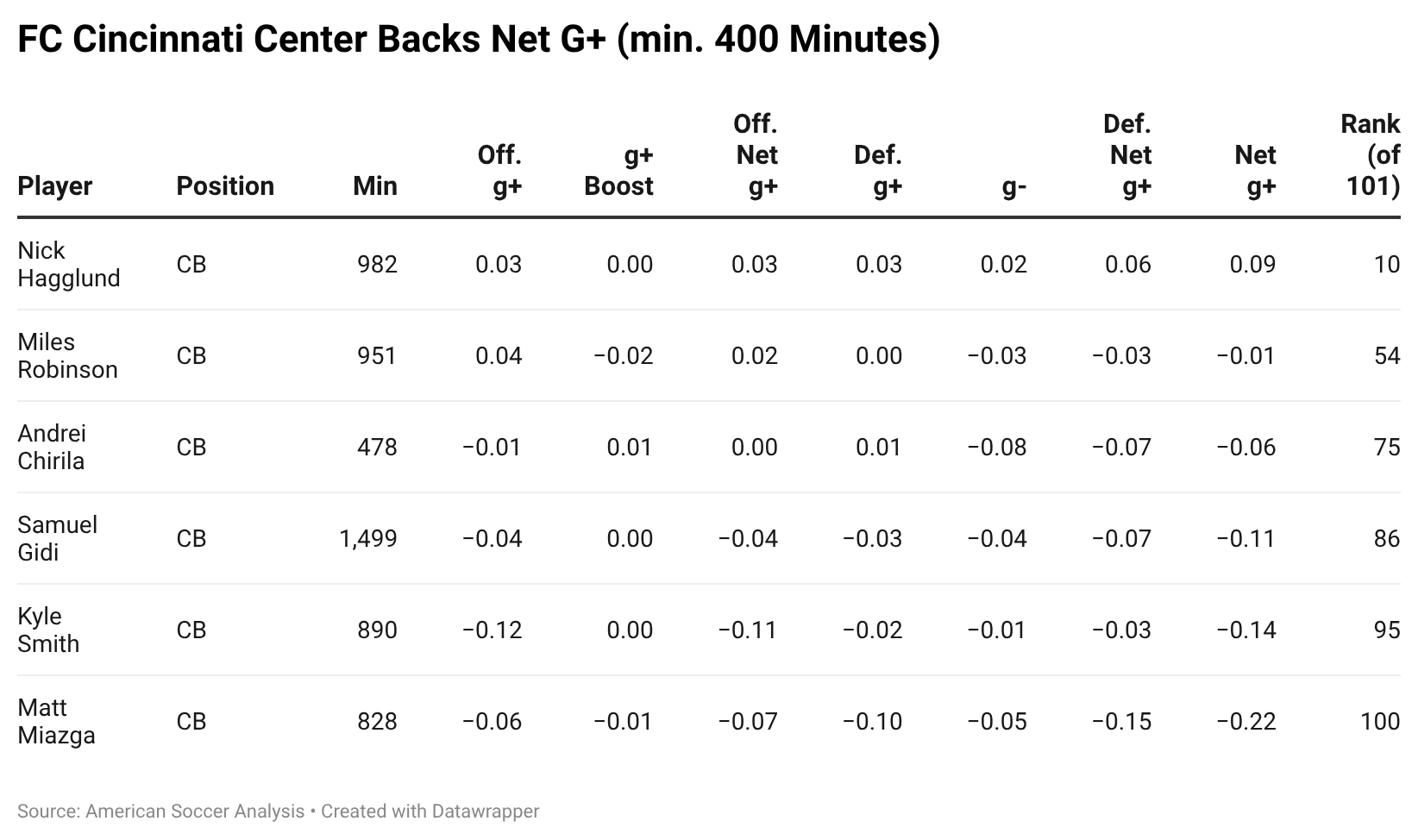
A part of this is likely structural. FCC's setup and inability to control games hasn't helped its center backs, who have consistently had to defend deep against sustained opposition pressure. That's an environment in which any central defender in the world would struggle. Still, even in less advantageous situations, the Orange and Blue's center backs haven't been very good. For a roster spending as many resources on its center backs as FCC is, that's obviously not a good thing, and has contributed to the defensive issues we've seen throughout the season.
The Miles Robinson Part
Miles Robinson's designation as a Designated Player has seemingly been the third rail of FCC discourse for much of the season.
First, there's room for optimism as we enter the second half of the season. As we've seen in the first few league games back after the World Cup, a healthy Robinson allows FCC to play in a more aggressive manner. His recovery ability and ball winning is still very good, allowing the Orange and Blue to hold a higher line, putting opponents under more consistent pressure, hopefully keeping the ball further from FCC's goal. His passing remains excellent for a center back, too, helping to bridge the gap between defensive and attacking thirds of the field.
But just because there can be optimism moving forward doesn't negate the fact that he's been merely an average MLS center back so far in 2026 as he's dealt with injuries, red card suspensions, and World Cup related missed time.
Because he's a DP, Robinson hits FCC's cap at most for $708,037, even though his actual salary is higher. He's one of only two center backs in MLS who have to occupy that roster slot, along with NYCFC's Thiago Martins (0.00 net g+, 48th among center backs), and, as shown above, has been...fine so far. And that's the crux of the issue. Because a team can pay whatever they want to a DP and have the contract hit the books for that relatively low salary cap number, it's the most impactful player acquisition mechanism available in the league.
On the one hand, I don't think a DP center back is likely to be the optimal way to build a MLS roster. However, it doesn't consign a team to being bad automatically, either. Previously, Robinson has shown the ability to be one of the best center backs in MLS. Even with surprisingly strong season from Hagglund, if I had to choose who I thought was FCC's best center back, I'm picking Robinson. And again, that doesn't mean he's been great or even good. For the Orange and Blue to get where they want to go, they'll need Robinson to be better, but the team isn't struggling defensively solely because of Robinson, and they'd almost certainly be worse off without him.
However, any team getting average or worse play from a DP, anywhere on the field, is going to have to make it up elsewhere. At a time when other teams have prioritized spending on attacking players, Chris Albright has zagged, investing considerable resources in defenders including but not limited to Robinson. With that strategy, finding high level contributors on value contracts in more traditionally expensive attacking positions becomes a must, not a nice to have. It's doable - it's just more difficult.
Two things can be true. First, Miles Robinson has been one of FCC 's best center backs in 2026, even though he's played at a pretty average level compared to 0ther center backs around the rest of the league. However, at the same time, Robinson's average play in a DP slot makes the path to building a truly contending MLS roster more difficult for FCC's front office.
Transfer Business
The summer transfer window closes in just about three weeks and things have been remarkably quiet from a front office that is usually quite active.
I'm not convinced that one or two incoming transfers are going to suddenly turn the Orange and Blue into a legitimate contender. But they can continue to build on a hopefully more flexible foundation that'll turn FCC back into a real silverware competitor.
Even starting to put together a potential list of players is absurdly difficult because it's just really hard to find data on other leagues as a member of the general public in 2026. So specific predictions are out (not that I'd be successful anyways) in favor of a couple directions I'd be curious to see the team move towards.
Resources Available
Albright and the front office have some player acquisition mechanisms at their disposal this summer to make additions.
FCC has an open U22 spot, after the loan of Gilberto Flores to Club Libertad Asunción in Paraguay, but as we've seen, those players offer a wider level of variance when they first arrive in the league. Basically, depending on a U22 to be a day one starter and impact player isn't a good way to do business. Absent any contract buyouts, FCC also looks to have the ability to fit in a relatively highly paid player, depending on any transfer fee paid, to shift the fortunes of the team this season.
Basically, the front office can make some moves, but they don't have so much flexibility to make a dramatic overhaul happen, at least not right now.
Profiles & Roster Directions
I've been on the record with my concerns about the sustainability of the three center back shape we've seen for the last few years. Many of those apprehensions still stand and are even stronger now. The simple fact is that we haven't seen a FCC's defense consistently deny opponents good chances for more than a season and a half, and I'd view any continuation of that approach with skepticism. There are two profiles I keep coming back to for types of players I'd be interested in seeing FCC bring in this window. Neither would lock FCC into one style of play for the future, allowing the team's style and tactical approach to evolve into something else.
- Center Back Who Could Play In A Back Four: With Matt Miazga and Teenage Hadebe in the last years of their contracts, the Orange and Blue will likely need to add another center back in the offseason. An incoming center back this summer would incoming could help an aforementioned group that has not been very good so far, as well as not lock the Orange and Blue into a play style for seasons to come.
- Attacker Who Can Play On The Left: An attacker who could play on the left wing or as a striker or attacking midfielder (basically, Kenji Mboma-Dem's role right now). This kind of player would give FCC flexibility to move to a four player defensive approach in the future, too, while Bryan Ramirez operates as a more traditional left back.
There's one problem with this kind of daydreaming: both of these player profiles are highly sought after, therefore expensive and trying to fill them with a U22 slot and maybe max TAM limits an already small pool of options.
Of most interest from the outside looking in, transfer business tells us what the team thinks about itself, and after the first half of this season, I'm very curious to see what potential transfer tell us about the direction of the team, both in the near, middle, and long terms.


