
Let's talk about wing backs
Examining the central question underpinning much of FC Cincinnati's team building strategy: will the perfect wing back(s) make everything work again?

Last Friday, Tyrell Malacia became the second wing back signed by FC Cincinnati in the summer of 2026, joining David Douděra. The next night in Houston, Bryan Ramírez, a wing back signing from nine months ago, had maybe his best game in Orange and Blue after he subbed on in the 54th minute. Simply put, the team has a lot of wing backs, and limited spots in which to play them.
The Orange and Blue's three center back structure, and the vitally important role wing backs play in it, has been a common enough topic in my writing. But, other than smaller sections in larger pieces (including the previous post), I think there's more to say. That the team continues to bring in new options every transfer window suggests that they don't think they've identified the correct players. Through that process, on the field, the Orange and Blue are fine - not good, not terrible - firmly mediocre.
Which brings us to a central question underpinning much of FCC's team building strategy: will the perfect wing back(s) make everything work? Because it's 2026 and FCC is essentially still searching to find its replacement for Álvaro Barreal to make things go again.
An Ongoing Search
It seems unlikely that Chris Albright and Pat Noonan envisioned this system when they came to Cincinnati in 2021 from Philadelphia. Granted, outside backs taking on an outsized share of attacking responsibility would be nothing new to them. After all, Kai Wagner and Olivier Mbazio were key offensive pieces of Jim Curtin's 4-4-2 diamond, responsible for providing width in the final third for the Union's narrow structure.
From the outside, the knock on effects of FCC's successful 2022 season are still being felt. After incumbent left wing back Rónald Matarrita was hurt, and after a shift to a more solid-at-the-back three center back shape, Barreal just kind of emerged, mostly fully formed, as the most dangerous wing back in the league. He didn't have to defend much, though he was game most of the time, because he had capable defenders behind and a solid midfield pairing in the middle of the field.
But the Orange and Blue have been chasing that success ever since.
By my count, not counting the SuperDraft, during Chris Albright's tenure as General Manager which began in December 2021, the Orange and Blue have signed 16 outside backs. At least seven of those players joined with some expectation that they'd be starting regularly.
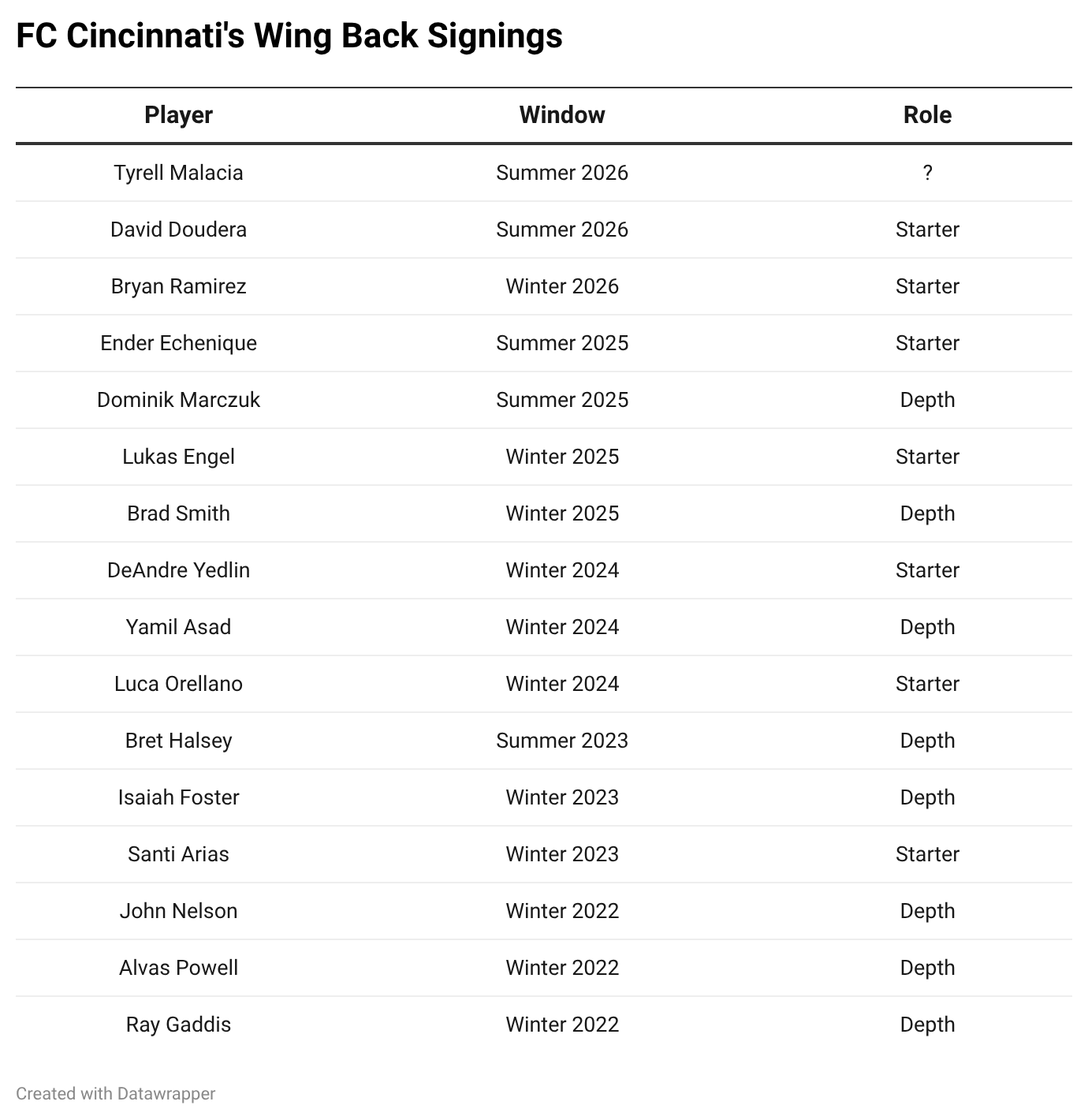
That's...a lot, even in a league where the bottom parts of rosters are subject to consistent churn after every season. Some of the new starters brought in were more or less forced, Barreal pushed for a move, Orellano moved further up the field, necessitating replacements. Last season, DeAndre Yedlin and Lukas Engel didn't provide enough going forward, and this year, clearly the front office feels like additional resources needed to be spent to get something that Ramírez and Ender Echenique aren't providing.
Needs & Profiles
Because of how Cincinnati's 3-5-2 has attacked, both wing backs ideally need to contribute in getting the ball into the final third while one has to play a major role making dangerous things happen once it's there. Defensive chops are less relevant, though not entirely for prospective players.
In FCC's Supporters' Shield winning season, Barreal was one of FCC's top options to move the ball forward and to find teammates in dangerous positions. But finding that level of production from a wing back isn't easy.
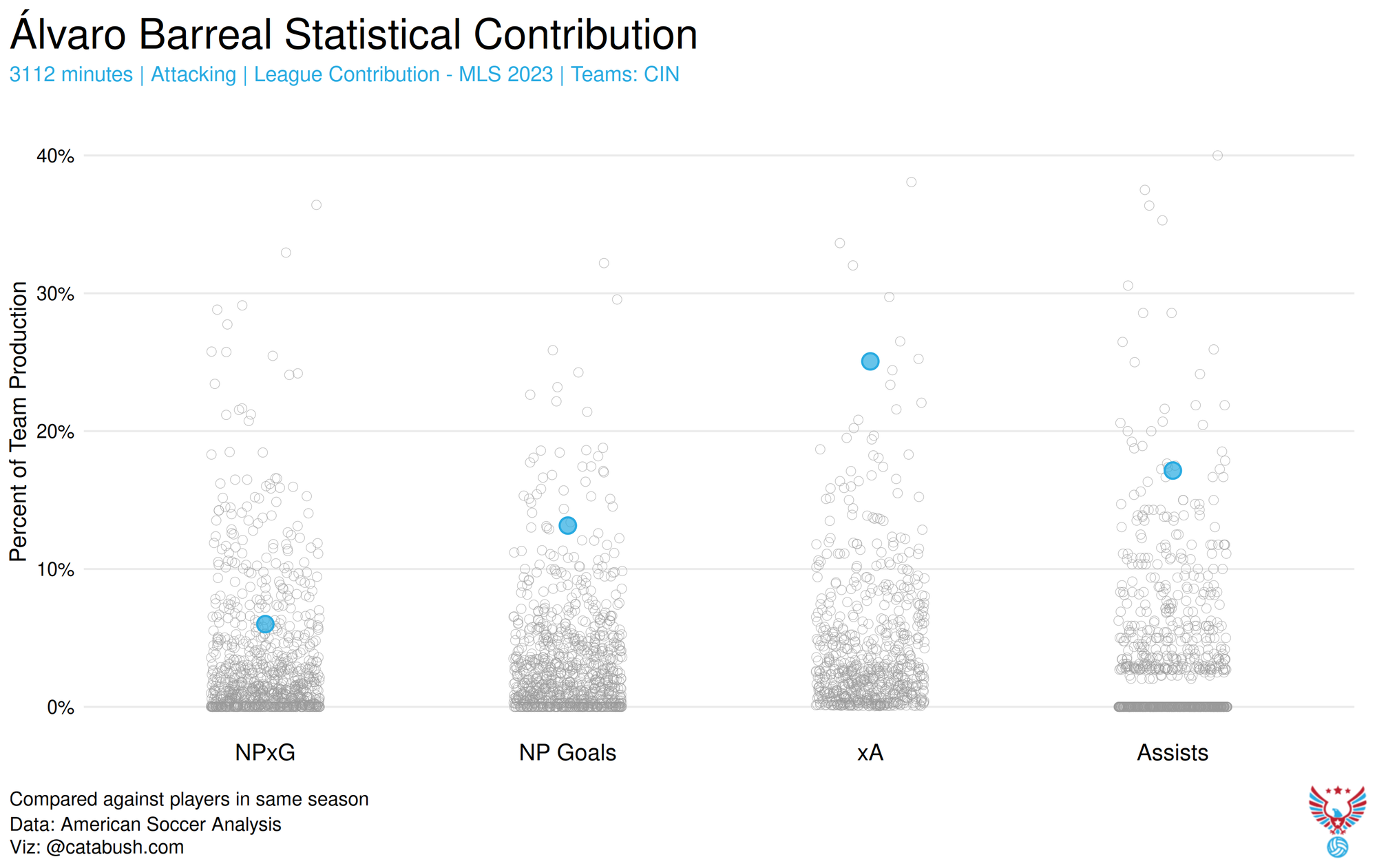
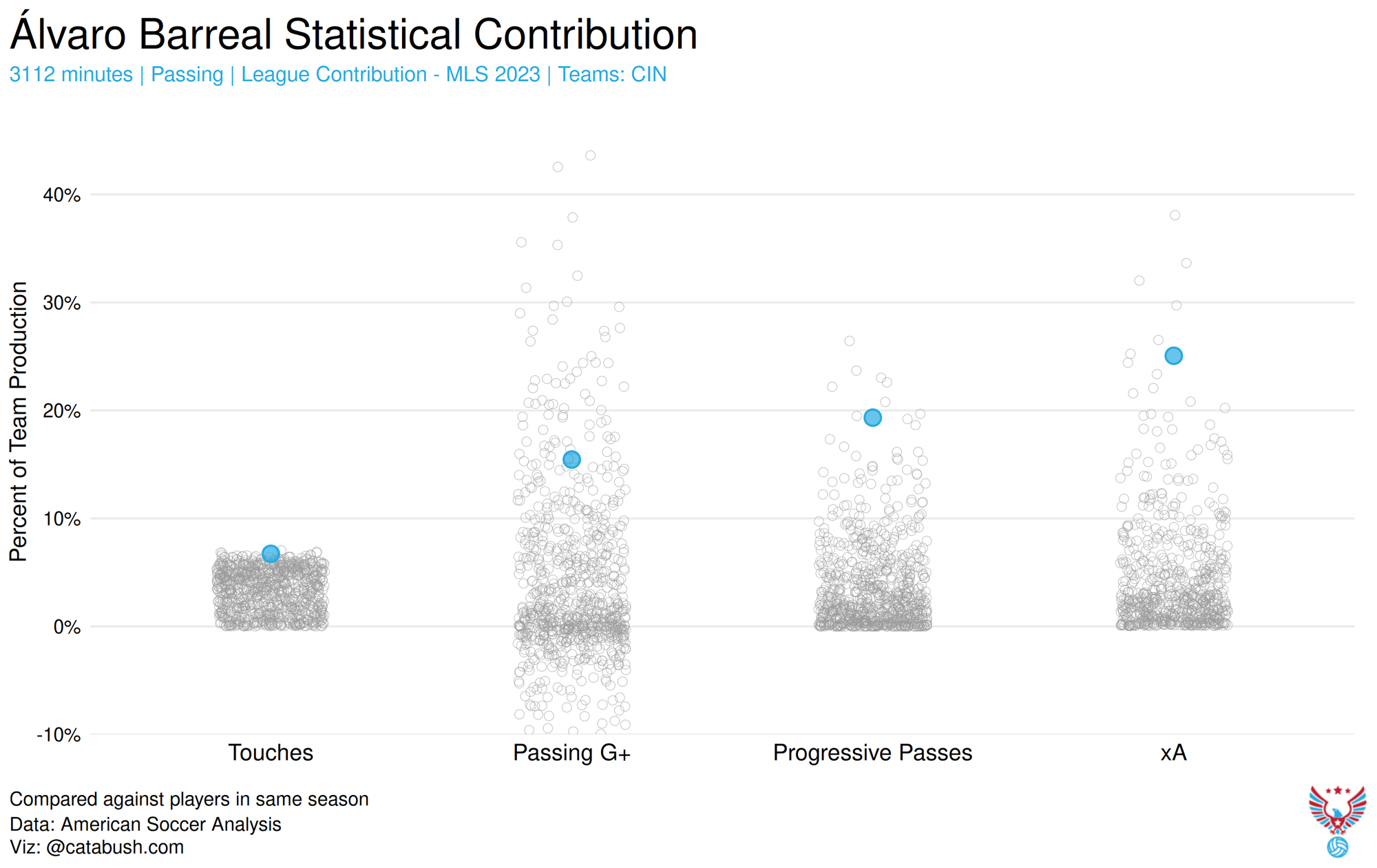
In 2024, Orellano and Yamil Asad combined to provide more than enough attacking influence from the left wing back spot to counterbalance the more defensively minded DeAndre Yedlin. But the next year, Yedlin and Lukas Engel just weren't very threatening in the final third, and that severely hamstrung the upside of FCC's attack for much of the season.
Yes, FCC had some success with wingers-turned-wing backs in Barreal and Orellano, but neither player seemed wild about the idea of actually playing the position long-term. As noted above, Engel and Yedlin, both more traditional full backs, lacked the ability to impact the game in attacking areas to the extent that the team needed. Echenique, signed last summer, is more of a return to the first archetype, while Ramírez was supposed to represent something of a middle ground, an actual bonafide attack minded wing back. But they haven't elevated FCC's level all that much, with central midfielder Pavel Bucha even deputizing at wing back for a stretch of games.
Finding a player who can check all the boxes the Orange and Blue need from its wing backs is a difficult proposition. Just think about the global pool of soccer players. There are a lot of professional soccer players out there! However, that universe gets immediately smaller when you remove the players who wouldn't be willing to move to MLS. It's whittled down even further if you actually want to sign players that have previously proven the ability to do everything FCC needs its wing backs to do. A smaller number of potential fits with specific skillsets usually means more expensive, too. Speaking of which...
Resources
Then there are the resources required. The nature of a salary capped league means that every team has to pick priorities. The Orange and Blue's three center back, two wing back structure requires FCC to expend more resources on the backline than other teams, which means, less salary cap space and uncapped mechanisms to throw at the attack.
Even if the salary spend isn't as high as in previous seasons, FCC is still expending significant resources on wing backs in 2026 even before the additions of Douděra and Malacia. Though Ramírez's guaranteed salary is $684,100, he hits the cap at a higher number due to his transfer fee also hitting the salary cap. Echenique carries a low cap hit, but occupies one of the Orange and Blue's three available U22 slots, a mechanism that, in theory at least, is supposed to allow teams to spend more on talent.
According to the most recent MLS Players' Association salary release, the Orange and Blue were already spending the most of any MLS team on defenders, which didn't even account for Ramírez and Echinique, who were listed as forwards. That number could creep even higher, even with Matt Miazga's salary off the books, with Douděra, Malacia, and Julián Malatini all incoming.
Which brings us to the question I asked much earlier: is FCC as currently constructed just a wing back away from championship contention?
Where That Leaves FCC
Maybe! Douděra and an ascendant Ramírez, plus Echenique and Malacia, or some combination of all of them, could form a wing back depth chart that totally changes the fortunes of the team and vaults it into contention for MLS Cup again. That would certainly be the best case scenario.
But there's a complicating factor. Even though the team ran beyond hot last year en route to second place in the Supporters' Shield race, buoyed by good goalkeeping and better luck, the Orange and Blue haven't been consistently better than their opposition for a sustained stretch since 2024. And that team had something this iteration doesn't: Lucho Acosta. Can Evander thrive in the same situation that Acosta did, even though they're different, though both talismanic, kinds of players? Evander isn't the ball progression engine that Acosta was to relentlessly move the ball into the final third of the field, nor does he have the one-vs-one dribbling ability. There are moments, like the play leading to Ramírez's opening goal against Houston where he creates really high level scoring opportunities, but those have been relatively few and far between in Orange and Blue.
It seems to me that the most likely, and uncomfortable, scenario is that the new wing backs provide some but marginal improvements in possession and maybe defensively, too. But those gains probably aren't going to be enough to pry back open the Orange and Blue's window of contention. In which case, FCC has even more resources allocated to wing backs, but isn't in a fundamentally different spot than right now: a pretty mediocre team.
As the Orange and Blue fight for playoff positioning down the stretch of the 2026 season, this will be a subplot worth watching. Has FCC finally found wing backs that make the system work again when so many others have failed? Or are we setting up for an offseason when the Orange and Blue have to consider more radical changes to the team's structural and tactical approach, one that doesn't require finding extremely specific player profiles.


