
Building Blocks
In which I talk myself into Dado Valenzuela the midfielder, praise Kenji Mboma Dem, and dream about what Andrei Chirila might become anchoring the Orange and Blue's backline.

FC Cincinnati returns to action following an extended international break facing what're more or less must win games. The team's new arrivals, Julián Malatini, David Douděra, and Tyrell Malacia all seem like they'll be available down the stretch, but whether they'll be able to change the Orange and Blue's fortunes in any meaningful way is an unanswerable question at this point. The good (or bad) news, is that we'll find out one way or the other soon enough and there will be plenty to analyze along the way. But today, I think it's worth digging in deeper on some players who make FCC's future brighter, regardless of what happens over the next month.
Building a winning team in Major League Soccer requires trade-offs. Like in other salary capped leagues, finding surplus value is of the utmost importance. Getting production from a player whose salary doesn't hit the salary cap for much, if at all, frees up cap space to bring in higher quality players elsewhere. Or at least that's how it's supposed to work. And in 2026, the Orange and Blue have some players delivering huge contributions relative to their roster designations, and it might just be the start.
Checking back in on Dado
A brief refresher: Valenzuela entered the 2026 season as Evander's backup in attacking midfield. Previously, I'd made the case that Dado hadn't really ever played like a #10. To this point, he just hasn't passed, or dribbled, forward enough. He's demonstrated an ability to be in the right place at the right time, especially in attacking positions, but as the central hub of an attack, he just hasn't done enough.
In May, when the Dado Valenzuela-as-holding-midfielder experiment was still in its early days. And, with more than 1,900 MLS minutes under his belt in 2026, one thing remains true: some advanced numbers still absolutely adore Valenzuela's season playing deeper in midfield. American Soccer Analysis' Net Goals Added, a combination of the g+, g+ boost, as well as g- rates Valenzuela as the sixth most valuable midfielder in MLS this season among players with at least 1,000 minutes played, trailing only Rodrigo De Paul, Sebastian Berhalter, Emil Forsberg, Alonso Coello, and Jeppe Tverskov.
That's sure something. It's a tough sell to me as an avid FCC watcher, even with how much I value advanced data. His progressive passing numbers are still pedestrian at best, and though he's a safe passer, that's largely because he's moving the ball horizontally across the field rather than vertically up it. So what gives?
The answer is relatively simple but explaining it is less so: it's the g+ boost. If you have the time and inclination, the linked description is worth reading in full. The TLDR, applied to Valenzuela, goes something like this: his passes to teammates in 2026 might not be pushing the ball all that much closer to the opposing goal, but they are putting teammates in positions to move it into dangerous areas immediately after.
This pass probably isn't the ideal action to illustrate g+ boost - it's probably too flashy - but consider how it aligns with the what Valenzuela has been best at this season. To go back in the analytical weeds, a possession value model would see a pass from a not very dangerous pair of x, y coordinates to another not very threatening location. But g+ boost adds in how much more dangerous FCC's position on the field was following Evander's carry forward.
This example has been the exception rather than the rule for Valenzuela in 2026. But think about all the times this season, playing deeper in midfield, he has been able to move the ball into space for a teammate with one or two touches. Valenzuela has the ability to attract and then play through pressure because he's technically adept and willing to receive the ball in tight quarters, something not all Orange and Blue midfielders are willing or able to do. Even though he's not passing the ball directly into dangerous positions himself all that often, he's putting teammates in positions to do so.
Defensively, Valenzuela has more than held on, even though his defensive counting stats aren't all that noteworthy. There are two things worth highlighting, however. First, he's done a lot of defensive work in and around FCC's penalty area, blocking shots and clearing the ball. Second, he's shown an ability to be in the right place at the right time in midfield to recover the ball. So even if he's not the one winning it outright, he's often there to claim possession, and that helps a team win.
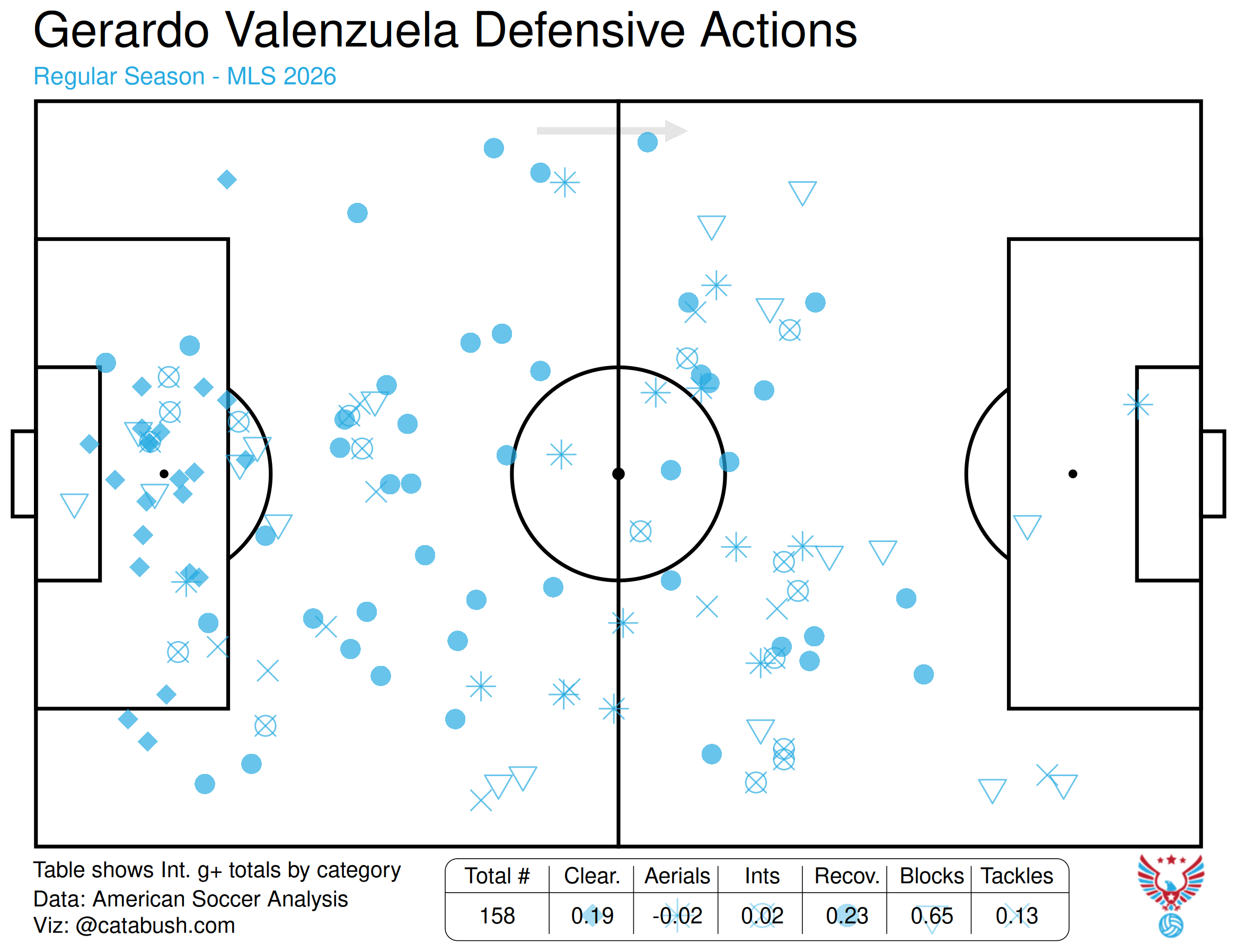
Valenzuela may not be a prototypical box-to-box or ball-winning midfielder, but he does a lot of things that should help FCC win.
But that raises an obvious question. If Valenzuela is having that big of an impact, why has FCC struggled so mightily throughout the season? I don't have an answer to that, at least not right now. My guess would be that the one thing he's been exceptional at, putting teammates into positions to succeed, still requires asks a lot of those teammates to win soccer games. Basically, Valenzuela isn't a game winner by himself, but, assuming this isn't just all an outlier season, his play is perfectly suited to raising the ceiling for FCC in possession.
So with a deeper depth chart coming out of the international break, I'd like to see how he'd fit next to Pavel Bucha in central midfield when the team takes the field in the games that'll matter most for the rest of the season.
A SuperDraft Success Story
In Chris Albright's first season in charge of the Orange and Blue, the MLS SuperDraft played a key role in the turnaround from Wooden Spoon to playoff team. Roman Celentano and Ian Murphy, picks #2 and #14 respectively, both played roles on the 2022 team and beyond, providing solid play on below market contracts.
After that, the SuperDraft has become less of a focus in the team's roster building calculus. Some of that is down to the sustained success enjoyed by the team. It's easier to find the best talent in the ever thinning pool of draft eligible players at the top of the draft rather than late in the first round and after. Still, I've been on the record advocating for an all-of-the-above approach to roster building because every year teams find contributors. It might take a while, but it's worth taking a shot. And it turns out, in 2024, the front office found a contributor, but it took a little bit.
Kenji Mboma Dem was the 57th overall pick in the 2024 SuperDraft out of the University of Dayton. His first couple seasons in Orange and Blue were almost entirely played with FCC2, where he racked up more than 3,000 minutes. Last year, he signed a first team contract last season after exhausting the allowed short-term call ups to the big club. After playing just 104 minutes in 2025, at the time of writing, he's logged 1,479 MLS minutes in 2026 and deserved to be out there, judging from his play.
He's scored five league goals on 5.24 xG, averaging 2.66 shots per game. Importantly, lots of those shots are from where you want an attacker to take them: in the penalty area between the goalposts.
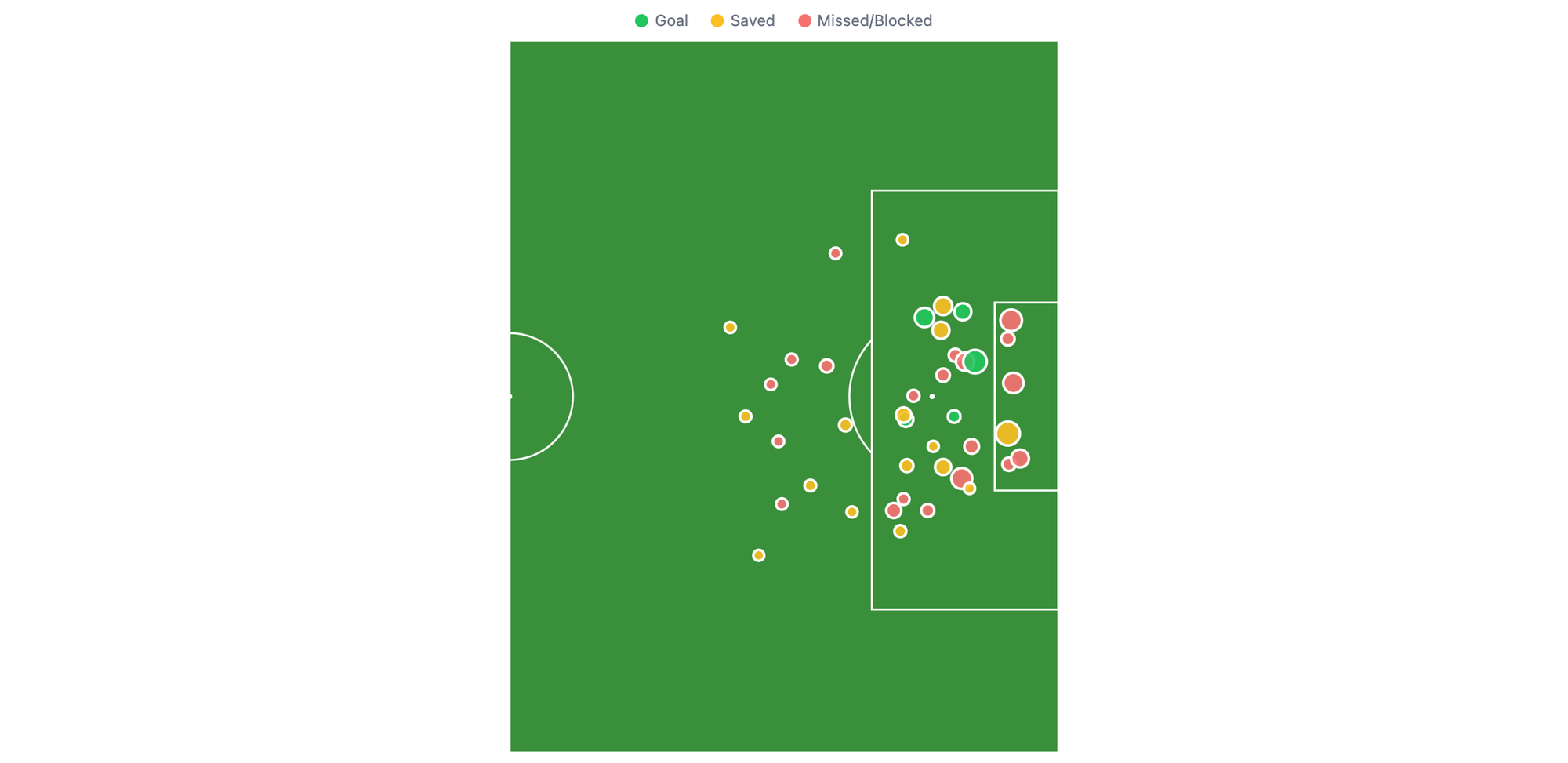
He's also a capable dribbler, something that's apparent watching him play as well as born out in the advanced numbers. His ability to play various roles in the attacking third as well as deputizing at wing back, only adds to his value on a MLS roster.
If the Orange and Blue's roster was constructed in a different way, say with more resources allocated to attacking pieces, Mboma Dem likely wouldn't be a first choice. But he'd still absolutely be a useful piece for spot starting duty or to come off the bench. It's clear he belongs at the MLS level, both according to the eye test as well as his underlying numbers. And every MLS team would love to get that level of production from a SuperDraft pick in the 50s.
A Potential Cornerstone
I've saved the potentially most important name for last: Andrei Chirila. Players like Valenzuela and Mboma Dem are necessary to build a winning MLS roster, but Chirila's age and upside makes him something different. He has the potential to be a franchise cornerstone for years to come, someone whose presence on the field, and on the roster, just makes everything easier.
With eight games left in the season, Chirila's 672 league minutes in 2026 ranks just outside the top-15 for minutes played for a MLS defender 17-years-old (or younger) since 2000 according to Fbref's Stathead database[1]. Nearly all of the 15 players ahead of Chirila played outside back, too.
Taking outside backs off the list puts him in even rarer company. Chirila trails only Sporting Kansas City's Ian James in minutes played as a 17-year-old or younger center back, and as of this writing, James leads by nearly 200 league minutes, making it unlikely that Chirila will catch up. Still, Chirila is doing something that exceedingly uncommon in MLS history.
Judging by how unprecedented it is for center backs as young as Chirila to play, the fact that he's been on the field is already a major vote of confidence in his current ability, to say nothing of his potential. To turn to our trusty friend ASA's Net Goals Added, Chirila ranks as the 70th out of 109 center backs who played at least 700 minutes. SKC's James is 108th.
Chirila has had some shaky defensive moments, as well as outright, costly errors, but that shouldn't be a surprise given his level of experience. As he plays more, especially against better competition, the hope, and expectation, should be that he'll improve on that side of the ball.
It's what happens when he's on the ball that you can really dream on. Already, Chirila is an above average progressive passer and carrier of the ball, moving it up the field better than guys who have played professional soccer for significant portions of Chirila's life. Having an elite distributor on the back line makes things easier for teammates further up the field. If FCC continues to operate with three center backs, and there's been no evidence to the contrary, Chirila's passing could raise the floor for everyone.
Development in soccer isn't always linear, but given that Chirila has been on the field at his age - and has played at a slightly below average level - bodes well for what his future might look like in Orange and Blue. Whenever you get into unprecedented territory, which where 2026 Chirila has been, it's okay to dream big.
Fbref determines a MLS player's season age by how old they are on February 1. For MLS, it's the age a player turns at any point that year. ↩︎


