
Long Range Calculations
Evander has been exceptional shooting from distance in 2026, but can he keep it up?

Let me set the stage.
It's the 73rd minute on Saturday night and FC Cincinnati has a one goal lead over the Seattle Sounders. The away team has ratcheted up the pressure a little bit as the second half has worn on, looking to get back in the game. Dado Valenzuela receives a pass deep in his own defensive third, before playing an inch perfect ball through the Sounders' press to the feet of a wide open Evander. The Orange and Blue's captain drives the ball forward in a five-vs-four break, with Tom Barlow and Kévin Denkey ahead, and Bryan Ramirez to his left, and Ender Echenique to his right. Just outside the 18-yard-box, Evander opts to take a shot. It goes wide.
Evander's shots don't always go wide. In fact, he's been on a remarkable run of turning shots from outside the box into goals. But how good of a chance has an Evander effort from distance been?
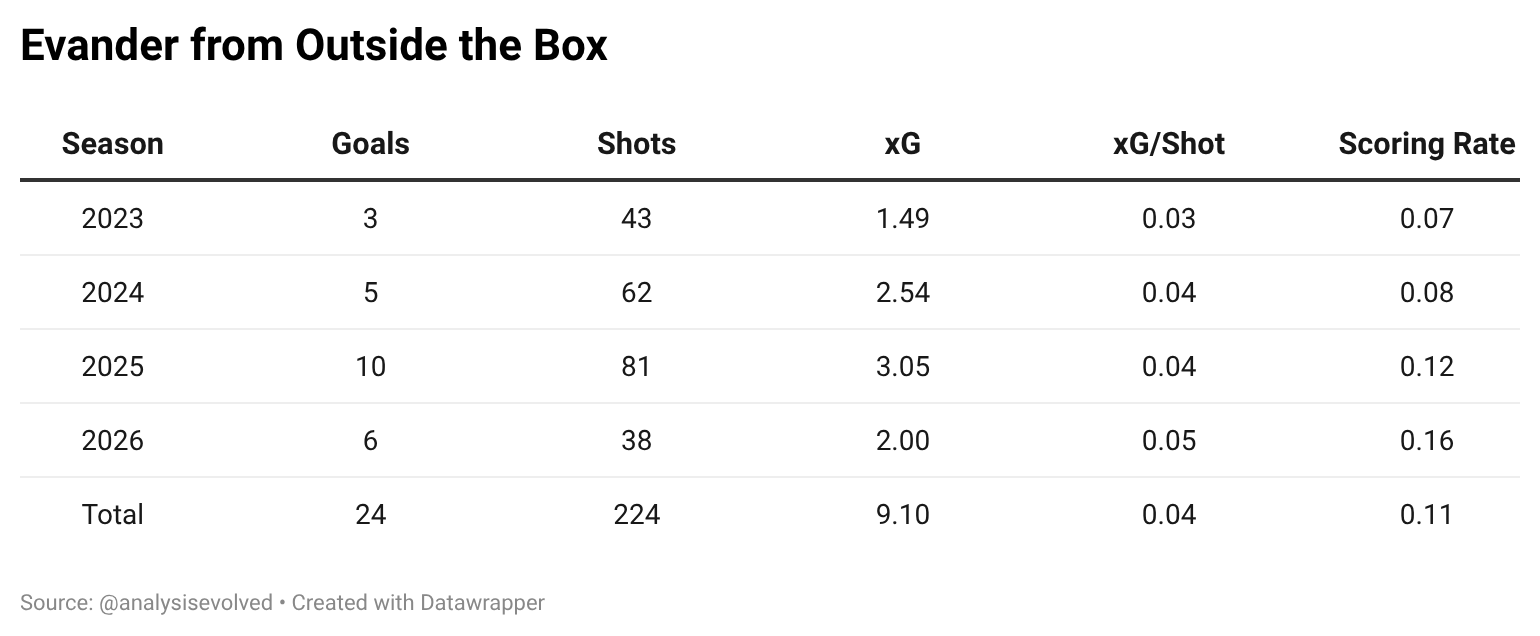
Any conversation about this benefits from some context about just how likely a shot from outside the box is likely to wind up in the back of the net. And a good place to start on that is expected goals. An expected goals model (xG) assigns a probability for whether a shot will become a goal based on hundreds of thousands, if not more, shots from all over the field. For any given location on a soccer field, players have taken shots from there. Over the course of his career, the shots Evander has taken from outside the box have been from locations where you'd expect him to score about 4% of the time (0.04 xG).
Since entering MLS, Evander has always outperformed his xG on long distance shots. As a member of the Portland Timbers, Evander converted on outside the box scored eight of 103 shots (a little less than 8%). After joining FCC, Evander has gone supernova, scoring 10 of his 81 attempts from long range last season and six of 38 so far in 2026. Overall, in Orange and Blue, Evander's shots from distance have ended up in the back of the net an astounding 13% of the time and an even higher 16% of shots have scored in 2026.
I was curious, what does a typical chance that gets scored 16% of the time look like? So here's a heat map of shots from last MLS season with an expected goals value of 0.16.
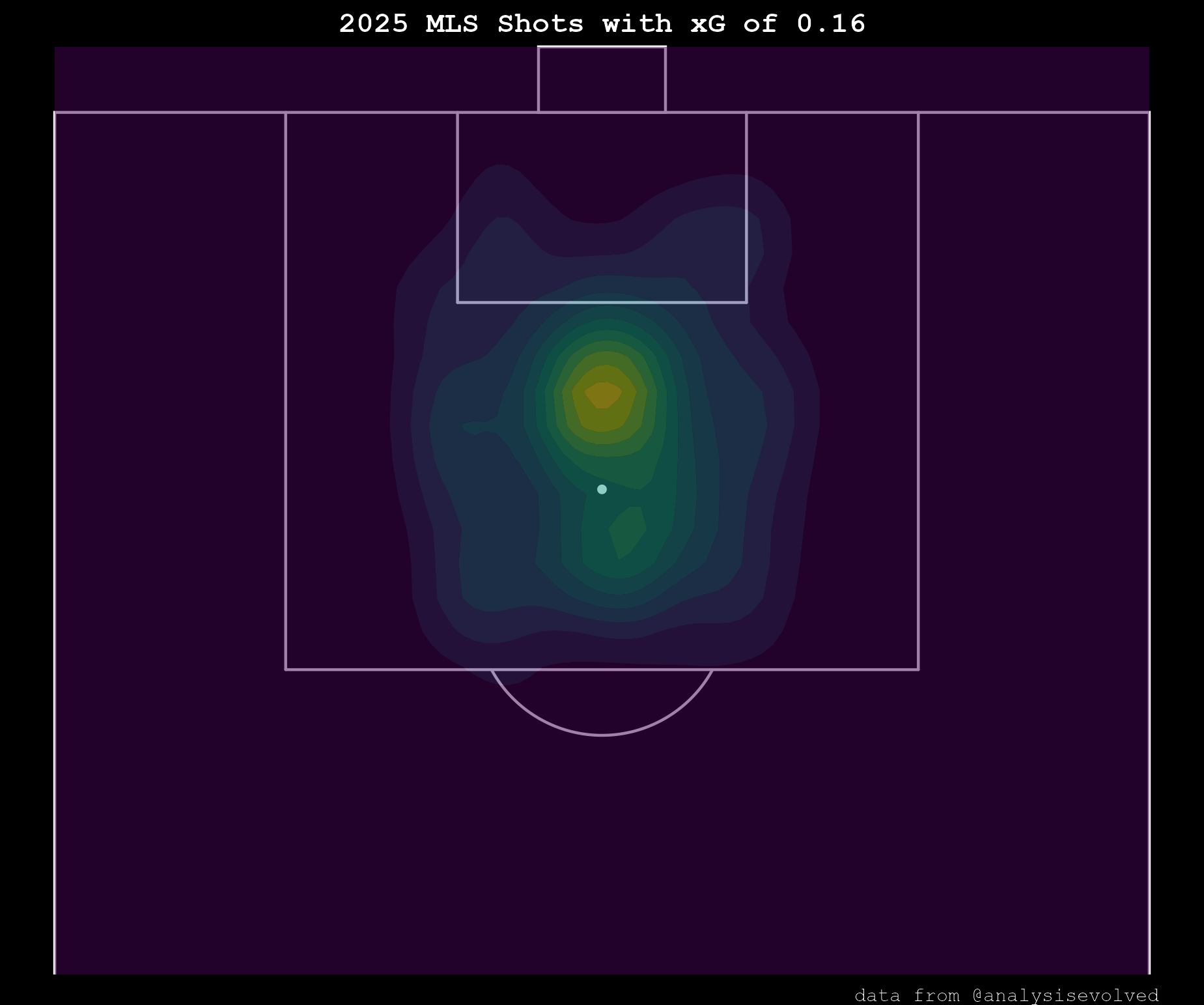
Those are really, really, really good chances. The kind of looks that you build an attacking structure around generating a few times over the course of 90 minutes. If you've seen Evander shoot from distance, you know that he's able to. I think it's entirely fair to suggest that his individual ability to strike the ball is dramatically underrated by a naive xG model. At the same time, I don't think that every time Evander shoots from outside the box its equivalent to a shot taken between the penalty spot and the top of the six-yard box.
What I'm saying is there's almost certainly room for some regression to the mean. It happened last year, after all. After I wrote about it then, Evander had scored nine of his 59 shots from outside the box. He went on to score just one of his next 22 (~4%).
Even outside of a potential for the ball to stop going in as much, there's a cost to those attempts, too. It's not exact given the potential for deflections and rebounds, but Evander has ended 38 of the Orange and Blue's final third possessions with a shot. Granted, some of them are good looks, and some were goals, but not always.
Which brings us back to Saturday night.
Even if we treat that shot (tagged on Fotmob as worth 0.04 xG) as being worth double (or triple) that simply because it's Evander, the situation, you'd really like to create an even better chance in what was essentially a 5-vs-4 fast break. Maybe Evander was looking to slip in Tom Barlow, but Barlow ran himself offside before the pass could be played, forcing FCC's #10 to take the shot himself.
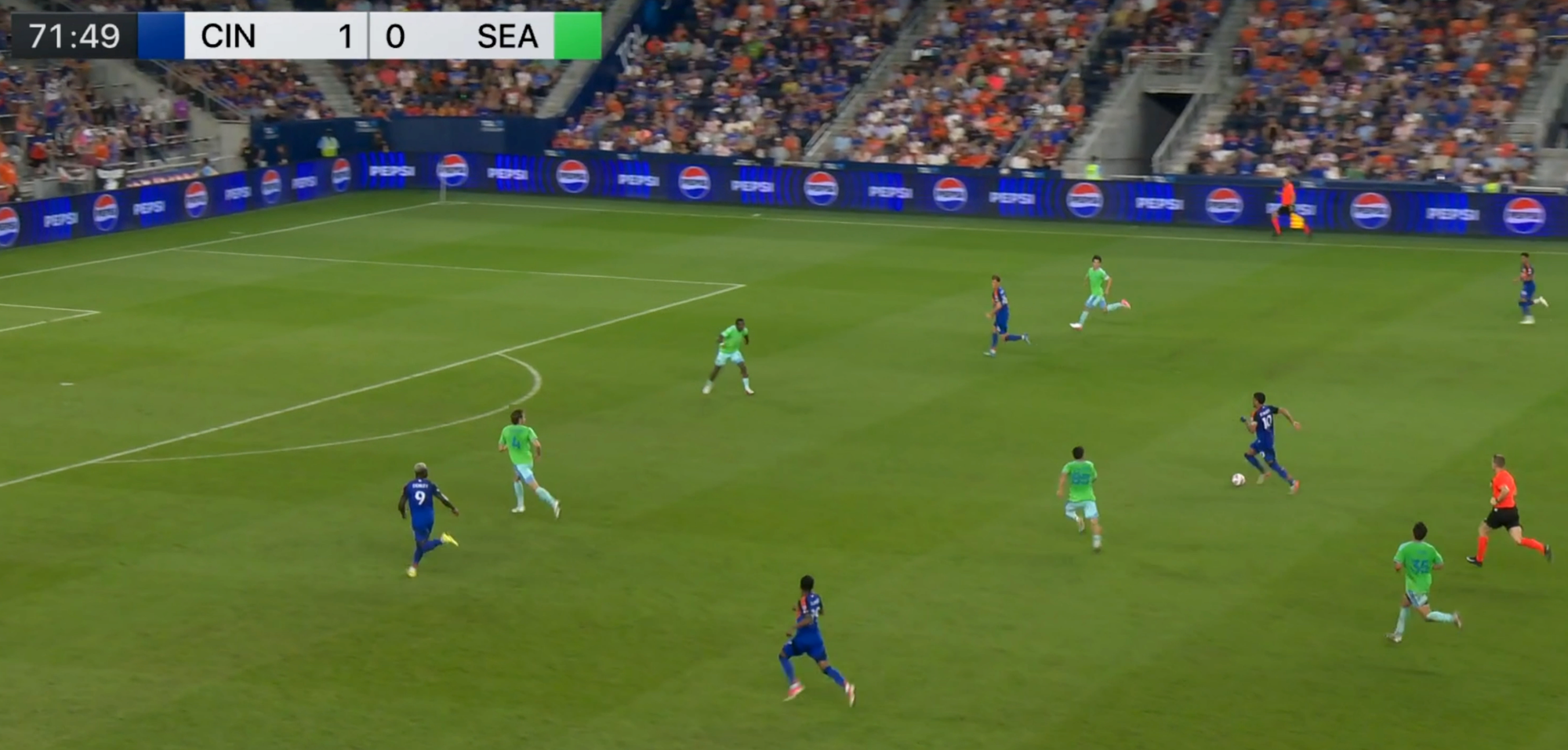
The set up was less than ideal, too. We've seen Evander cut onto his right from the top of the box and unleash a wicked strikes that goalkeepers have a hard time reacting to quickly enough. But against Seattle, driving straight at goal after a lengthy carry with minimal traffic in the box to shield the goalkeeper, Evander would've needed a perfect strike to score. He didn't get one.
He's still scoring, but relying on Evander scoring from distance doesn't seem like a strong foundation upon which to build an attack. Yes, his ability to shoot from distance means that the shots he takes are more likely to turn into goals than an xG value would estimate. However, even for a player of his ability, this current hot streak isn't likely sustainable, even just compared to his own past seasons.
Shooters shoot, and if Evander didn't, he wouldn't have scored as many goals as he has in Orange and Blue, but there's got to be a middle ground between finding his own shot and playing in teammates.
As FCC looks to be playing its best soccer of the season in the second half, fewer shots from distance from Evander might be a counter intuitive way to get the team's attack humming again.


