
All-of-the-Above
The case for maximizing roster development options plus a look at some of the FC Cincinnati's young talent


All stats from FBref unless otherwise noted
To say building a successful Major League Soccer team is a complicated process undersells the job. The number of roster mechanisms including Designated Players, U22s, TAM & GAM, Homegrown Players, the SuperDraft, and the gone but not forgotten Allocation Order, are (or were) among the tools at the disposal of league decision makers to build the best team possible. Unlike some leagues where the best teams are likely to the richest, vacuuming up the best available talent, MLS requires success across all of these mechanisms to build a Championship caliber team.
Take the newly crowned MLS Cup Champions LA Galaxy. Big name (and money) signings Riqui Puig, Gabriel Pec, and Joseph Paintsil might steal the headlines but less glamorous signings like John Nelson, Edwin Cerrillo, and Mark Delgado played big roles in the team’s MLS Cup victory, too.
Though FC Cincinnati’s short- and long-term success still likely depends most heavily on hitting on its biggest signings, like this winter’s $15 million addition of Kévin Denkey, finding contributors on cheap contracts can be the difference between a good and great team. Most of those contributions aren’t especially glamorous, at least by in the way that supporters will remember for years to come. But they don’t have to be to help a team win Silverware.
At his end-of-year press conference, Chris Albright highlighted the importance of roster depth provided by players released from contracts at the end of 2025. He said, “But, you know, if you look at London [Aghedo], Joey [Akpunonu], Isaiah [Foster], Quimi [Ordonez] and Malik [Pinto], all those guys were part of a championship winning team. And so for them to contribute at that level, at that age, there's a lot of guys that will go their whole career and not win anything. And so what was really hard to move on from a lot of those players, I think it's important to note the contribution that they had towards putting another trophy in the case at FC Cincinnati.”
The players mentioned above combined to play 1,137 first team minutes in league games across the 2023 and 2024 seasons according to American Soccer Analysis. Their role wasn’t as central as ones played by Lucho Acosta or Roman Celentano but more than 1,100 minutes is a very real contribution to a team. Those are minutes that other key players didn’t have to play, leaving them fresher for future games. Or those players stepped up in emergency situations where a first team starter wasn’t available.
So as the FCC looks to refresh its bench, adopting an approach that provides as many options to find contributors as possible makes sense. Though DP and U22 signings will garner the most interest, finding players in less exciting ways, like promoting players from the academy or drafting a gem in the SuperDraft is vital to building a well-rounded roster. Those players might only end up playing a few hundred minutes a season at a slightly above replacement level, but that’s okay.
In the grand scheme of things, MLS academies are nascent in the landscape of global soccer and FC Cincinnati’s is newer than most. Seeing consistent results from an academy is a years if not decades long process and will be measured by the success of a fraction of the players who graduate through the system. Investing in the academy.
As academies continue to ascend, the value of the this week’s SuperDraft as a top-tier method to acquire talent continues to fall. However, there is still value to be found. Look no further than high ceiling success stories of former top ten picks Moïse Bombito and Duncan McGuire in the 2023 class as examples of the still occasional top talent available. The later rounds can still yield contributors. Jasper Löffelsend, the 81st pick in the 2022 draft, has played more than 3,000 MLS minutes over the course of his first three seasons. He isn’t an All Star but, as noted above, there’s tremendous value in cheap depth on a MLS roster.
MLS NextPro makes taking fliers on draft picks easier. The best case scenario for a draft pick would obviously be impressing to such an extent that they earn a first team contract. But a contract with a NextPro team allow teams to sign draft picks, develop them in their system while they play professional minutes.
What exactly the NextPro to first team pathway looks like is still something of an unknown because we just don’t have enough data. Unlike baseball’s minor leagues with its multiple levels, MLSNP features players of varying ages and places on their paths through their professional careers. And due to other pathways for bringing players to first teams, it’ll never be the primary path for filling roster gaps. Will MLSNP minutes be high enough quality to develop academy or SuperDraft talent into first team contributors? Or will loans to a middle ground, a USL league for instance, be needed to ensure that players will be most prepared to step into regular minutes? We should continue to get answers to these questions over the next few seasons but until then, maximizing the number of chances to find contributors seems like the best path towards building a successful roster.
FC Cincinnati 2 stands to be a major avenue towards developing key depth pieces. A day after FCC released its end-of-year roster decisions, FCC2 followed suit, setting up a busy offseason for that team. As it stands, FCC2 has just seven players contracted for 2025.
It may seem counterintuitive, but this too, seems like a good approach. Apologies to any devoted FCC2 fans that might be reading this but the purpose of the MLSNP team is to develop players for the first team, not to win. A talented team should win more often but there could still be situations where developing a player for the future takes precedence over today’s results. If the front office and coaching staffs, either through practices or game time, determine that a player ultimately isn’t going to be up to the first team level, it makes sense to move on, as heartless as it is.
Building a Championship winning team is the goal of any front office. Getting the biggest signings right will probably have the greatest correlation with winning silverware but maximizing every marginal advantage matters more in MLS than most leagues. Using every available opportunity to make a team the best it can be is part of that.
Before I sign off for the rest of 2024, I wanted to highlight a few prospects who are deserving of in-depth looks.
Dado Valenzuela
Dado Valenzuela played the biggest role on the first team of any player who could be classified as a prospect. According to American Soccer Analysis, he played 1,140 minutes for the first team in 2024 in addition to 286 with FCC2. Most of Valenzuela’s minutes came as a 19-year-old, as he turned 20 in September.
On the ball, Valenzuela showed some burst to drive forward with the ball at his feet as well as an ability to progress the ball by passing it. His production in the final third needs some more seasoning, however. Lastly, Valenzuela proved to be a willing defender from the front, something that could be in higher demand should FCC look to press more aggressively in 2025.
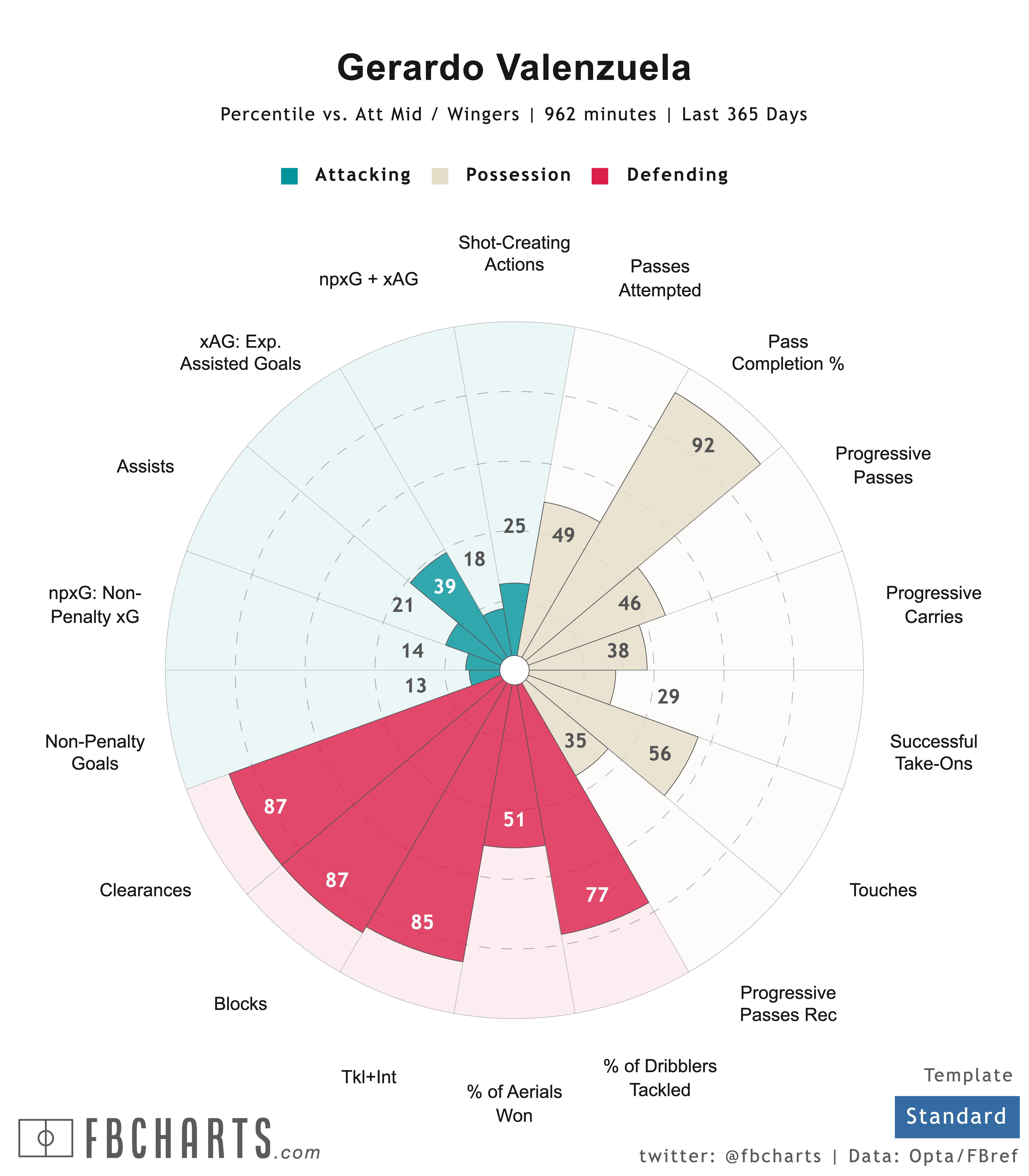
The more existential debate about Valenzuela’s development is hard to answer without behind-the-scenes information. Will there be enough first team minutes for Valenzuela to fully develop? If Lucho Acosta is to depart this winter, Valenzuela would surely be in line for at least some of newly available minutes. But Albright and the coaching staff will have to walk a fine line between having the strongest bench possible for stretches of the season and ensuring that players reach their full potential.
Stefan Chirila
Perhaps no FCC youth player has the hype of Stefan Chirila. He signed a contract with FCC2 in May 2024 which will become a Homegrown contract starting in 2025 running through 2028 with an option for 2029.
In nearly 1,500 MLSNP minutes in 2024, Chirila scored six goals on 8.06 xG. His 0.53 xG per 96 minutes ranked in the top ten among MLSNP players who played at least 1,400 minutes and his 2.84 shots/96 ranked in the top-25. Pretty good stuff from a 17-year-old in a professional league.
His non-penalty shot map (goals in orange, size of the point corresponds to the xG of the chance) shows a striker who can find the ball in dangerous positions in the box and turn those touches into shots.
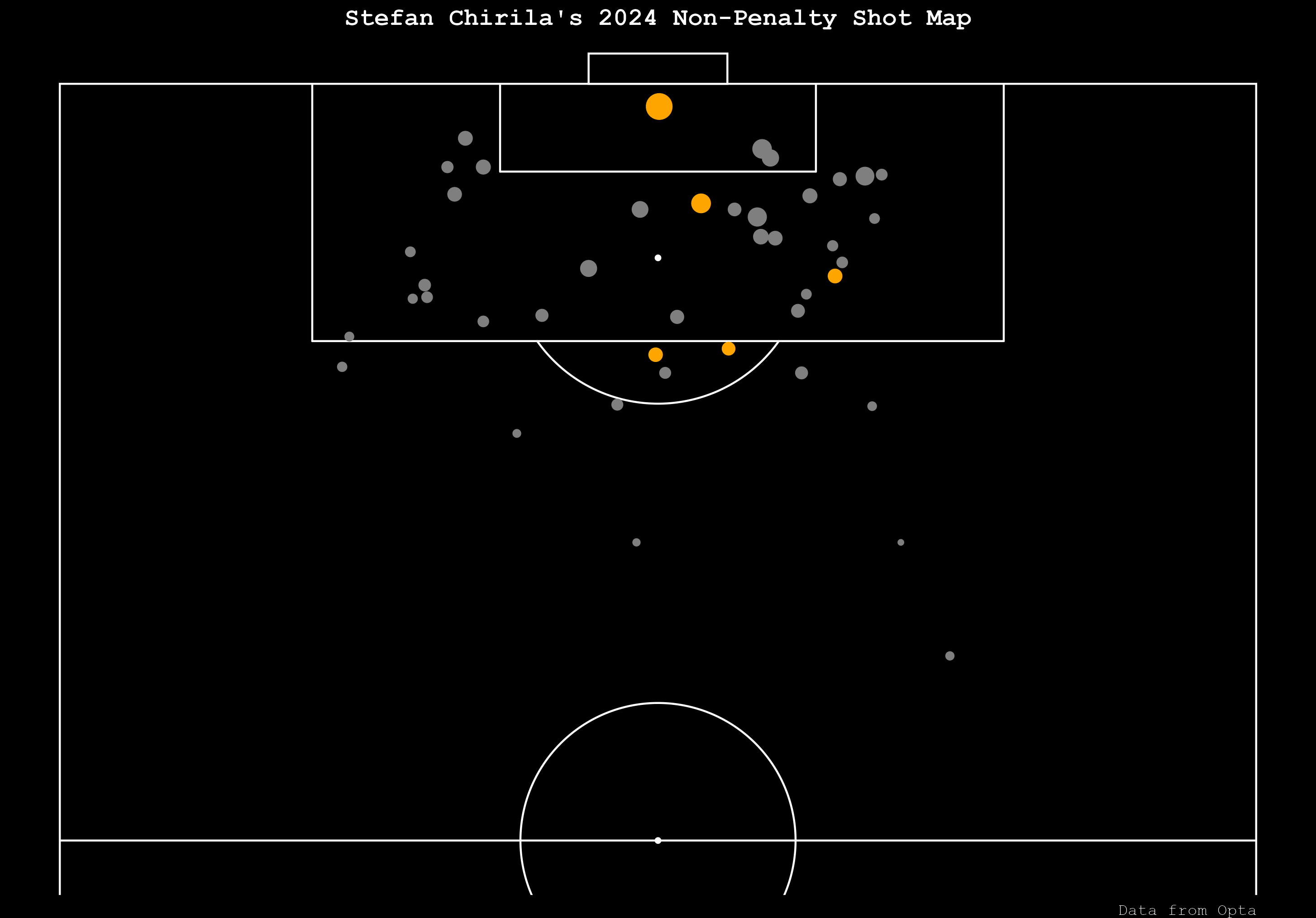
Though Chirila will be on the first team roster, it feels unlikely that he’ll have much of an impact he’ll have on the 2025 season. Look for him to play more minutes at Scudamore Field with FCC2 in addition to cameos off the bench with the first team. A return to the U.S. Open Cup would be nice for a player like Chirila, assuming FCC drew lower-tier teams in the first few rounds.
Chirila’s development should be closely watched because it should provide insight into how FCC’s front office views the best pathway to develop players. Following his progress over the next few years should prove to be very interesting.
Kenji Mboma Dem
Mboma Dem, FCC’s second round draft pick in the 2023 MLS SuperDraft, had a very good first season with FCC2. Though he signed with the team relatively late, in April 2024, he put up really good numbers in nearly 1,500 MLSNP minutes. He averaged more than three shots and 0.62 expected goals plus expected assists (xG+xA) per 96 minutes. His xG+xA average was comfortably in the top-20 MLSNP in 2024.
Is there a chance that Mboma Dem can work his way into being a rotation option at the end of the first team bench? If he can, he’ll just be another example of why the SuperDraft is still relevant.
Others Deserving Of Mention:
- Brian Schaefer was FCC’s first round pick in the 2023 draft from the University of South Florida and is another of the seven players under contract for FCC2 in 2025. Schaefer played as a centerback for and, according to American Soccer Analysis, had the second highest goals added above average on the team, trailing only Mboma Dem, though Schaefer played nearly twice as much over the course of the season.
- Stiven Jimenez: Jimenez signed a Homegrown contract in November 2022 when he was 15. He played more than 1,200 minutes in MLSNP (in addition to 13 first team minutes) in 2024 and seemingly struggled at times. Still, Jimenez is just 17 and he’s playing up in MLSNP. Obviously the best case scenario for Jimenez and FCC would be him holding his own and dictating games against older, more experienced players. But Jimenez still has plenty of time to grow into the professional game. However, 2025 seems like a big year to start making that happen.
- Paul Walters: Walters, a goalkeeper signed to a Homegrown Deal in January 2023, spent part of his 2024 season on loan, playing almost 700 minutes with USL Championship’s Hartford Athletic and nearly 1,300 minutes with FCC2. Walters’ shotstopping numbers left much to be desired, especially in his brief loan stint in USL. However, with FCC2, Walters’ numbers improved and he graded out as an above average keeper, according to ASA’s G+. Improvement in his shotstopping is a must and that’s what I’ll be keeping an eye on in 2025.
If you made it this far I hope you have happy holidays and a good New Year. See y’all in 2025 for more niche FC Cincinnati musings.1
Unless something absolutely wild happens in FCC-land, of course. ↩


