
Winning Ugly: Monday Takeaways (4/14/25)
Plus attacking alarm bells ratcheting up and Dado Valenzuela stock watch

All stats courtesy of FBref unless otherwise noted
1. Winning Ugly
FC Cincinnati made it three one-goal wins in a row with a 1-0 victory against DC United on Saturday. In the midst of a mini-injury crisis, the Orange and Blue did just enough to eke out a result. Though DCU controlled large stretches of the game, the home team struggled to create consistently dangerous opportunities while FCC took made one of its few chances count. Basically, it was the definition of an ugly win.
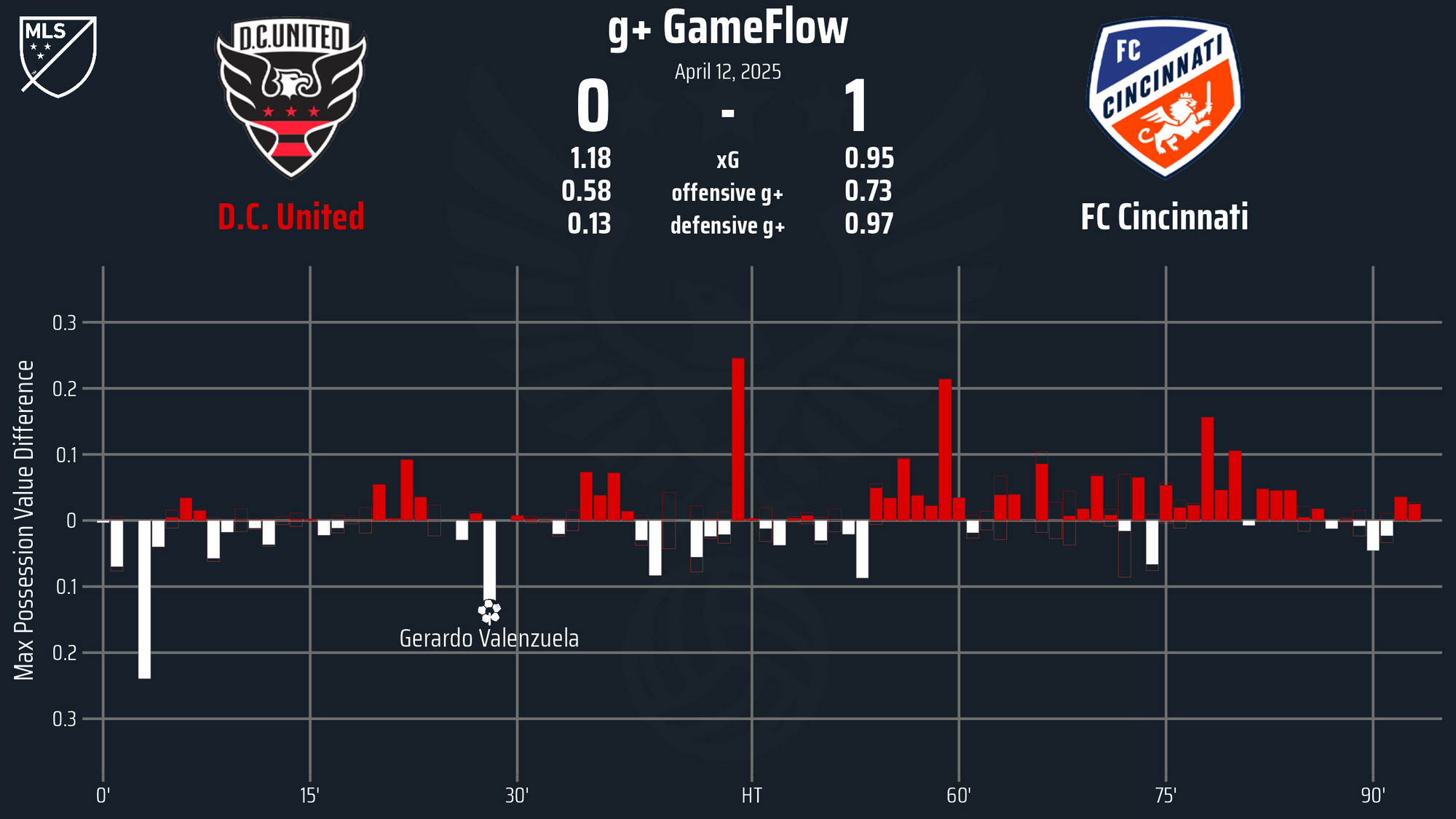
FCC was mostly the better team in the opening thirty minutes and Dado Valenzuela capped that stretch with his first goal since July 2024. With the lead, the Orange and Blue largely defaulted to absorbing pressure from the home team, and for the most part, limited the Black and Red to a series of not-very-good looks at goal.
Depending on what expected goals model you’re looking at, DCU averaged 0.08 or 0.06 xG/shot. The Orange and Blue created very little going the other direction, but with the relatively early goal, FCC could sit back and make DC break them down. That might not work against better teams but it did on Saturday.
Across the 90 minutes, DCU attempted 33 crosses. Even though crosses are generally low-percentage propositions, it’s not the worst idea when Christian Benteke is the target on many of those. However, FCC’s three centerbacks held up.
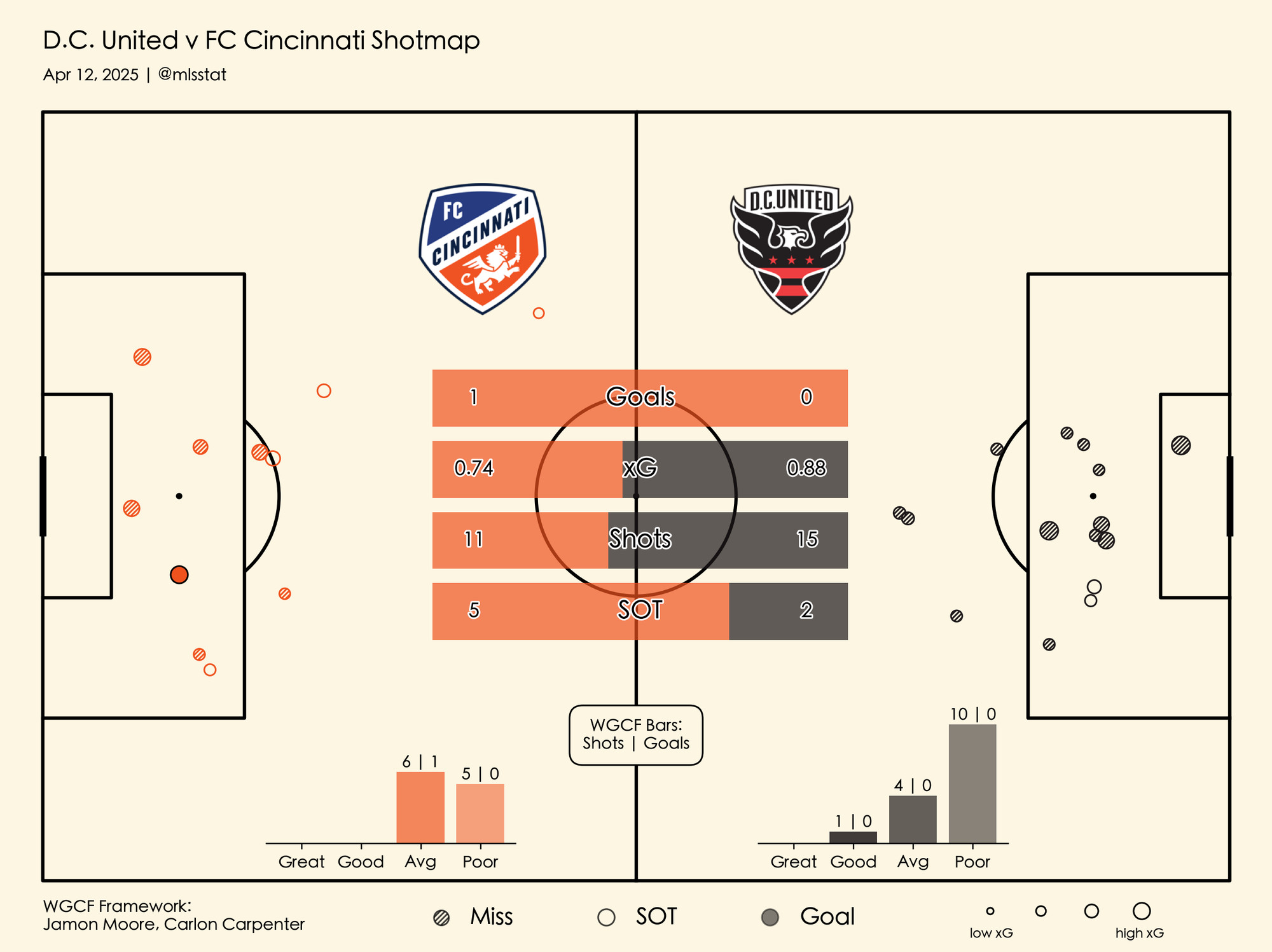
After the game, Pat Noonan said, “We couldn’t keep the ball. And they, I thought structure wise, were disciplined in both halves with getting pressure to the ball and being tough to break down. And like I said, we didn’t have a lot of creativity and good hold up play from our attacking group, and they kind of fed off of that and pinned us in. And when you allowed teams to attack you from those positions, like I said, and get service into the box, not only is it a challenge to defend crosses, but now it’s the second phase of being able to secure the ball closer to your goal or anticipate plays. To be able to control the ball and move us up the field and we weren’t able to do that at all in the second half.”
Recently, we’ve seen Noonan opt to make second half-adjustments to get another attacker on the field in place of a central defender. On Saturday, he kept things largely the same defensively but replaced Valenzuela with Sergio Santos after a little bit more than an hour. Santos didn’t help the Orange and Blue maintain possession but did give the team another counterattacking option. As DC pushed bodies forward in search of an equalizer, Santos, Kévin Denkey, and Luca Orellano were ready to attack at pace the other direction following turnovers. That plan nearly worked but FCC was unable to string together the final pass needed to generate a really dangerous chance.
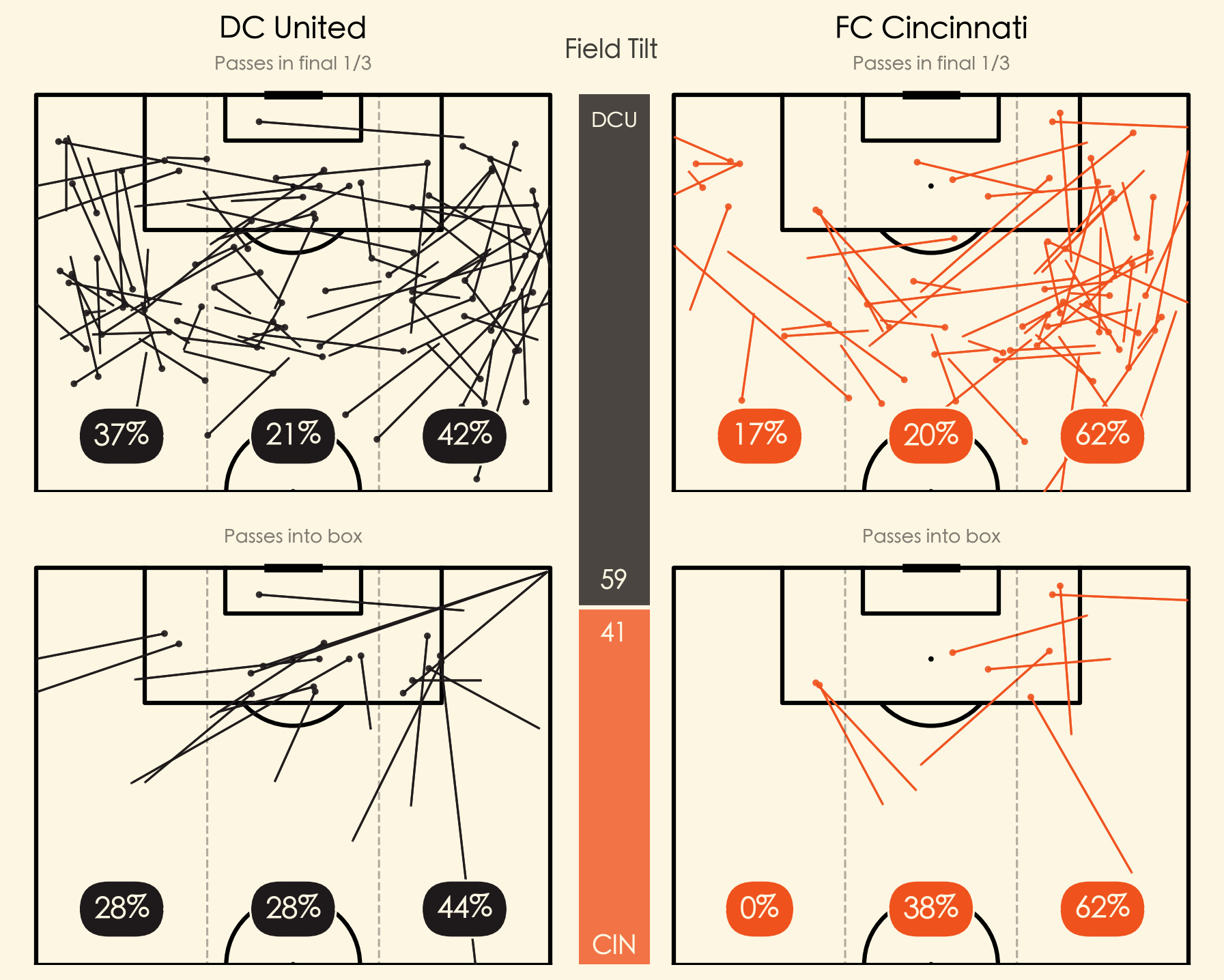
Opting to defend and counter seems like the right play based on personnel available. When FCC progressed the ball into the final third, the team struggled to create much of anything. DeAndre Yedlin had the second most touches by a FCC player in the final third on Saturday but wasn’t consistently dangerous. Lukas Engel, Yedlin’s opposite number at wingback, made even less of an impact in the attacking third, though he played a more reserved role in possession.
Orellano’s most dangerous quality is receiving the ball and cutting infield onto his left foot. Even when opponents know its coming, Orellano is still generally successful. Pushing Yedlin higher in possession to provide width in the space that Orellano vacates makes sense. However, too often this season it feels like FCC is banging against a wall on the right side. Yedlin so far hasn’t been able to beat defenders on the dribble to create space for himself or to connect on dangerous passes to teammates in and around the box.
2. When Do Alarm Bells Start Ringing?
Saturday was yet another unconvincing offensive performance from the Orange and Blue in 2025.
Let’s start with the reasons why it’s too early to panic. FCC is missing Evander, who should be a driving creative force for the team. That, combined with absences earlier in the season from Denkey and Orellano, means the Orange and Blue’s attacking trio really haven’t had much time on the field to develop an understanding together. Can things get better when FCC has all its key pieces playing together? Probably.
However, games are adding up and we’re still talking about the same thing: a lack of cohesive attacking ideas and Saturday was a continuation of things we’ve seen before.
Denkey was isolated for large stretches of the game, logging just 28 touches in 90 minutes. Noonan cited a lack of hold up play from FCC’s attacking trio but playing direct to one real striker competing against three opposing centerbacks is a big ask.
Add in the fact that Pavel Bucha didn’t have the same ball progression contributions on which the Orange and Blue have relied on heavily so far this season. His partner in central midfield, Brian Anunga, was solid defensively as always but he just doesn’t provide much of a forward passing option. There’s always going to be a give-and-take playing with three centerbacks - sacrificing some offensive potency for defensive solidity - but it just isn’t really gelling for FCC at the moment.
Granted, the team is still undergoing a major shift to its offensive identity. Over the last few years, FCC’s offensive success was built around a ball dominant attacking midfielder and wingbacks with outsized attacking responsibilities.
Does Saturday’s last 30 minutes provide a blueprint going forward? Matt Miazga’s return might set the Orange and Blue up for a return to winning low-scoring affairs like we saw at the beginning of last year. Would Noonan and his coaching staff be comfortable inviting more pressure and countering through Orellano, Denkey, and Evander? Time will tell.
But unless FCC starts to figure some things out offensively, the warning bells will be getting louder and louder.
3. Valenzuela’s Outlook
Dado Valenzuela made his first start of 2025 in place of a still injured Evander. Despite limited touches due to FCC’s ball progression struggles, Valenzuela made the most of his opportunity in the 28th minute, shrugging off a challenge from Lucas Bartlett and then putting DC’s two other centerbacks on their heels before finding the back of the net.
Last year, Valenzuela might not get past Bartlett, let alone create an opening for a shot in a 1-v-2 situation. When asked about Valenzuela’s improvement, Noonan said, “He’s maturing. You might not see it right away with the on field and those performances, but things that he’s doing to take care of himself, and just how he’s talking about improving, and the work that he wants to do after training, video. I think he’s growing up, and that’s a good sign.”
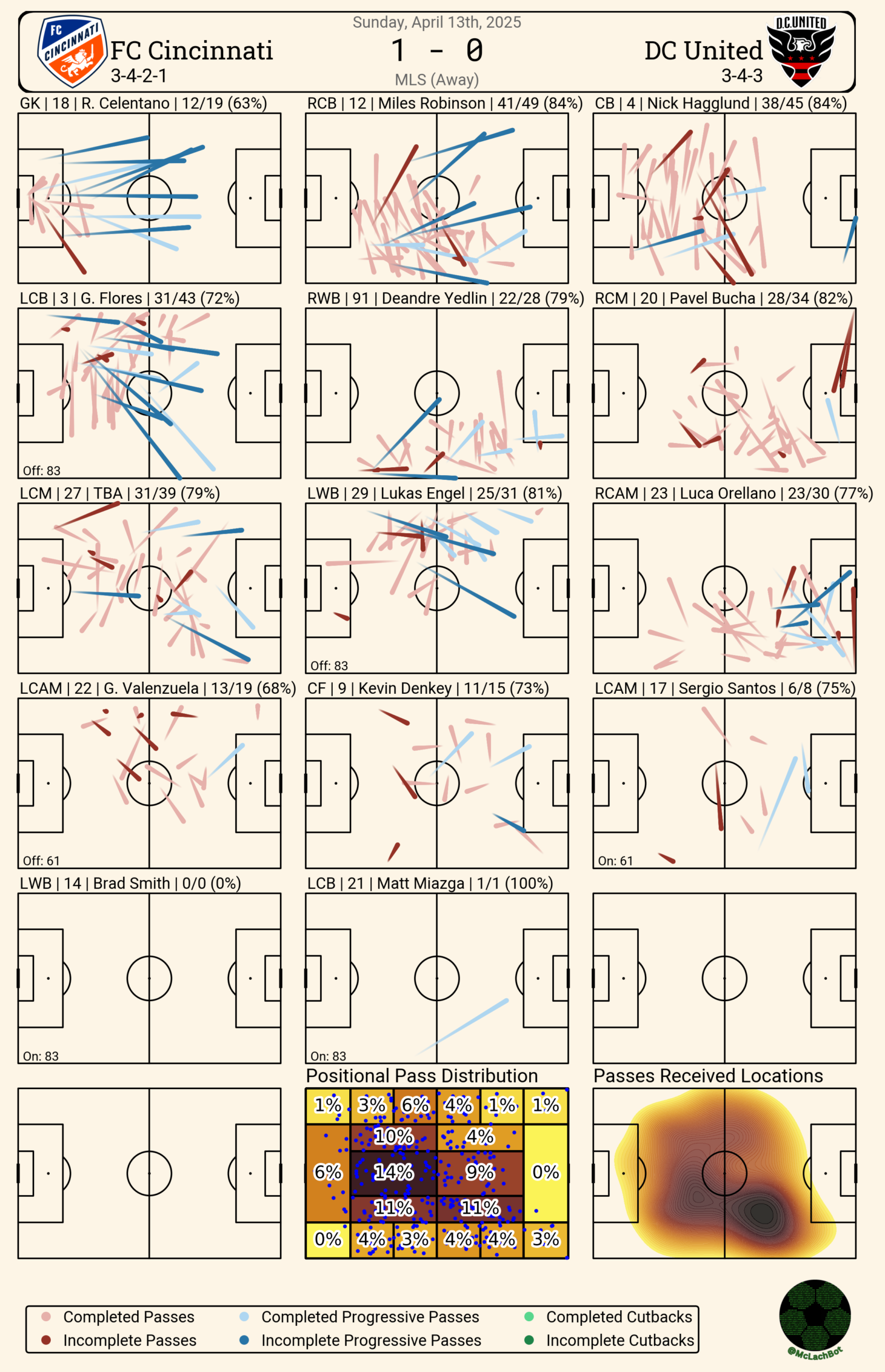
Outside of the team building advantages a hit of a homegrown player provides, Valenzuela turning into a real contributor would be a boon for the rest of 2025. He might be most comfortable as a backup for Evander or Orellano, operating in the half-spaces, but having dangerous bench options in those spots would be a major help. There’s still plenty of room for improvement - just look at his pass map above and notice many passes are going backwards - but Saturday was most definitely a step in the right direction for Dado Valenzuela.


