
What's Next for Obinna Nwobodo?
Assessing where FC Cincinnati's midfield destroyer extraordinaire is after the 2024 season and what his future in the Queen City could be.

All statistics from FBref unless otherwise noted

What’s Next For Obinna Nwobodo?
When Obinna Nwobodo signed for FC Cincinnati in 2022, he provided exactly what the team needed: a seemingly omnipresent ball-winning midfielder. Defensively, Nwobodo thrived playing in Pat Noonan’s pressing system. With the ball, he benefited from a tactical set up involving counterattacking and a system to move the ball from back-to-front mainly revolving around kicking the ball towards Brandon Vazquez’s head and winning second balls.
But 2024 brought a shift in style, with the Orange and Blue embracing a more possession heavy approach.
In FCC’s 37 MLS matches (including playoffs) in 2024, the Orange and Blue had less than 50% of possession just ten times. Compare that to 18 of 38 games in 2023 and 28 of 36 games in 2022.
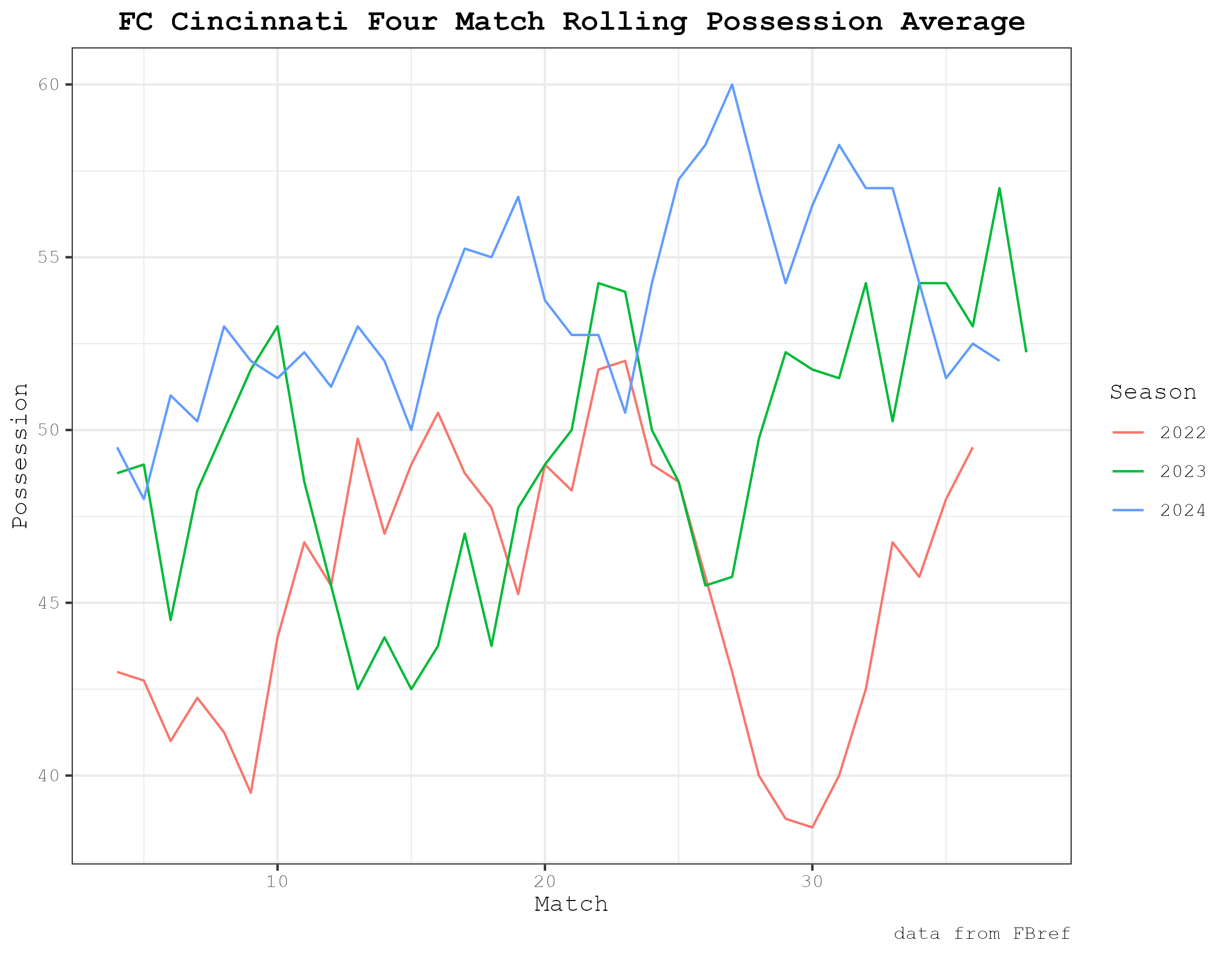
Noonan’s tactical shift from emphasizing playing against the ball to playing with it brought benefits for Miles Robinson, who can break defensive lines with his passing from his centerback position, while putting Roman Celentano and Nwobodo in unfamiliar positions when FCC tried to pass its way from back to front.
For Nwobodo, it created an environment where FCC chose to do the inverse of what he really excels at, opting to have him on the ball more and defending less.
Still Defensively Effective
Any assessment of Nwobodo’s value to the Orange and Blue should start with his strengths. So, let’s start with Nwobodo’s bread and butter: winning the ball back from opposition.
Counting stats can be deceiving, especially when it comes to defensive presence on a soccer field. The best defenders might not lead the league in tackles or interceptions because often they’ll be in the right positions to avoid even having to make a play on the ball.
Similarly, teams that enjoy more than possession than their opponents have fewer opportunities to win the ball back because there are fewer opportunities to win the ball.
This is a long run up to say that even though Nwobodo’s ball winning counting stats like tackles and interceptions were down from 2023 (4.95/90) to 2024 (4.29/90) his true production didn’t drop as much as it might seem. When adjusting for possession, his tackles and interceptions remain relatively steady, with according to MclachBot, with 4.7 possession adjusted interceptions plus tackles in both 2023 and 2024. He won fewer tackles (and made fewer challenges of dribblers) but intercepted opposition passes more often.
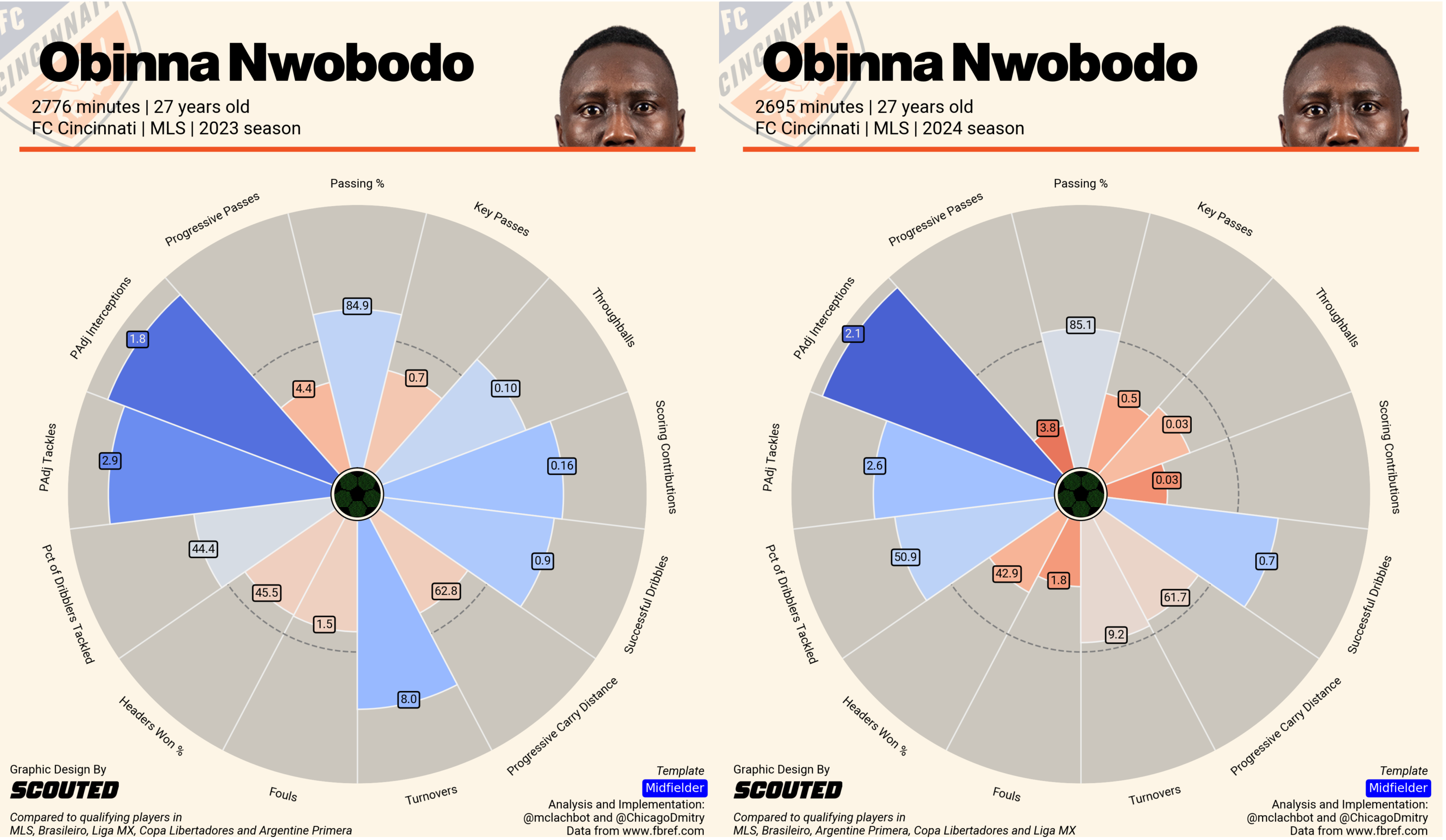
Even hampered by injury for much of the season, Nwobodo remains an effective defensive midfielder. Though he wasn’t quite as prolific as in 2023 (largely for reasons noted above), Nwobodo is still a very good defensive midfielder and his partnership with Pavel Bucha was defensively stout.
An optimistic case for Nwobodo to return to his 2023 form in 2025 includes increased health for himself and for the rest of FCC’s defensive line, increasing cohesion and chemistry between the group.
Clear Impact Of An Offensive Shift
The area of Nwobodo’s game that raises the most questions about his future in the Queen City is when FCC has the ball. As noted above, Noonan’s shift to a more ball-dominant game model in 2024, especially one focused on building out of the back, put Nwobodo in new positions.
Compared to other midfielders in FBref’s “Next 14 Leagues,” which includes Major League Soccer, Nwobodo’s progressive passes and carries per match rank in the 28th and 38th percentile respectively. He completes a slightly higher than average percentage of his passes, but those passes should be completed at a higher rate because they are generally less ambitious.
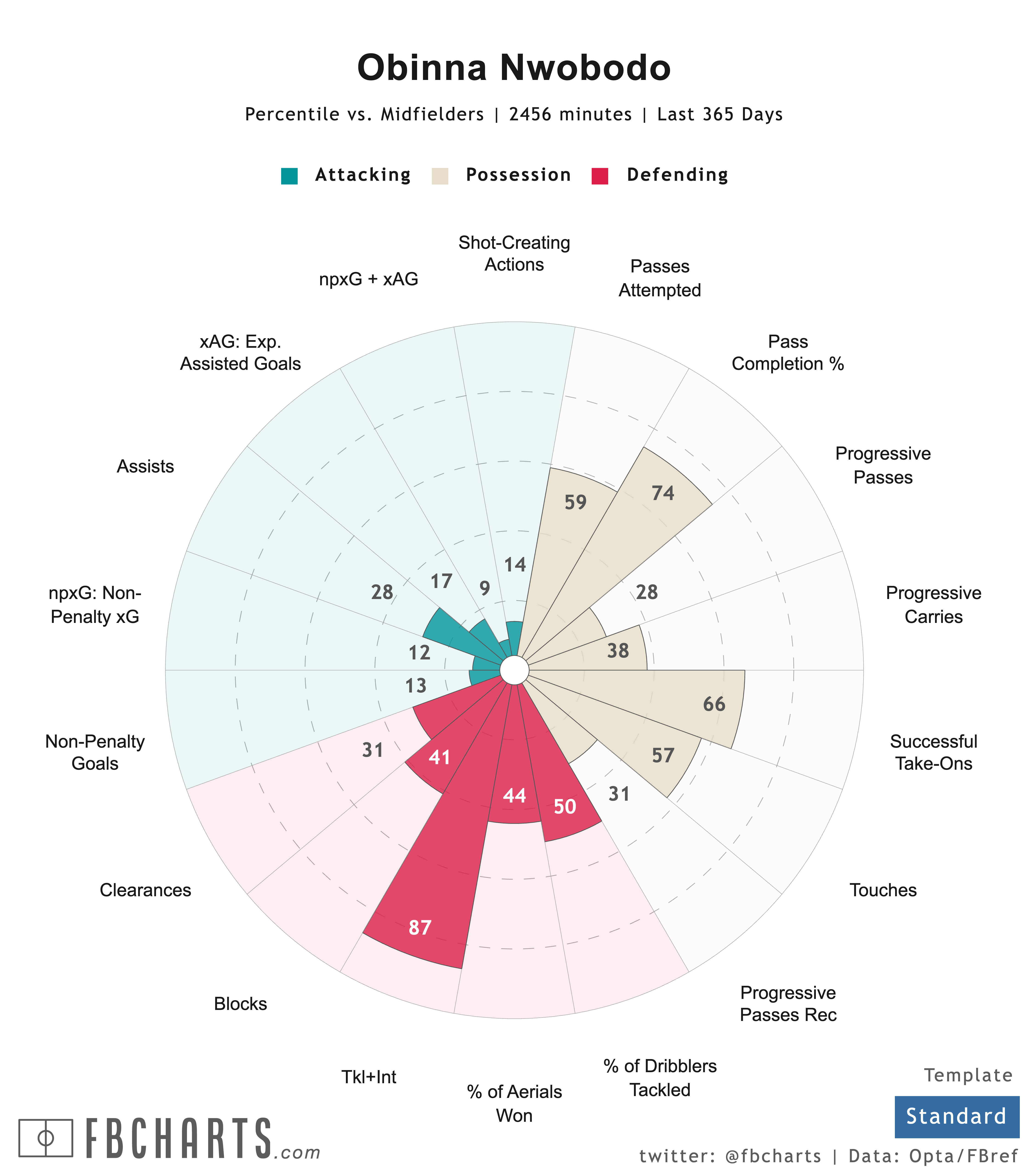
There’s certainly value in having a midfielder who can and will recycle possession and move the ball side-to-side. However, when playing with just one other pure central midfielder, as Nwobodo has in Cincinnati, that lack of ball progression can really limit a team offensively.
As the Orange and Blue looked to build out of the back, Nwobodo’s discomfort on the ball with his back to the opposing goal was an issue. Celentano’s own discomfort playing passes into tight windows didn’t help matters, either. Even if Nwobodo isn’t a first option to break an initial line of defensive pressure in FCC’s half, you’d like to see him making a pass to transition to attack immediately after the press is broken.
Nwobodo’s presence in the final third in 2024 was basically non-existent. He completed just four passes into the penalty area compared to 13 in 2023 while having the most touches in the middle- and final-thirds of the field of any of his seasons in Orange and Blue. Part of this is almost certainly by tactical design but having another player willing to try to break lines to create opportunities for attackers would benefit FCC.
In 2024, FCC’s centerbacks, playing higher up the field in possession, were able to take on more ball progression responsibilities and link play from back to front. However, if Nwobodo could provide just a little bit more, either carrying the ball forward himself or splitting opponents’ defensive lines from midfield, better goal-scoring opportunities should open up for FCC.
2025 And Beyond
Even with the reservations about Nwobodo’s offensive game expressed above, his continued future in Orange and Blue makes sense for a variety of reasons.
First, given how much else is likely to be on Chris Albright’s plate this offseason, not having to spend money (and player acquisition resources) to replace yet another starter is the simplest way forward. Nwobodo is under contract via a team option for the 2025 season and he shouldn’t use a Designated Player roster spot due to the amortized portion of his transfer fee coming off FCC’s books.
The best case scenario from the perspective of the salary cap and maximizing FCC’s roster in 2025 and beyond is a contract extension, potentially at lower salary though multiple guaranteed years. Such an extension could make sense for both sides as FCC would have more salary room to upgrade the rest of the roster while Nwobodo would secure more guaranteed money, though making less in 2025.
He’ll also be 28-years-old for most of the 2025 season, so still firmly in his athletic prime for the first couple years of a potential contract extension. It’s unlikely he’ll be the next Diego Chara but envisioning a scenario where Nwobodo remains productive for the next three to four years seems realistic.
An Acosta Caveat
A Lucho Acosta departure would almost certainly change the calculus for FCC’s front office and coaching staff. Acosta’s role in ball progression the last couple seasons cannot be overstated. Chido Awaziem and Teenage Hadebe look to be quality passers, opening the possibility for FCC to play in a similar way in 2025, even without the presence of Miles Robinson.
Can a team with Nwobodo and Bucha anchoring the center of the field generate enough passing to succeed in possession? In a season when FCC controlled possession more than ever, Nwobodo did less to move the ball forward into truly dangerous areas. Even though Nwobodo finished fourth on FCC in completed passes into the final third, many of those were to Acosta in that part of the field familiar to anyone who even occasionally watches the Orange and Blue: somewhere between the left wing and left half-space in front of the penalty area. Letting Lucho dictate play from that part of the field has been an effective attacking plan for years but what Obi’s final third passing looks like without that option remains to be seen.
However Albright and Noonan envision a potentially-Acosta-less future, replacing Acosta’s ball progression is one of the more daunting tasks. Nwobodo’s defensive ability justifies a continued tenure in Cincinnati but his limitations on the ball will require another big splash in the transfer market in the form of a direct replacement or a reimagining of how FCC consistently moves the ball into the final third and penalty box.


