
Three Pairs: Monday Takeaways (5/12/25)
Lineup changes, two strikers, and asking what it means going forward

All stats courtesy of FBref unless otherwise noted
FC Cincinnati returned to winning ways with a - you guessed it - one goal victory over Austin FC at home on Saturday night. Outside of a rocky first five minutes of both halves, FCC was the better team, controlling the game and looking dangerous for extended stretches. Though the team is still not creating enough high-quality scoring chances, Saturday looked to be a step in the right direction.
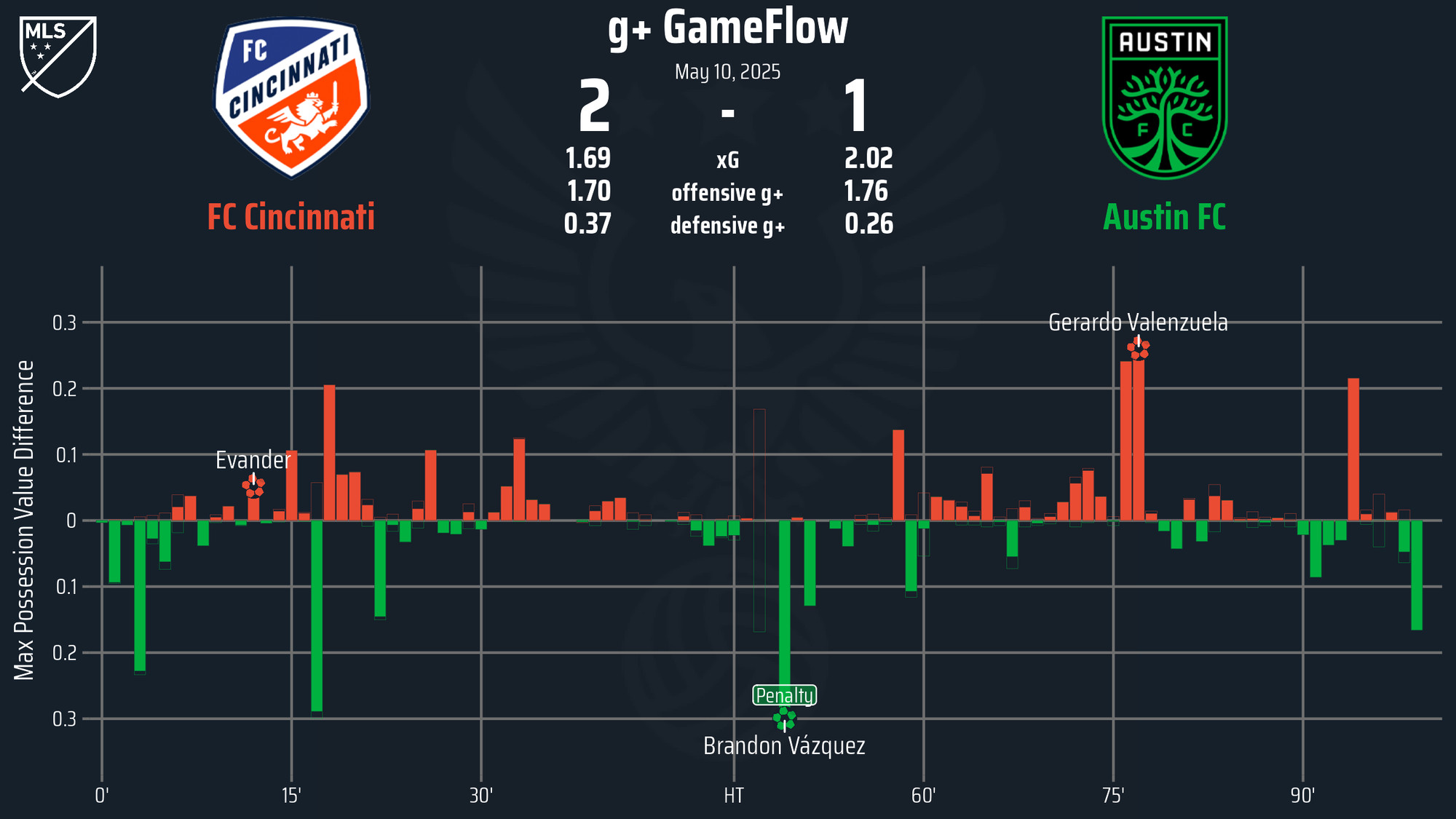
1. Duos
Pat Noonan’s lineup changes were a big reason why the Orange and Blue looked more dangerous on Saturday.
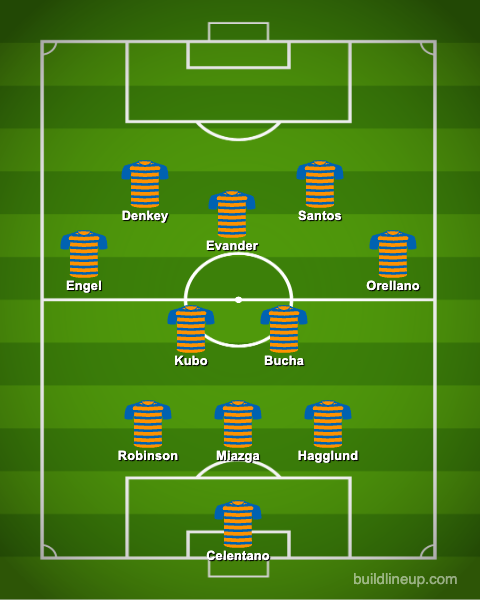
Luca Orellano started at right wingback while Nick Hagglund retained his centerback spot, dropping DeAndre Yedlin to the bench. Yuya Kubo joined a healthy Pavel Bucha in central midfield and Sergio Santos partnered with Kévin Denkey up top in the attack.
These changes made the Orange and Blue more fluid and balanced in possession, allowing FCC to use both flanks to move the ball into the final third of the field.
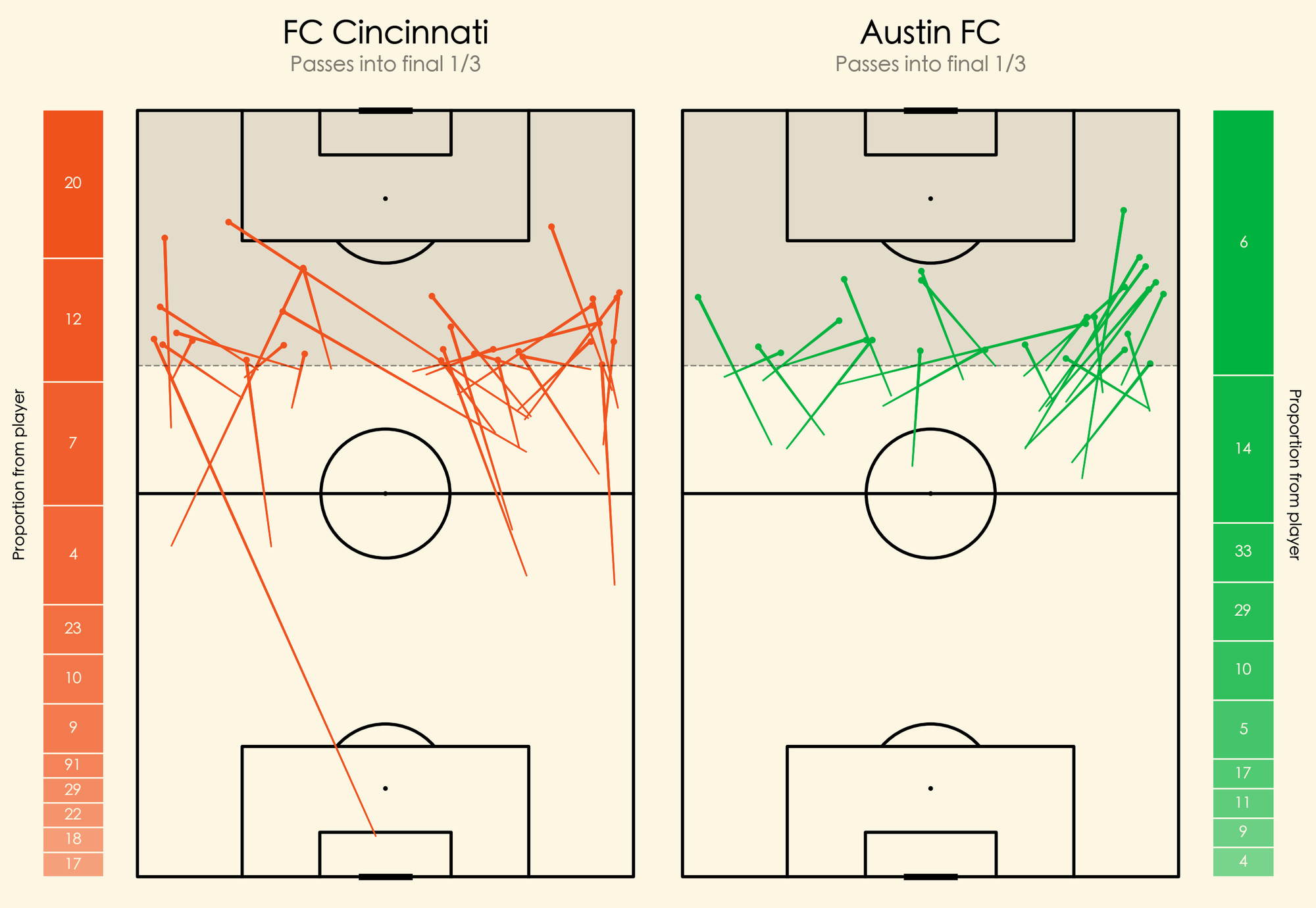
The ball progression burden was more evenly distributed, too. Seven FCC players contributed four or more progressive passes over the course of the match, a far more equal distribution than what we’ve seen in previous matches when the Orange and Blue relied on one or two players to push the action.
Also crucially, Noonan’s changes put the team’s best players in positions to succeed.
Denkey & Santos
Let’s start with the two strikers: Santos and Denkey.
With Austin matching the Orange and Blue’s shape with three center backs, Noonan’s choice to play two strikers paid dividends. With a single striker, we’ve seen the Orange and Blue’s shape in possession require the team’s two attacking midfielders to operate in the half-spaces, while Denkey largely stayed central. On Saturday, Santos and Denkey were willing targets in the half-spaces while Evander (mostly) occupied central areas underneath the two in possession.
The strikers’ ability to play with their backs to goal created opportunities for FCC’s other attackers. Minutes after Evander’s opening goal, pressure from the Orange and Blue created a turnover at midfield. As Austin looked to close down the ball and prevent FCC’s midfielders from getting on the ball, Hagglund found an opening for a line-breaking pass to the feet of Sergio Santos. Instead of looking to turn and run himself, he laid the ball off to an onrushing Evander, running into space towards Austin’s 18-yard-box.
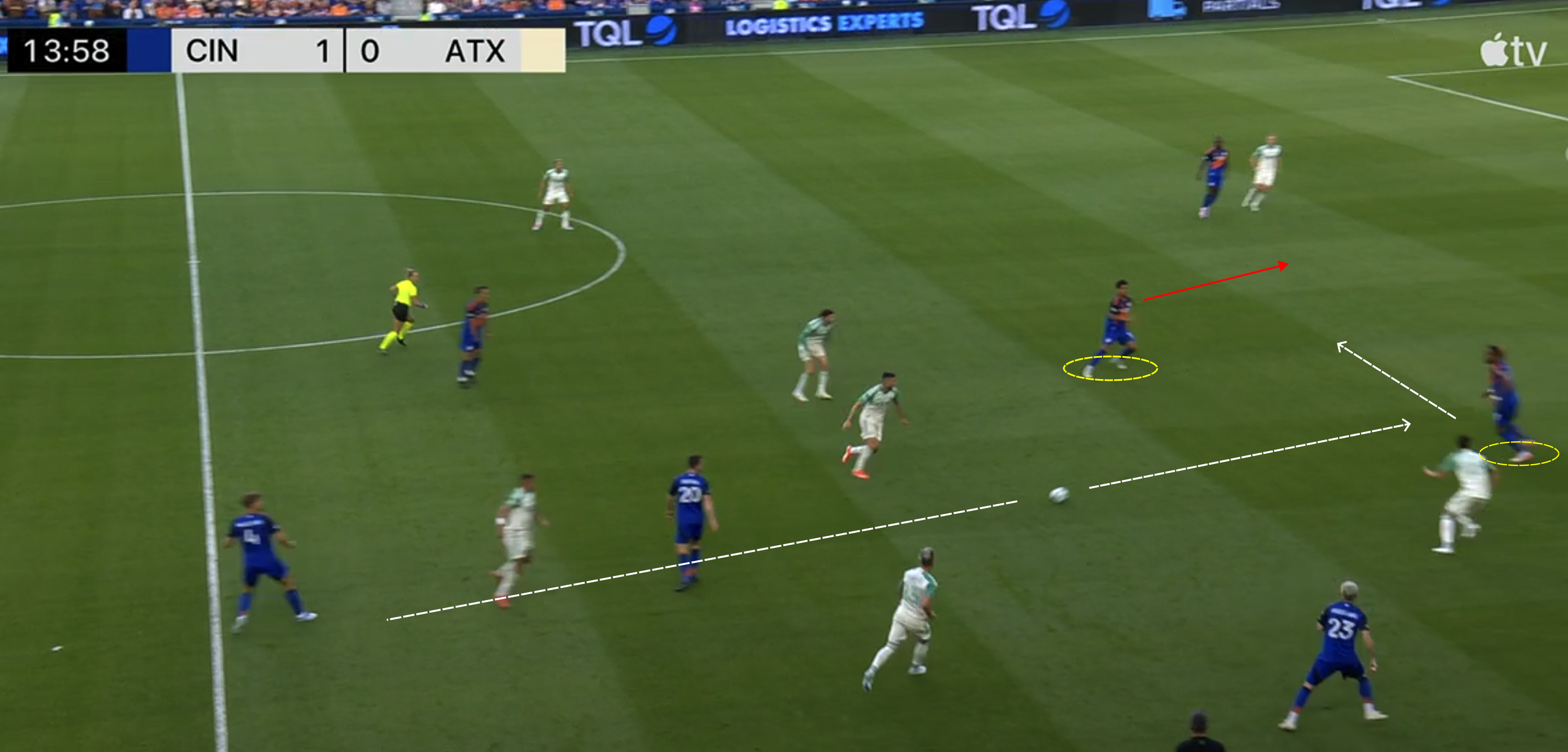
Having options to receive the ball with their backs to goal allowed Evander, Orellano, and others to pick up the ball where they’re most dangerous: running into space towards the opposing goal.
Kubo & Bucha
Kubo got the start over Brian Anunga and the differences in comfort on the ball between the two was evident from the game’s opening minutes.
Having two players willing to push the ball forward in midfield was hugely beneficial. With both midfielders and wingbacks comfortable receiving the ball in tight spaces, plus solid passing from the team’s center backs, FCC was able to play through Austin’s first line of confrontation relatively easily.
After the game, Noonan said, “It’s just recognizing how to play to pressure and having more patience than we had previously. And also not trying to play up one channel when that wasn’t the best option. So I think we did a better job of understanding how to move them left to right, to find ways to play through the middle, to switch play.”
He continued, “What does it look like for Yuya (Kubo) and Pavel (Bucha) to find deeper positions. So I thought their movements and how they rotated with the play was good and allowed us to have different ways to advance the ball up the field. So Yuya and Pavel, I thought were excellent in just how they played behind their initial pressure.”
Saturday’s midfield, combined with striker and wingback duos, created passing triangles all over the field. No matter where the ball was, a player almost always had two options, and both options were comfortable enough to find the next pass and so on and so forth. With Denkey and Santos providing backboards to play off up the field, FCC’s midfielders found pockets of space in conjunction with Evander, keeping enough vertical space between themselves to prevent Austin from closing them down.
Luca & Lukas
The Orange and Blue’s wingbacks were heavily involved in the game, too. Orellano’s return to wingback puts him slightly further from goal, but with how Noonan has set the team up in possession all year, he’s still a key attacking piece, occupying the widest spot on the right side in FCC’s attacking band of five when in possession.
Playing from there, Orellano has the most field possible to cut inside onto his favored left foot when driving the ball forward. Crucially, he received the ball facing goal more often, too. When playing as an attacking midfielder or striker, he has operated more centrally on and was asked to receive the ball with his back to goal, lay it off to a teammate or spin a defender himself before turning and pushing up field.
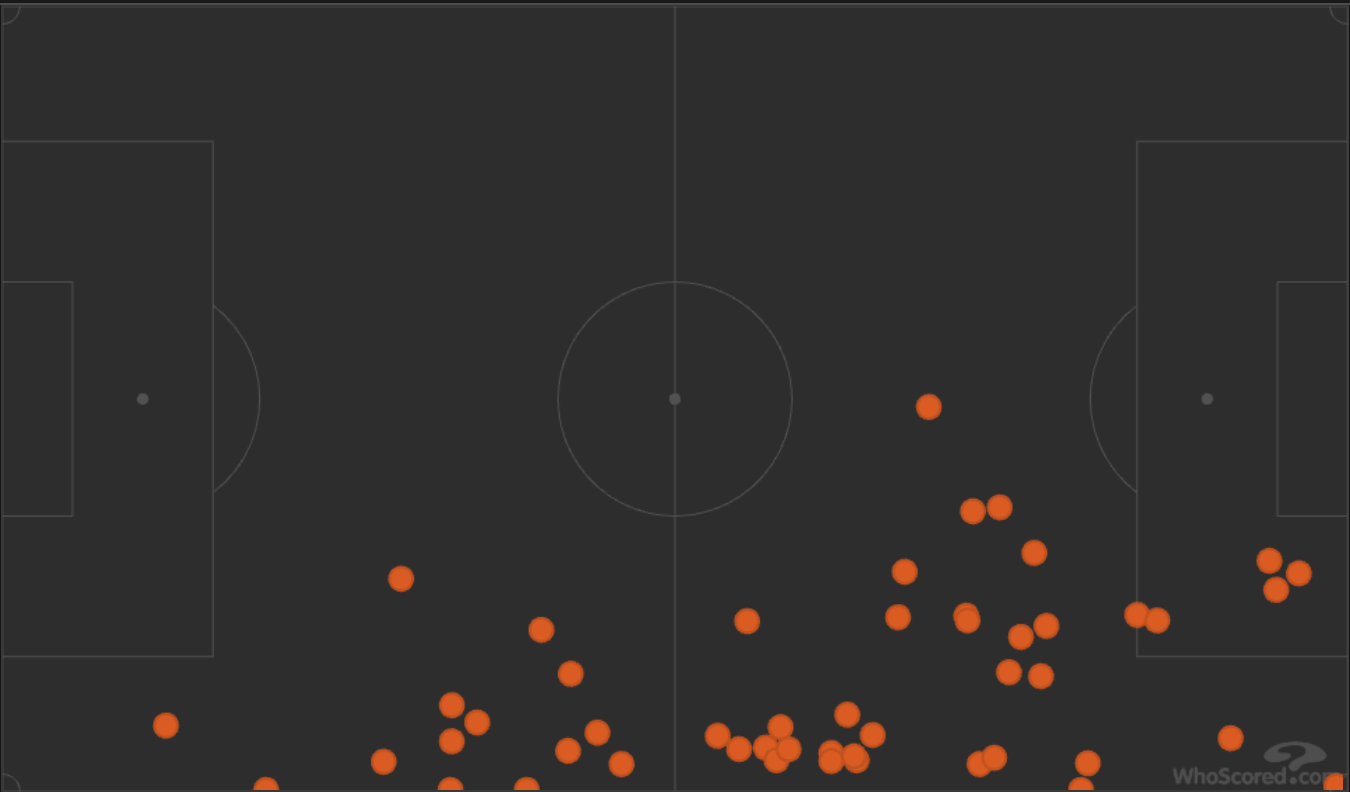
He nearly scored a curler from outside the box in the first half after playing simple passes, and receiving the ball back, from both Santos and Denkey.
There are some outstanding questions if Orellano is shifted further back on the field on a more consistent basis. How does he hold up when he has to do more defensively? Last year, he did enough but Austin didn’t offer too much of a test in possession, preferring to attack on the counter. Still, the offensive upside likely outweighs the defensive downside.
Engel’s contributions on Saturday shouldn’t be overlooked, either, as he had another strong game. He found space as FCC switched the point of attack horizontally across the field and combined neatly with midfielders as the ball ended up on the sideline. The Orange and Blue will need him to be more defensively responsible than Orellano, something he showed he can do on Saturday, racking up four tackles and two interceptions in addition to solid passing numbers. Engel probably won’t be the most dangerous attacker in the final third at any point this season, at least I hope not, but his ability to help move the ball up the field and provide width on the left brings value to FCC.
2. Evander Reaps The Benefits
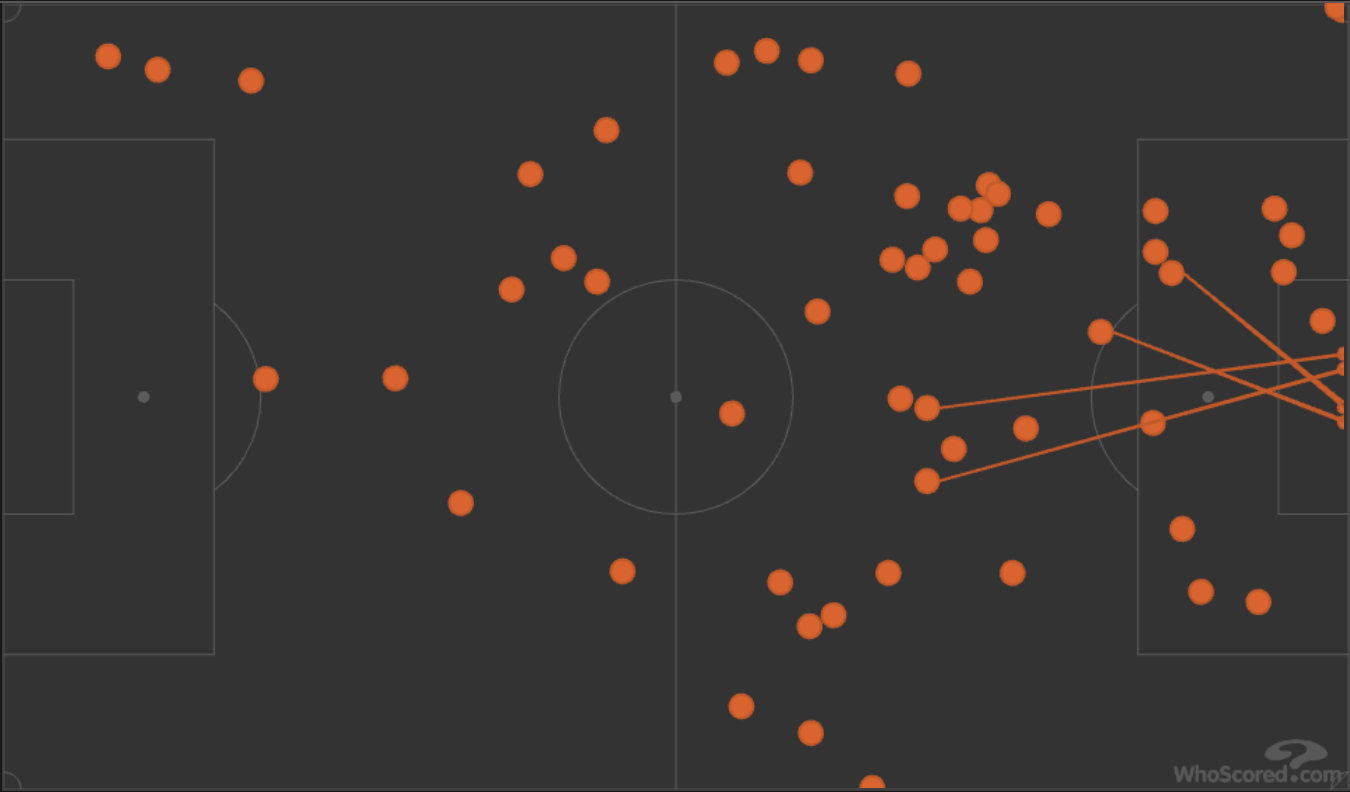
All of these adjustments put the Orange and Blue’s talisman in better positions to succeed. Given room to roam around the middle of the field, Evander found space and drove the ball into dangerous areas. His five progressive carries led the Orange and Blue on Saturday and three of his dribbles pushed the ball into Austin’s penalty area, also a team high on the night.
Though he still did not have a ton of touches in Zone 14, his 35 touches in the attacking third and nine touches in the opposing penalty area were both season highs.
After the game, Noonan said, “When we were talking about what their shape was going to look like, there was going to be different ways where we thought we could play through the middle. But how do you recognize it? How do you have the composure to play under pressure? How does the movement look like from our midfield three and Evander on the ball side?”
Evander’s movement stressed Austin’s defensive structure throughout the match. He caused problems by occupying space higher up the field, requiring a midfielder to stay back or a center back to step up to him. When the Orange and Blue looked to press, Evander occupied the middle, with Denkey and Santos alongside, cutting off passes to Austin’s outside center backs. His pressure led to long kicks from Austin that FCC’s center backs consistently won and then put him in prime areas to lead attacks after turnovers as shown above in the sequence in the 14th minute.
Evander also caused problems dropping deep, making Austin’s front line of pressure and its midfield account for him closer to his own goal.
In the 12th minute, Evander joined Kubo and Bucha on their midfield line, drawing attention from Austin’s Ilie Sánchez. As Sanchez followed, Kubo simply ran into that vacated space and pushed the ball forward after receiving a pass from Engel. Evander put an exclamation mark on the sequence when he scored the opening goal just seconds later.
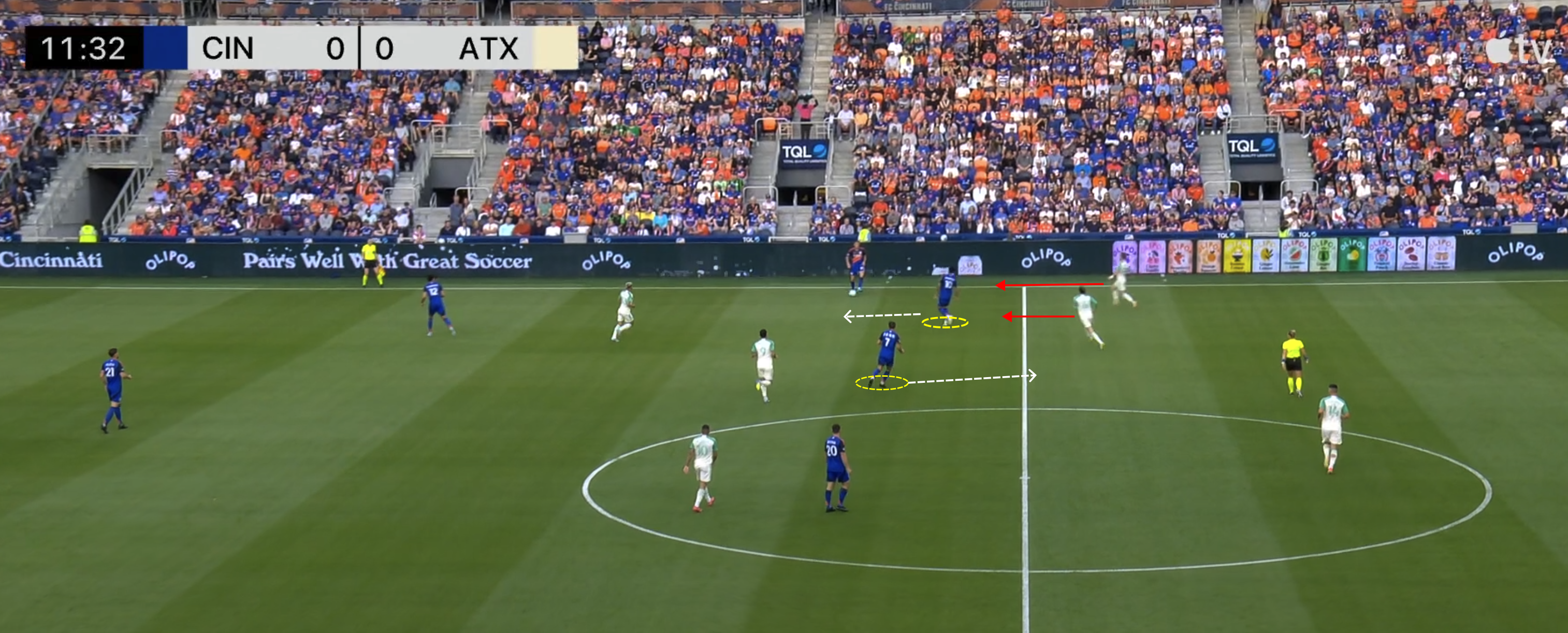
Evander’s freedom to find space ahead of the midfield pair and behind FCC’s strikers led to dangerous situations throughout the match. Making sure he continues to have that freedom, and space, might be the only thing holding back the Orange and Blue’s attack.
3. A One-Off or Something More?
So are we looking at a shift in how Noonan wants his team to attack moving forward or was Saturday’s change in personnel a one-off to take advantage of Austin’s setup?
After the game, when asked about the adjustments, Noonan said, “We tried to map out the week and understand the opponent, where we’re playing match ups, and we felt this was a strong 11 to go win a game. And we’re at the stage now where there’s good competition and there’s going to be tough decisions.”
We’ll find out midweek as the Orange and Blue take on Toronto FC as the first Hell is Real Derby of 2025 looms next weekend. Expect to have a better answer if the two striker approach was a specific game plan to take advantage of an opponent’s weakness or if it represents a return to Noonan’s earliest successes with the team by this time next week.
One last thing to note: Kei Kamara’s pending signing might provide a clue to Noonan’s long-term intentions. He provides another striker on the bench who should fit seamlessly into the role played by Santos on Saturday night. With Denkey, Santos, Kamara, Stefan Chirila, and Corey Baird, the Orange and Blue might have the depth to make a two-striker system work for the rest of the season.


