
Navigating Gridlock: Monday Takeaways (4/28/25)
Thoughts on stagnation in the final third and Luca Orellano's positioning

All stats courtesy of FBref unless otherwise noted
FC Cincinnati won another one goal game on Saturday with a 2-1 victory over Sporting Kansas City in the West End. There were flashes of quality - and one moment of brilliance courtesy of Kévin Denkey - but FCC is still struggling to put the pieces together in attack. The Orange and Blue finished the night with 15 shots but worth just 0.86 expected goals (0.057 xG/shot). Not ideal.
On a positive note, the Orange and Blue’s defensive effort limited Kansas City to 0.58 xG on 11 shots (0.053 xG/shot). SKC isn’t exactly an attacking behemoth, though the team has been better in its post-Peter Vermes era, but limiting any opponent to that level of offensive production will keep you in games. FCC’s defensive continuing to round into form with a getting-healthier-every-week Matt Miazga is a good sign that the team can continue to win ugly.
And that might be needed as FCC continues to struggle to create consistent scoring chances.
1. Final Third Struggles
FCC is searching for solutions in the the final third. The team’s attack looked dangerous in transition, continuing the trend from last week, though the final pass ultimately proved elusive.
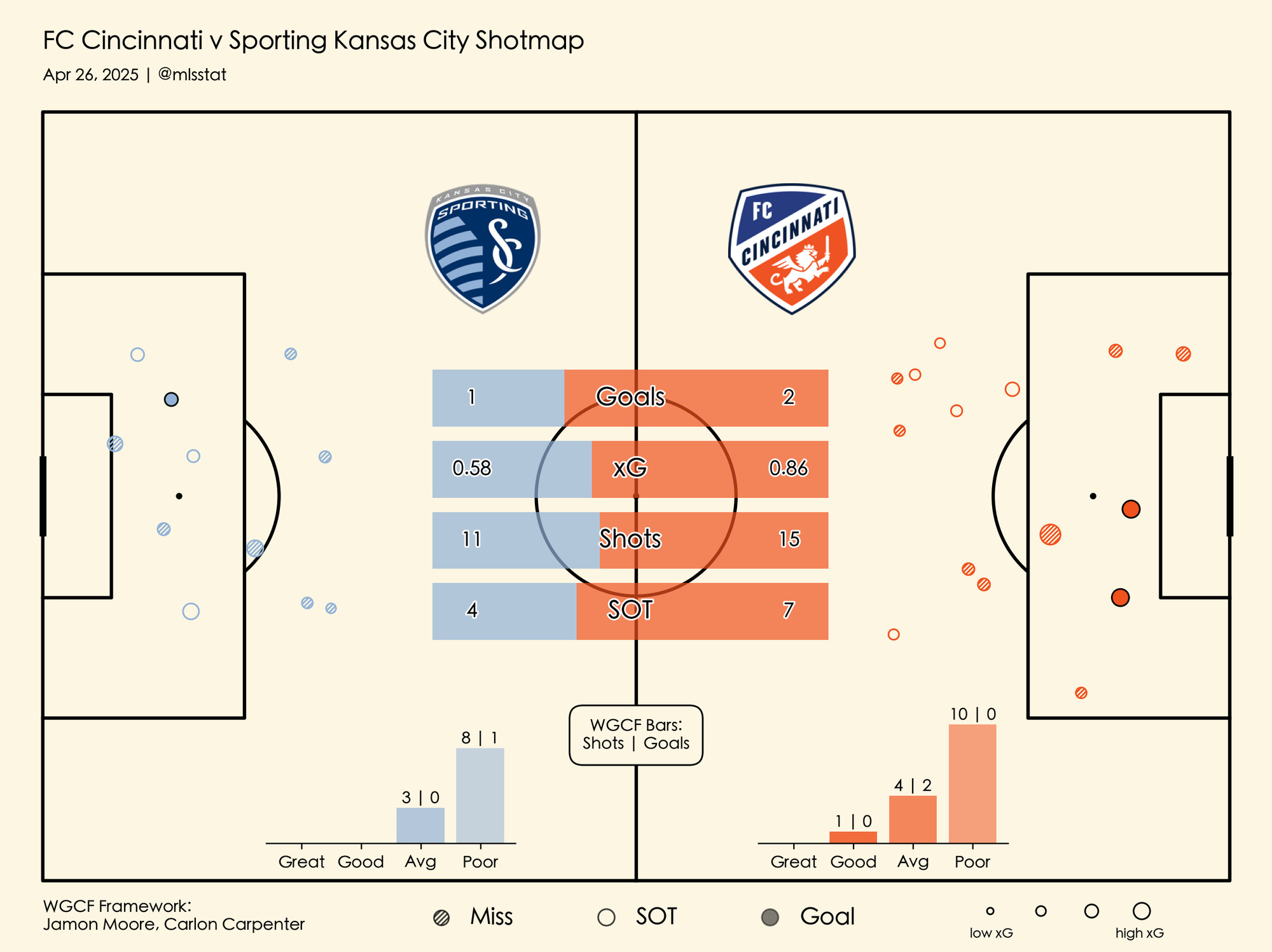
However, in possession, once again, the Orange and Blue struggled to turn having the ball in the final third into much of anything dangerous.
On Saturday, FCC heavily tilted to the right side of the field in possession. Even when the Orange and Blue successfully moved the ball through SKC’s mid-block, Sporting’s compact shape was able to recover and clog up potential passing lanes.
After the game, Pat Noonan said, “Even before the final third, with their structure tonight, they were compact. From front to back, there was 20, 30 yards max. And so, if that’s the case from front to back and if they’re narrow, we have to move the ball from left to right quicker. We have to think about how we play in from behind.”
The Orange and Blue found success switching the point of attack horizontally to counter SKC’s compactness and narrowness in defense in the sequence leading to the opening goal. With eight Kansas City defenders compressed on the right half of the field, Lukas Engel was essentially alone in space at the top of the 18-yard-box after a one-touch layoff from Pavel Bucha. Though John Pulskamp saved the shot, he could only parry it into the path of Denkey who volleyed home.
However, too many FCC possessions bogged down on the right side of the field in the final third. Just look at where these completed passes, both in the final third and into the box, ended up.
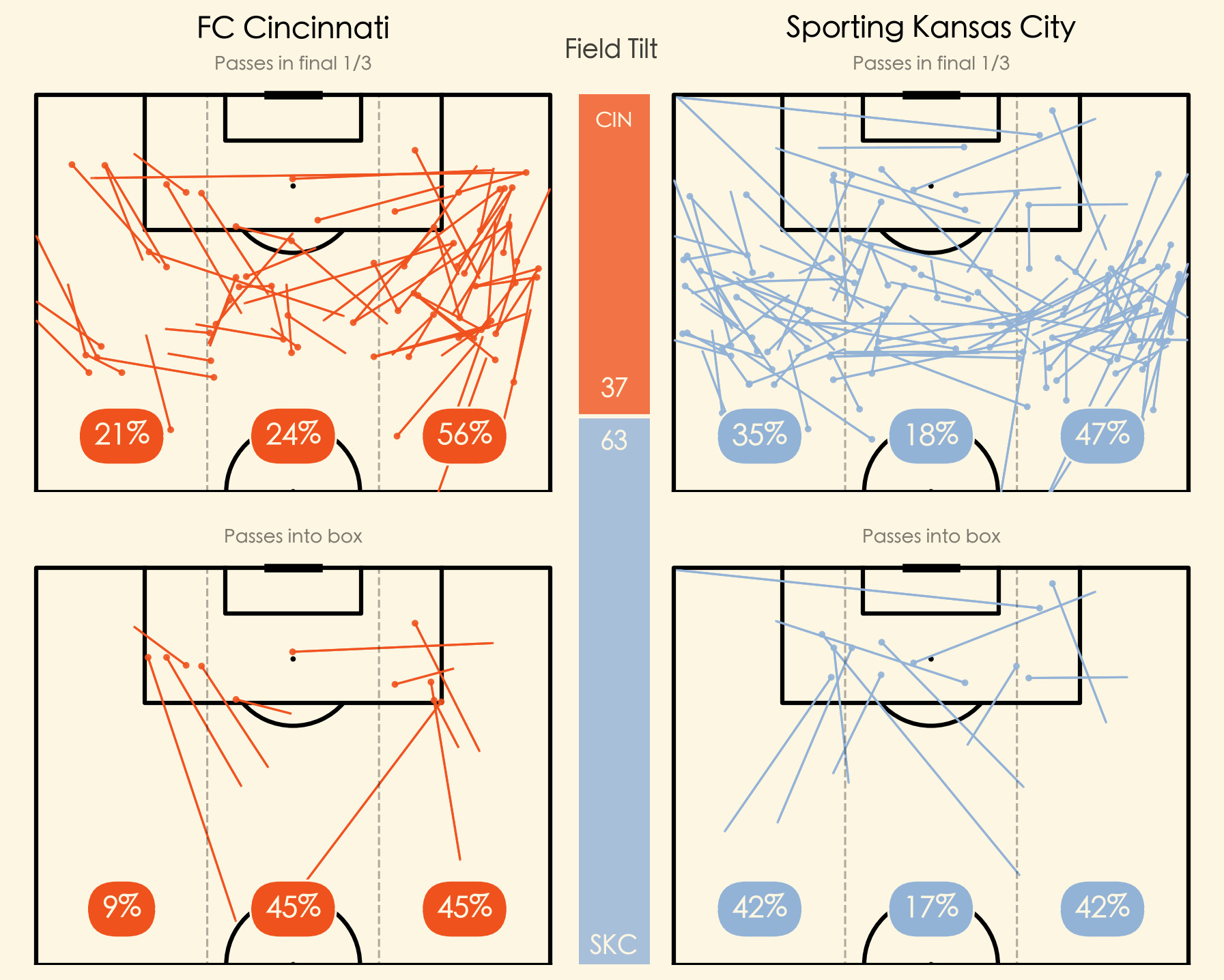
It’s difficult to generate good chances when the ball is rarely in dangerous parts of the field.
Too many possessions are ending with Luca Orellano or Evander dribbling into the heart of opposing defenses at the top of the box, leading either to low-quality attempts from distance or a situation requiring everything to go perfectly to lead to an eventual shot.
After the game, Noonan cited the team playing too slowly as a main reason for FCC bogging down in dangerous territory.
He said, “In the final third, I think it’s a matter what guys see, but also taking too many touches, and that brings in more defenders and then the moment to play behind is gone. The moment to play to their teammates is gone. Hold onto the ball too long, overcomplicating the pass instead of making the simple one that might lead to our wingbacks, especially getting time and space on the ball so we could run hard in front of goal.”
But I’m skeptical of Noonan’s proposed solution. From a purely theoretical tactical perspective, yes, finding wingbacks wide and looking for cutbacks across the 18-yard-box to attackers making hard runs towards goal makes a lot of sense. But the Orange and Blue’s players in those spots haven’t proven that they’re actually very good at doing exactly that. DeAndre Yedlin does a lot of things well, but being a shot-creating threat in the attacking third has never really been one of them. Lukas Engel has shown flashes so far in 2025 in Orange and Blue but, similarly, he’s never really been a marauding attacking option from wingback in his career.
2. Luca’s Repositioning
One way to ensure that FCC is more dangerous in the final third involves an adjustment we’ve already seen a few times during the 2025 season: using Luca Orellano as a chess piece.
After the final whistle, I thought Saturday’s game was one of Orellano’s strongest of 2025. Starting up top with Denkey and Evander, Orellano was active and involved throughout the game’s first sixty minutes plus.
In the first hour, Noonan seems to have wanted Orellano to play as more of an advanced option. After the game, talking about getting Evander involved, Noonan said, “I thought Luca (Orellano) and Kévin could stay higher in the line to create some space for him or he could move into wide areas where their wingbacks move enough to try to just get our most creative player on the ball to make plays.”
Orellano had a decent amount of success in the first hour, not necessarily stretching SKC’s backline vertically but in getting on the ball and making things happen. Despite everyone in the stadium, opponents included, knowing that his bread and butter is cutting inside onto his left foot and dribbling, he still succeeds more often than not. On Saturday, he completed his five of the seven attempted take-ons and accounted for all five of the Orange and Blue’s carries into the final third.
The chemistry seems to be improving among FCC’s trio of attackers, too. Though Orellano is still dribbling into opposition numbers and taking not-great shots too often, on Saturday he and Evander were nearly on the same page more than once.1
In the 63rd minute, Noonan tweaked the system. He subbed out a centerback, in this case Matt Miazga, and brought on another attacker, Sergio Santos.2 This substitution held Yedlin further back in possession and pushed Orellano wider, occupying Yedlin’s previous spot.
FCC’s offensive structure remained the largely same, with the team building up in a 3-2-5 shape in possession but Orellano replaced Yedlin in that shape.
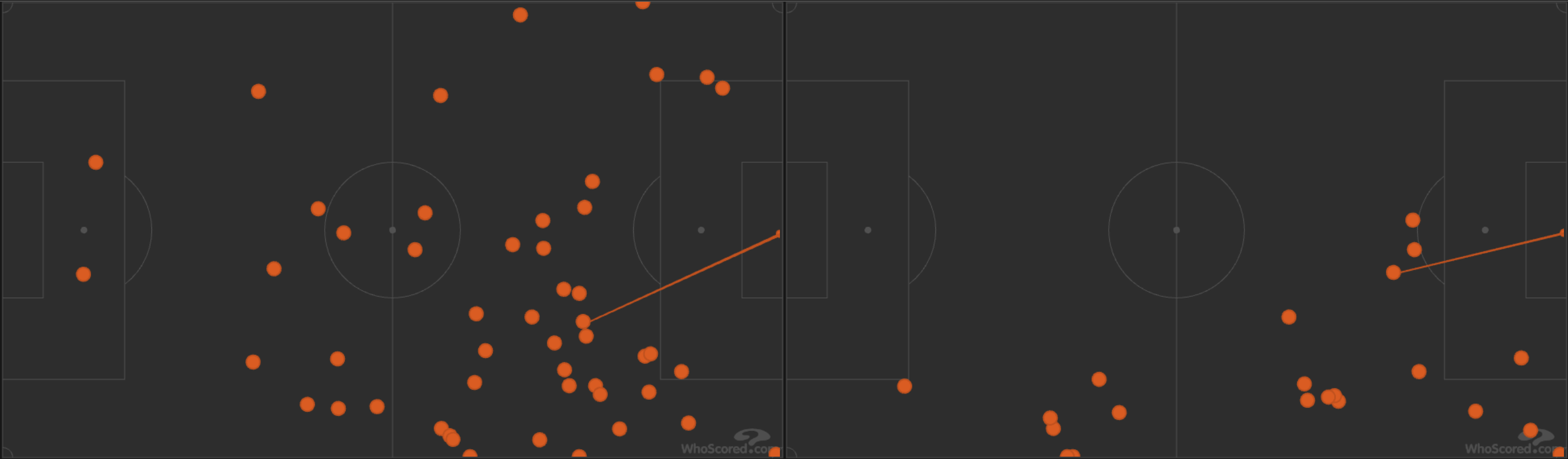
In my view, this isn’t just a case of Orellano impacting the game more as a wingback. To my eye (and the data), Orellano was impactful in the first half playing in a more advanced role. However, there is something to the combination of Orellano being more comfortable on the outside of that forward line of five in FCC’s possession shape AND him being much more effective in the final third compared to Yedlin which makes FCC more dangerous. Orellano had the benefit of running at a more tired defense of a team that was already chasing an equalizing goal. However, having attackers already ahead as Orellano drove the ball forward on the dribble opened up additional options that were not there in the first sixty minutes.
As I’ve written about previously, there are multiple ways for Noonan to get to this point. Whether it’s with three centerbacks or two, putting Orellano in the best situations to thrive in a given game will have a big impact on how dangerous the Orange and Blue are.
I’m not ready to give up on the dream of Orellano the attacker yet - far from it - but the option gives Noonan an enticing option to switch things up.


