
Monday Takeaways (4/7/24)
Changeups and Kévin Denkey putting in a shift

All stats courtesy of FBref unless otherwise noted
If you’re reading this and watched FC Cincinnati’s 1-0 win in the West End over the New England Revolution in person, I hope you’re finally dry. The rainy conditions and general availability of the Orange and Blue’s availability due a variety of issues make drawing any sweeping conclusions from the game a futile exercise. However, a win is still a win.
FCC’s defense limited the Revolution to marginal chances while the patchwork attack found a goal to secure all three points. After a run of games where the Orange and Blue were the worse side yet still found a way to get points, it’s nice to look back at a game where FCC was the better side and won.
1. When Should a Changeup Become Your Primary Pitch?
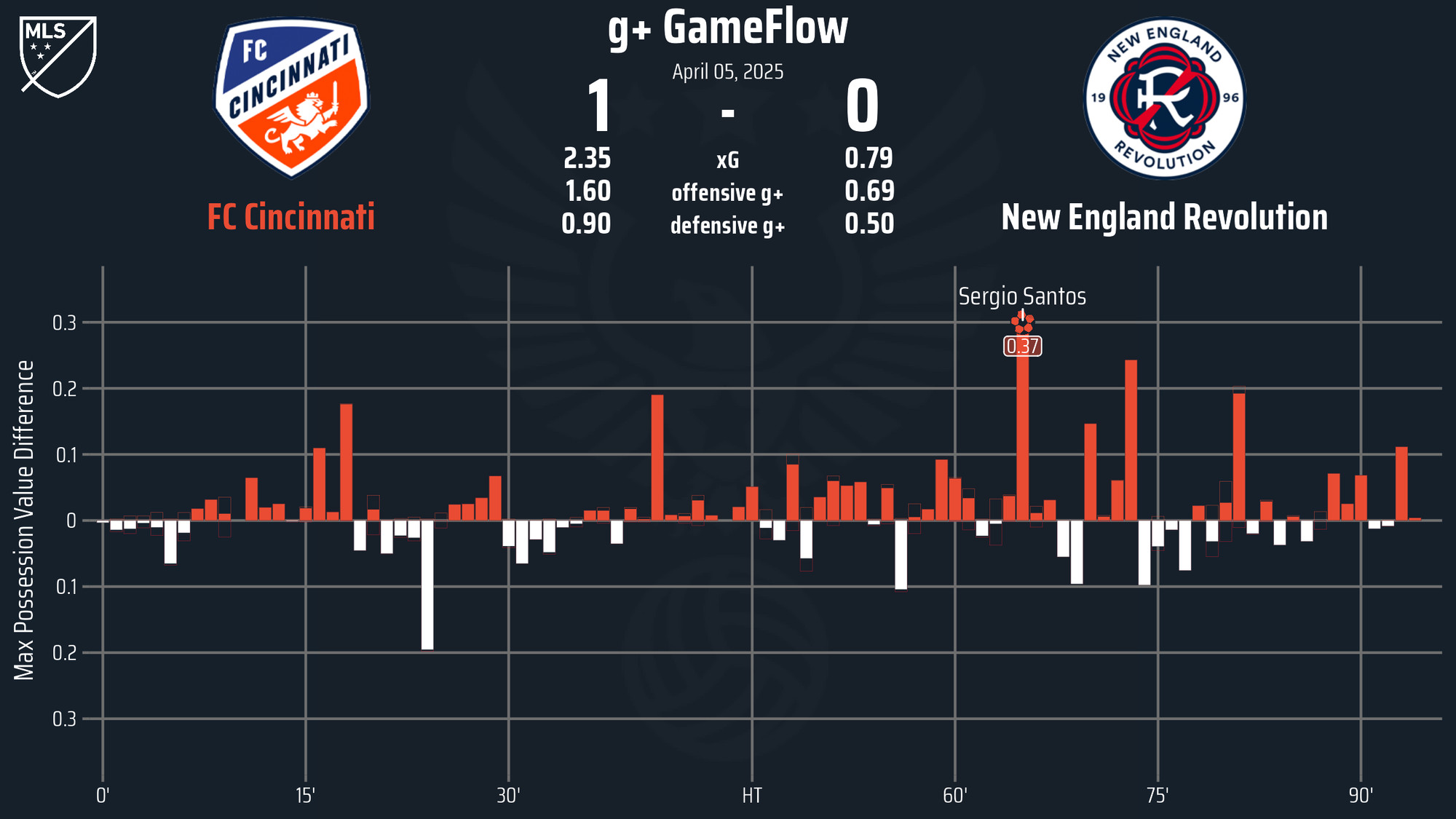
In the second half, Pat Noonan made an adjustment and if you’re a regular reader, you’ll likely know where I’m going with this. When Sergio Santos replaced Brad Smith in the 58th minute, the Orange and Blue shifted from playing with three centerbacks to two. And wouldn’t you know it, FCC started creating dangerous chances.
Though the formation looked more 4-4-2 than 4-2-3-1 with Santos and Kévin Denkey playing up top, the structure in possession remained similar to what we’ve seen over the past few games. A fullback, on Saturday it was Lukas Engel, sat deep, joining Nick Hagglund and Gilberto Flores, as the Orange and Blue looked to move the ball from back to front.
In the first half, already dealing with a depleted attacking depth chart, the Orange and Blue just didn’t have enough passing quality in the final third to break down the Revolution. Brian Anunga had a solid game but, like Obinna Nwobodo, he shouldn’t be expected to produce much in and around the box. FCC’s wingbacks, Yedlin and Brad Smith, similarly aren’t going to provide a killer final ball to an attacker.
Having an extra attacker on the field made a big difference. Santos’ presence alleviated some pressure on Denkey, allowing him more room to operate. In a game where Denkey had to do more on the ball, having another striker make dangerous runs was vital. On the game-winning goal, Santos ended up in the right place at the right time because of his initial run to open space for Denkey to receive the ball at the top of the box. When Aljaž Ivačič parried Corey Baird’s shot into Pavel Bucha’s path, Santos was there for the tap in.
Here’s some back-of-the-envelope math based on the last three games: with three centerbacks on the field, the Orange and Blue’s expected goal difference (xGD) is -0.67. With two central defenders playing, the team’s xGD is 0.3. Don’t take this as something predictive - small sample size caveats still apply - but single game xG has value in a descriptive way.
However, the roster really isn’t built to play with four defenders all the time. FCC is spending a lot of roster resources on centerbacks and, with Matt Miazga inching towards a return to the field, the centerback depth chart is going to be even more complicated. FCC also lacks a real wide option to play opposite Luca Orellano. There are structural reasons to continue with three centerbacks but every game when FCC looks better playing with different personnel should amplify what the setup for the rest of 2025 should look like.
As of today, the (extremely limited) numbers and my eyes are telling me the same thing: FCC is a better team with two central defenders on the field rather than three.
2. Kévin Denkey Doing Enough
As noted above, with the absence of Evander, Denkey had to do a little more on Saturday night. His 39 touches tied a season high and his 10 touches in the opposing penalty area were the most so far in 2025. He was an available option up the field, receiving seven progressive passes. Importantly, as FCC looked to play through Denkey, he didn’t lose the ball very much. Though the Orange and Blue struggled to turn his hold-up play into more dangerous situations, Saturday seemed like a step in the right direction for FCC’s new #9.
His ability to find space to take shots is promising, too, even if the outcomes were not. Denkey’s five shots against New England were a season high in MLS play. Though those shots only totaled 0.3 xG, two were decent looks at goal. Ideally, he won’t have to try to take relatively low-percentage shots as FCC gets healthier and on-field chemistry between attackers increases. However, without Evander and other key contributors, Denkey helped ensure that the Orange and Blue could threaten New England’s goal even if FCC didn’t have enough quality in attack until the last half-hour of the game.
On a night with far from ideal conditions, Denkey was a big a reason why the Orange and Blue won the game. Even though he didn’t score, that’s what you need from a Designated Player.


