
Monday Takeaways (3/24/25)
FC Cincinnati's first half struggles, second half alterations, plus Alvas Powell appreciation

All stats courtesy of FBref unless otherwise noted
Given FC Cincinnati’s roster issues on Saturday, a draw isn’t necessarily a bad result against Atlanta United, which faced it’s own roster crunch. It wasn’t necessarily a game to remember but second half adjustments from the Orange and Blue put me in a more positive frame of mind than I would’ve been if I was only writing about the first 45 minutes.
1. First Half Struggles
The first half on Saturday was frantic, with FCC never really settling into the game. In his post-game press conference, Pat Noonan said, “The first half was sloppy. Just technically poor, passing and decision-making led to unnecessary transition moments, and I think we cleaned that up in the second half.”
One of those transition moments led to Atlanta’s best opportunity of the match in the 35th minute after what looked like a miscommunication in the Orange and Blue’s press. Evander and Obinna Nwobodo both looked to press the same player, creating the opportunity for a simple Atlanta pass that broke FCC’s defensive lines wide open. Tristan Mumbaya’s header and Emmanuel Latte Lath’s ensuing chance totaled 0.97 xG. Ultimately, more than 75% of Atlanta’s xG created for the game came from that opportunity plus Saba Lobjanidze’s chance1 in the 18th minute.
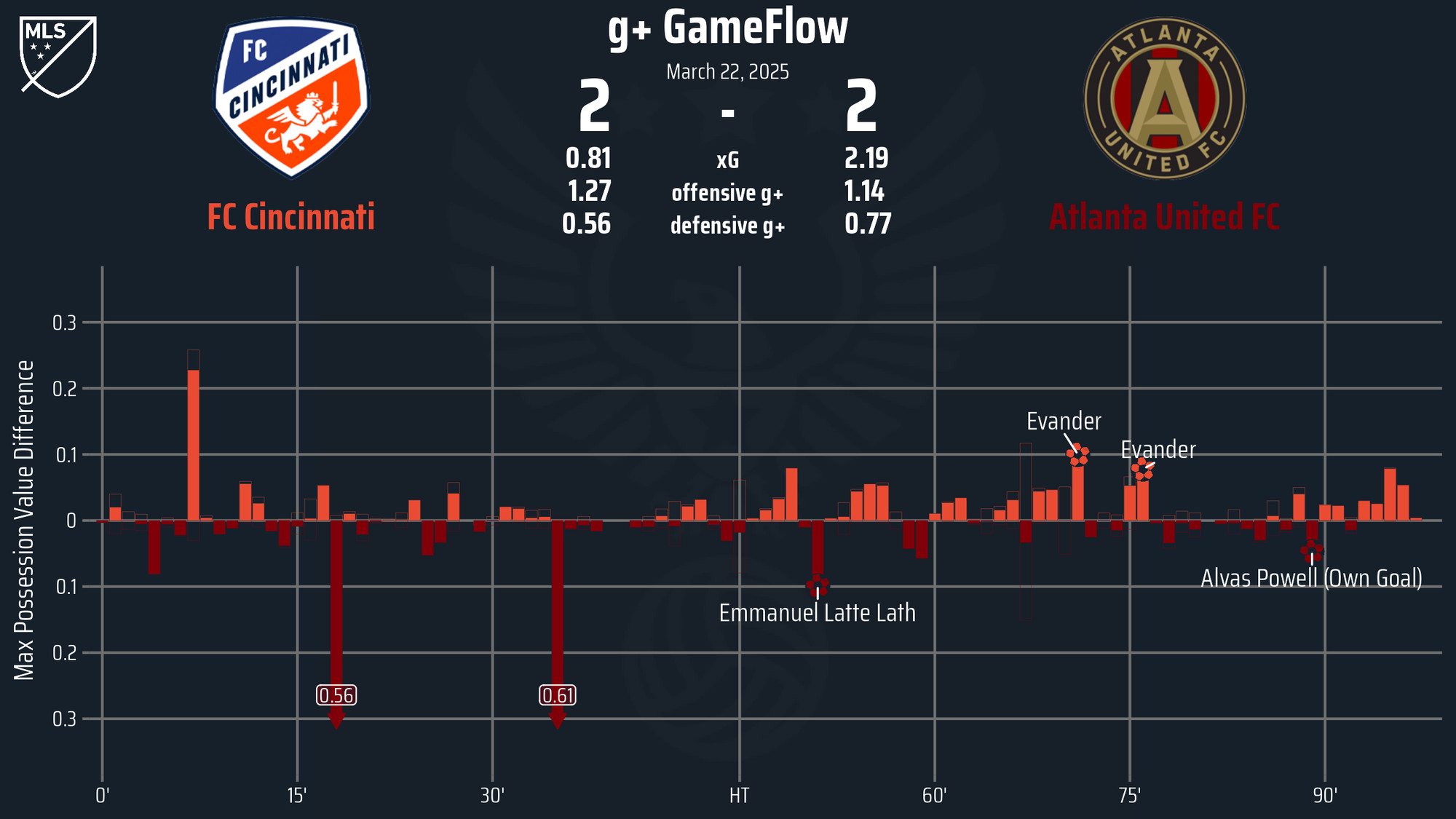
Outside of those two major opportunities, Atlanta didn’t create all that much, reflecting well on FCC’s makeshift defensive line. However, FCC did almost nothing of note with the ball in the first half, as well.
In what has been a recurring theme so far in 2025, the Orange and Blue’s opponents have dared its centerbacks to either thread passes directly through tight windows to find FCC’s attacking line or to play quick combinations with Obi Nwobodo and Pavel Bucha to progress the ball. With three new starting centerbacks, FCC struggled to break through Atlanta’s mid-block.
Even in instances when the Orange and Blue found space in semi-transition, either after turnovers or decisive passing, Atlanta, smartly, simply wouldn’t allow play to continue.2
The team’s touch map from the first half illustrates FCC’s struggles to move the ball into dangerous positions. Kubo’s right-footedness provided little to no width on the left and Evander couldn’t find the ball in the middle of the field.
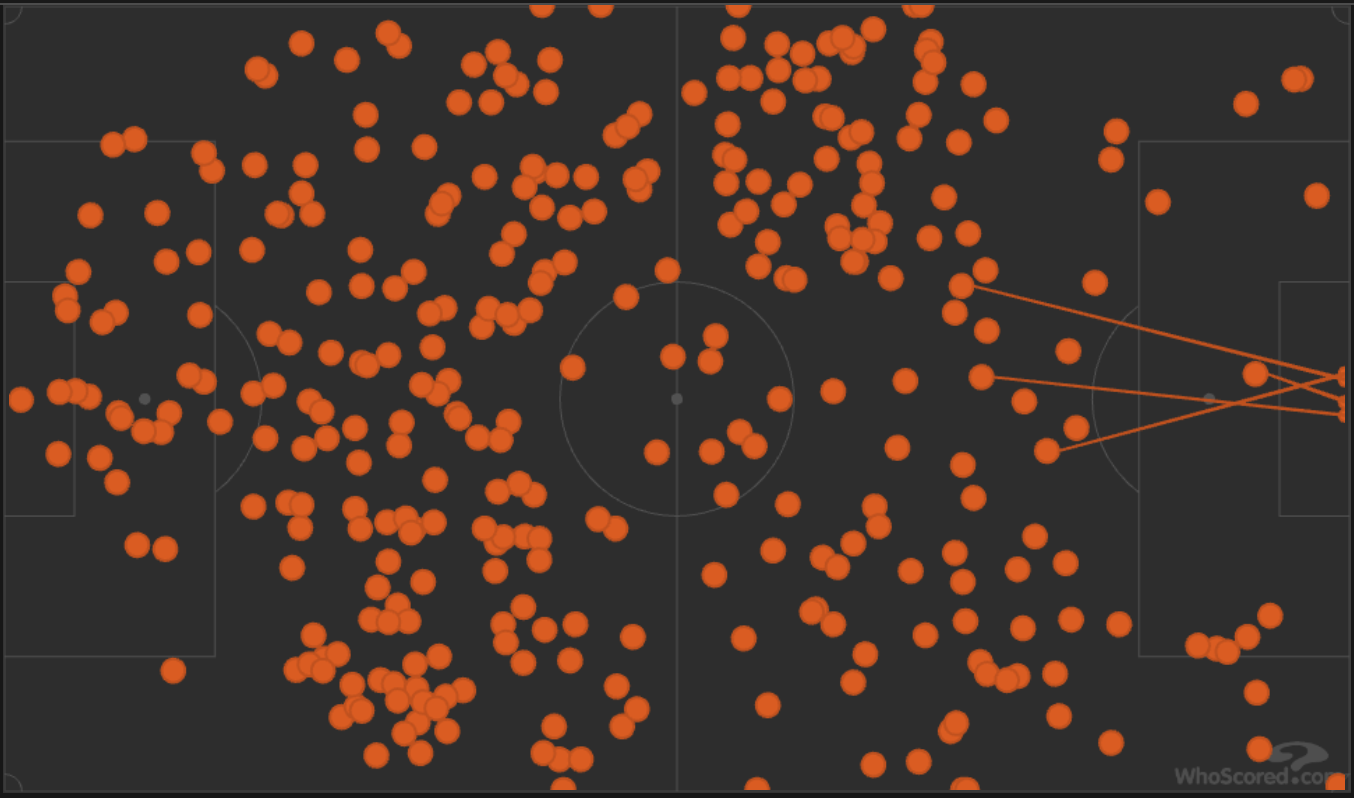
As a result, unsurprisingly, FCC’s shot selection suffered. In the rare instances when the ball was in the final third and Atlanta was set defensively, the Orange and Blue’s most likely option was to try to beat Brad Guzan from distance. In the first half, FCC’s xG from open play was 0.09 on three shots from an average distance of 30 yards from goal.
2. Second Half Improvements
The second half was different - but largely in a good way. Even before Emmanuel Latte Lath’s go-ahead goal, the Orange and Blue looked more comfortable - and dangerous - in possession. As noted above, Noonan cited cleaning up poor passing and decision making as issues in the second half but halftime adjustments also set up the team to play better.
Contrast FCC’s second half touch map with the one above. Lots more possession in and around Zone 14 and shots from better - but still not great - locations.
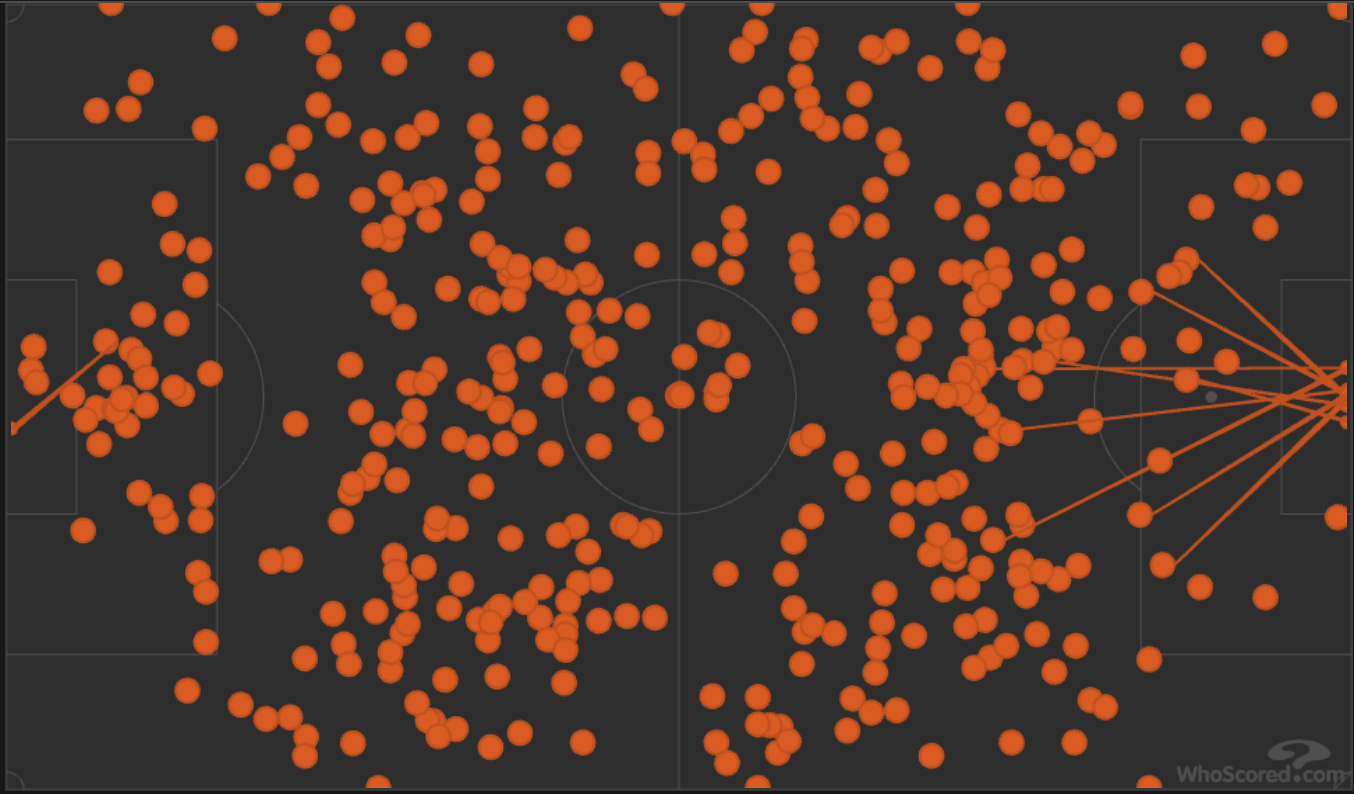
Corey Baird replaced Nick Hagglund at the break, giving FCC a more viable offensive option on the right wing in possession. DeAndre Yedlin, who tried to occupy more advanced space on the wing in the first half, dropped back, occupying the right side of FCC’s back three.
Baird’s technical ability allowed the Orange and Blue to operate closer to the sideline also for quicker interchanges between wide and more central spaces in the final third. Yedlin’s passing from deep also helped. Though he contributed little in Atlanta’s half in the first 45 minutes, Yedlin connected with both Baird and Luca Orellano from deeper, more central positions in the second half. FCC’s ball dominance in the second half meant Baird wasn’t tested all that much defensively, either.
Nwobodo was in better positions in the second half, too. In the first half, Nwobodo’s deep positioning in build up largely meant that even he received the ball from a centerback, he was usually facing Roman Celentano’s goal AND Atlanta’s mid-block was still cutting off passing lanes.
In the second half, FCC got the ball to Obi in situations where he was already facing Atlanta’s goal instead of having to play on the half-turn. Getting Nwobodo in those situations helped FCC switch the point of attack quicker, allowing a wingback to push the ball up the field while Atlanta’s defense had to recover.
When Brad Smith made his FCC debut for the last half hour, he capitalized on these moments. Having a naturally left-footed left wingback made a difference in providing width on that side, too.
Pavel Bucha benefitted from FCC’s breaking Atlanta’s mid-block, finding space in the final third. Though he had a season low 49 touches, Bucha made them count. He was successful in all five of his take-ons and led the team with seven shot-creating actions. Bucha was a constant threat around the opposing penalty area when FCC had the ball, something, if continued, will provide another variable to be accounted for by opposing defenses.
3. The Fun Case for Alvas Powell
Warning: largely vibes-based section incoming.
There’s really no other way to put it: Alvas Powell’s own goal in the 88th minute was a crushing moment. You can do just about everything over the course of 90 minutes and yet, one mistake will be the only thing anyone remembers. Unfortunately, such is life for a defender on a soccer field.
Powell’s first stint with the Orange and Blue in 2018 didn’t go great - but, hey, not much did that season. Since his return to the Queen City after the arrival of Chris Albright and Pat Noonan before the 2022 season, Powell has carved out a valuable role on the team.
Flexibility is a non-negotiable for most depth options on Major League Soccer rosters and Powell provides it at both wingback and centerback.
Less important to team success but still vitally, Powell is just fun to watch on the soccer field. Yes, I care about what happens on the field and why it does but I wouldn’t be doing this if soccer wasn’t fun to watch and for my money, Powell might be the most fun player to watch in Orange and Blue.
Orellano’s mazy, fearless dribbling and inclination to shoot from literally anywhere on the field makes him strong competition. Bucha’s silky control and understanding of space also puts him up there.
However, Powell’s willingness to, for lack of a better term, try stuff at any given moment elevates him to the top of my list. Make no mistake, some of those decisions are objectively not the right ones but more often than not, Powell makes them work. I don’t have data to substantiate this but I’m pretty sure he leads the league in both number of passes made with his chest and also the total distance those passes travel.
Someday, hopefully soon, one of Powell’s attempts at the spectacular will finally end up in the top corner of the opposing goal. Until then, some part of me hopes he keeps shooting even as another prepares to write, yet again, about FCC’s willingness to settle for bad shots.
really hard to tell if he actually got a foot to it but a good opportunity nonetheless. also shout out to whoever brought the Georgian flag in the south end of the stadium. ↩
see: Muyumba in the 23rd on Evander, Reilly in the 27th on Evander (though advantage was played), Reilly on Evander (again) in the 33rd, ↩


