
Monday Takeaways (3/17/25)
Digging into FC Cincinnati's need to create better chances, Miles Robinson's passing, and more

All stats from Fbref unless otherwise noted.
Another season, another not-so-great performance from FC Cincinnati on the road in Charlotte.
The Orange and Blue didn’t play badly outside of the five minute period when the home team scored both its goals. There’s not much more to say about the first than it was just a one-off mistake as Pavel Bucha headed the ball into no man’s land leading to a counter attack. As for the second goal, sometimes a guy, or in this case guy(s), just makes a play. Adilson Malanda hit an inch perfect, line breaking pass through FCC and Patrick Agyemang scored from a really tough angle into the side netting at Roman Celentano’s far post.
With the exception of those two moments, FCC’s defensive effort was probably good enough to keep the team in the game. Offensively, however, the Orange and Blue weren’t nearly good enough to win.
A quick look at the boxscore doesn’t look so bad. FCC’s 17 shots with 7 on target seems like a promising offensive performance. However, this wasn’t just a case of “ball just didn’t go in goal” for FCC. The Orange and Blue struggled to create good shooting opportunities against Charlotte.
1. Better Shots
At times on Saturday, FCC’s attacking play in the final third was reminiscent of last season: too slow and too static to really threaten a set defense.
In his postgame press conference, manager Pat Noonan said, “We need better runs in the box to open up different spaces. We need better crosses, more dangerous crosses. I think we did a good job of finding some shot creation from around the top of the box where, you know, it’s about hitting corners. And you know, a lot of I think those moments were right in the hands of [Kristijan] Kalina. So I felt like there was a lot of promising attacks, but like I said, they defend the box well, and we just didn’t have enough accuracy on a lot of things we did closer to goal.”
The lack of movement meant the Orange and Blue largely settled for low percentage shots. Only Yuya Kubo’s 62nd minute effort had an expected goals (xG) value higher than 0.08 per Fbref data.1 Across the game, FCC’s shots came from an average distance of 26.1 yards from Kristijan Kalina’s goal.2 Even if Kalina, MLS’ reigning Goalkeeper of the Year, wasn’t in goal, shooting from that far out is not a recipe for success.
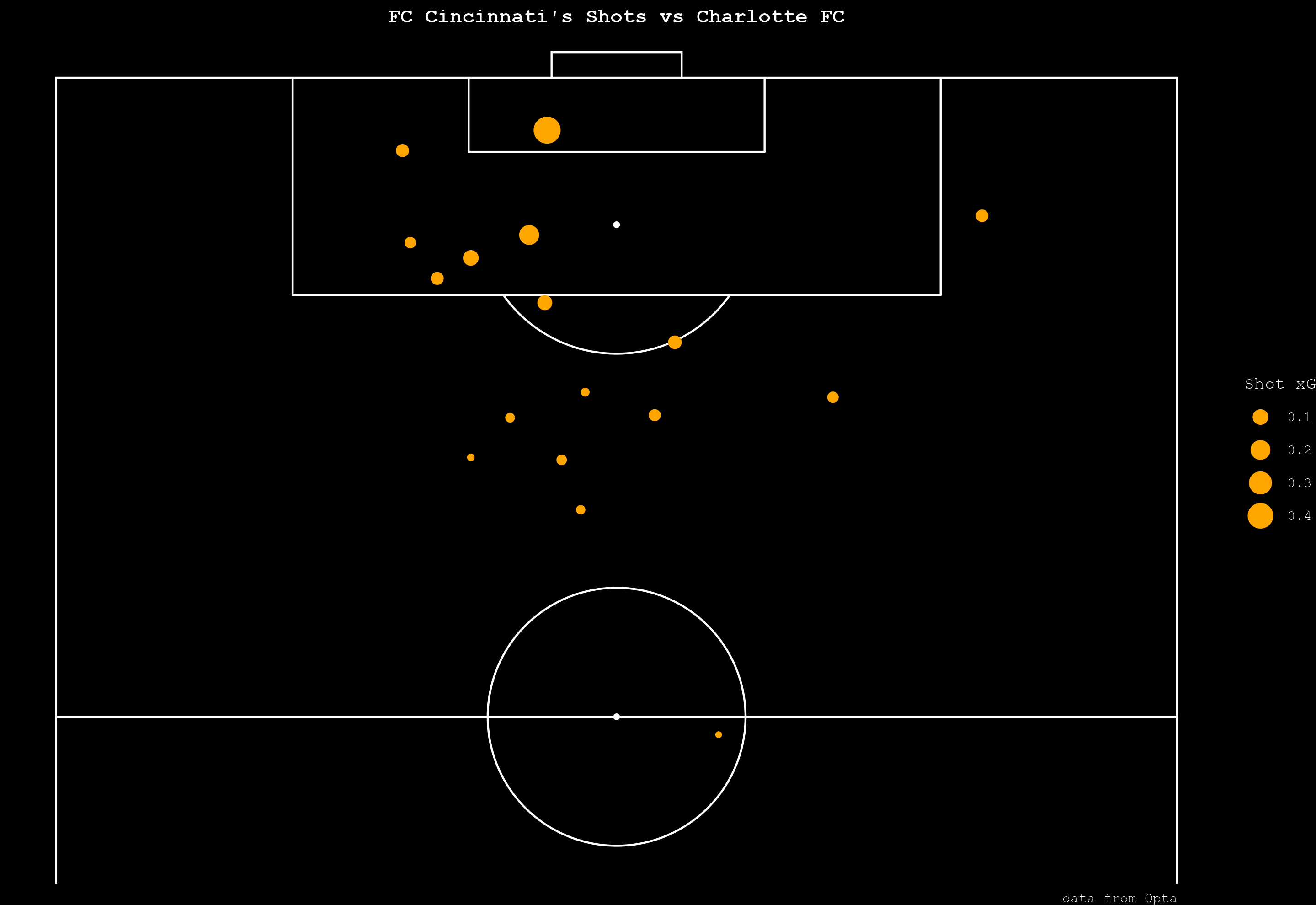
Unlike against Philadelphia, the issue wasn’t that the Orange and Blue couldn’t move the ball up the field. Instead, on Saturday, FCC just didn’t have a lot of answers for how to turn final third possession into something more dangerous.
There’s no reason to panic. FCC’s front three are still figuring out how to play together. There were some promising sequences that didn’t lead to a shot. However, for FCC to have the season many expected in 2025, the team is going to have to start getting into better shooting positions.
2. Missing Miles’ Passing
Charlotte rarely looked to press FCC’s centerbacks, instead seeming to dare them to move the ball forward themselves. In the first third of the game, the Orange and Blue were able to do just that and build up through Charlotte’s defensive structure in no small part due to Miles Robinson’s passing.
However, when he exited the game in the 30th minute, the Orange and Blue looked lost. Neither Gilberto Flores nor Teenage Hadebe could replicate Robinson’s passing range and FCC’s hold on the game suffered. A couple times in the first 30 minutes, Robinson took advantage of a gap in Charlotte’s midfield and found Kévin Denkey’s feet, putting the Orange and Blue in position to attack in semi-transition. After Robinson’s departure, build up from FCC’s centerbacks slowed down.
After the game, Noonan said, “And Teenage came in and did some good things, struggled in some ways where we were trying to, I think, create too much from our center back position with direct play, and just needed to play simple to move us up the field.”
With two centerbacks generally unwilling to try break lines on the ground and really only one option at the base of midfield comfortable enough to receive the ball facing Celentano’s goal and turn up the field, FCC stagnated. Denkey had to drop deeper and deeper to find the ball. He finished the game with 34 touches but 21 of them came in the middle third of the field, which is not exactly the ratio you’re looking for from a striker.
Finding ways to consistently link play from defense to attack will be a challenge all year for Noonan. Robinson’s passing range makes things easier but there needs to be a secondary option.
3. Wide Right
The shift from a three centerback setup to a two centerback shape means a different role for FCC’s outside defenders. As I wrote about a few weeks ago, with three centerbacks, the Orange and Blue look to build up in either a 3-2-5 or 3-3-4 setup, largely dependent on Evander dropping into the middle line.
In the 4-2-3-1 starting shape deployed on Saturday, FCC still looked to build with a three defenders in a line with two or three midfielders ahead. This kind of setup has become ubiquitous in modern soccer because it creates passing options to attempt to break opposing pressure while also providing defensive solidity in case of a turnover and counter attack.
Without a third centerback, an outside back had to remain in line with FCC’s central defenders to form that defensive band of three. More often than not, that responsibility fell to right back DeAndre Yedlin, as can be seen in his touch map from Saturday.
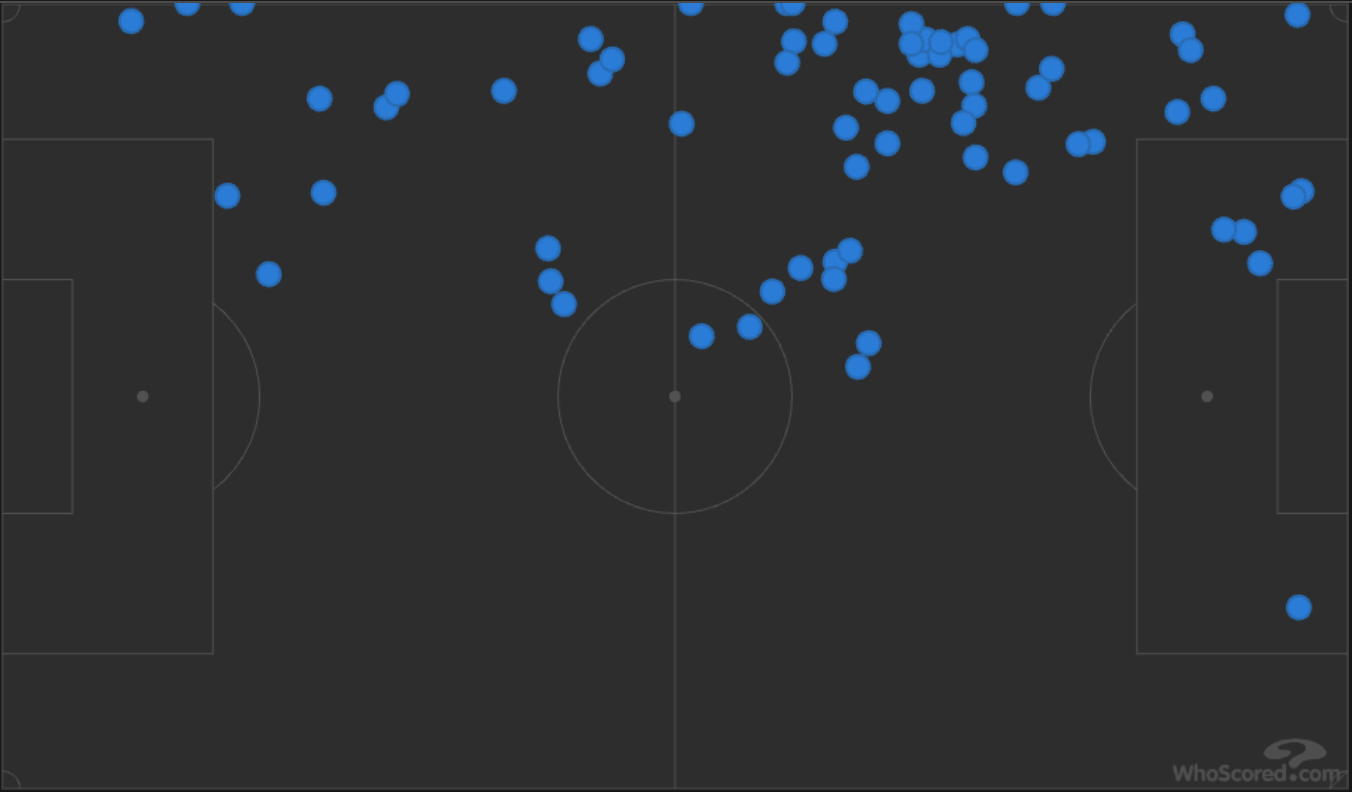
With another attacker on the field, there ideally shouldn’t be much of an issue. The width Yedlin offered when pushed up on the right should be provided by the winger on that side. However, when that nominal winger is Luca Orellano, there can be issues.
Orellano’s desire to impact the game from a central position meant he didn’t provide a consistent option to stretch the field horizontally in favor of cutting inside on his favored left foot. Lukas Engel looked dangerous at times on the left, offering an option to cross the ball but Yedlin’s expanded defensive responsibilities meant a similar option was largely absent on the right.
When Matt Miazga finally returns to the field, FCC’s best option still seems likely to be a starting eleven with three starting centerbacks. That lineup should be better balanced in terms of horizontal spacing but if Noonan is going to continue to rely on a four-person backline as a secondary option, figuring out how to better balance it seems like a priority.


