
Looking Back: What Happened (Without the Ball)?
Part II in a retrospective series on FC Cincinnati's 2025 season

All stats courtesy of Fbref unless otherwise noted.
ICYMI:
Quick refresher: FC Cincinnati outperformed its underlying numbers - and the eye test - en route to a second place finish in the Supporter’s Shield. This week, let’s dig deeper into what happened on the field, what went right, but mostly what went wrong, for FCC when it didn’t have the ball.
As with every aspect of a review of FCC in 2025, reckoning with the team’s defensive record is a question of end results or process because the latter paints a much more worrying picture looking ahead than the former. That’s simply illustrated by the Orange and Blue’s efforts preventing goals.
- Outcome: FCC’s opponents scored 40 goals in 2025, the fifth fewest in the league, an improvement from 2024 when FCC conceded 48 goals.
- Process: FCC’s opponents created lots more scoring opportunities than were reflected in the end of season goal tally.
Here are some data points about how big of an overperformance 2025 was defensively.
Regression In Everything But Goals
Expected goals (xG) isn’t a perfect statistic but over the course of the season it’s a good measure of the quality of chances a team creates. It’s predictive in MLS but it’s also descriptive of a team’s season. Opponents created 56.76 expected goals against the Orange and Blue in 2025 compared to 41.17 xG in 2024 per American Soccer Analysis data, yet somehow scored fewer goals. FCC’s defensive overperformance was the biggest in the league last season.
Looking at Cata Bush’s awesome visualizer at American Soccer Analysis, other ASA data, and Fbref, FCC was worse defensively in 2025 than in 2024 in some key defensive categories:
- Shots Allowed: 21st in 2025 (13.59 per game), 7th in 2024 (12.03 per game)
- xGA/96: 21st in 2025 (1.67 xGA), 2nd in 2024 (1.21 xGA)
- Offensive G+ Allowed/96: 1st in 2024 (0.986 G+/96), 23rd in 2025 (1.458 G+/96)
There’s a pretty straightforward explanation for why the Orange and Blue were more vulnerable defensively: the opposition maintained possession in dangerous parts of the field more often.
- Final Third Touches Allowed: 158.7 per 90 in 2025, 128.1 per 90 in 2024
- Penalty Area Touches Allowed: 23.5 per 90 in 2025, 18.0 per 90 in 2024
- Opponent Danger Zone Touches: 26th in 2024 (17.2 per 96), 10th in 2025 (22.2 touches per 96)
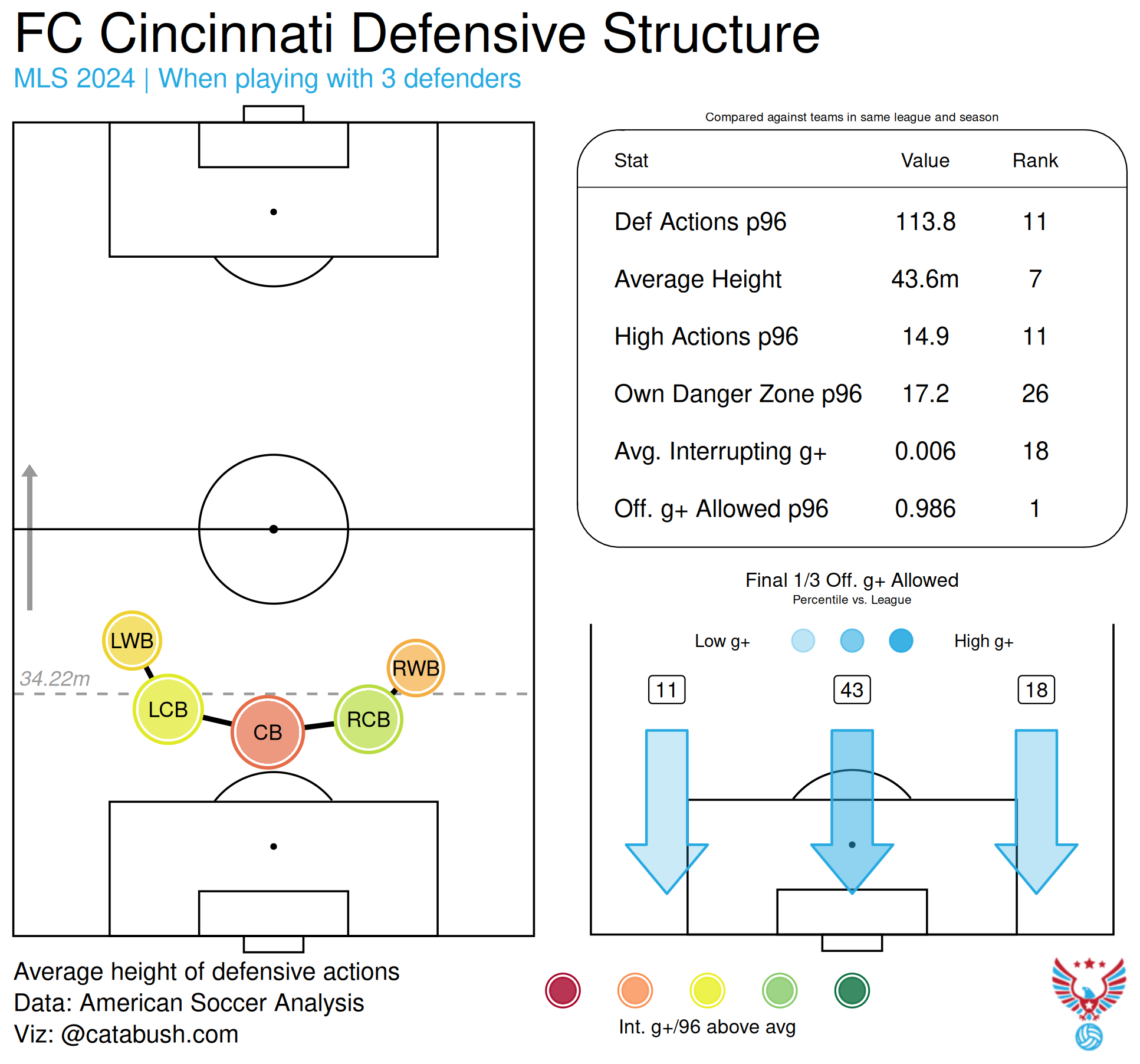
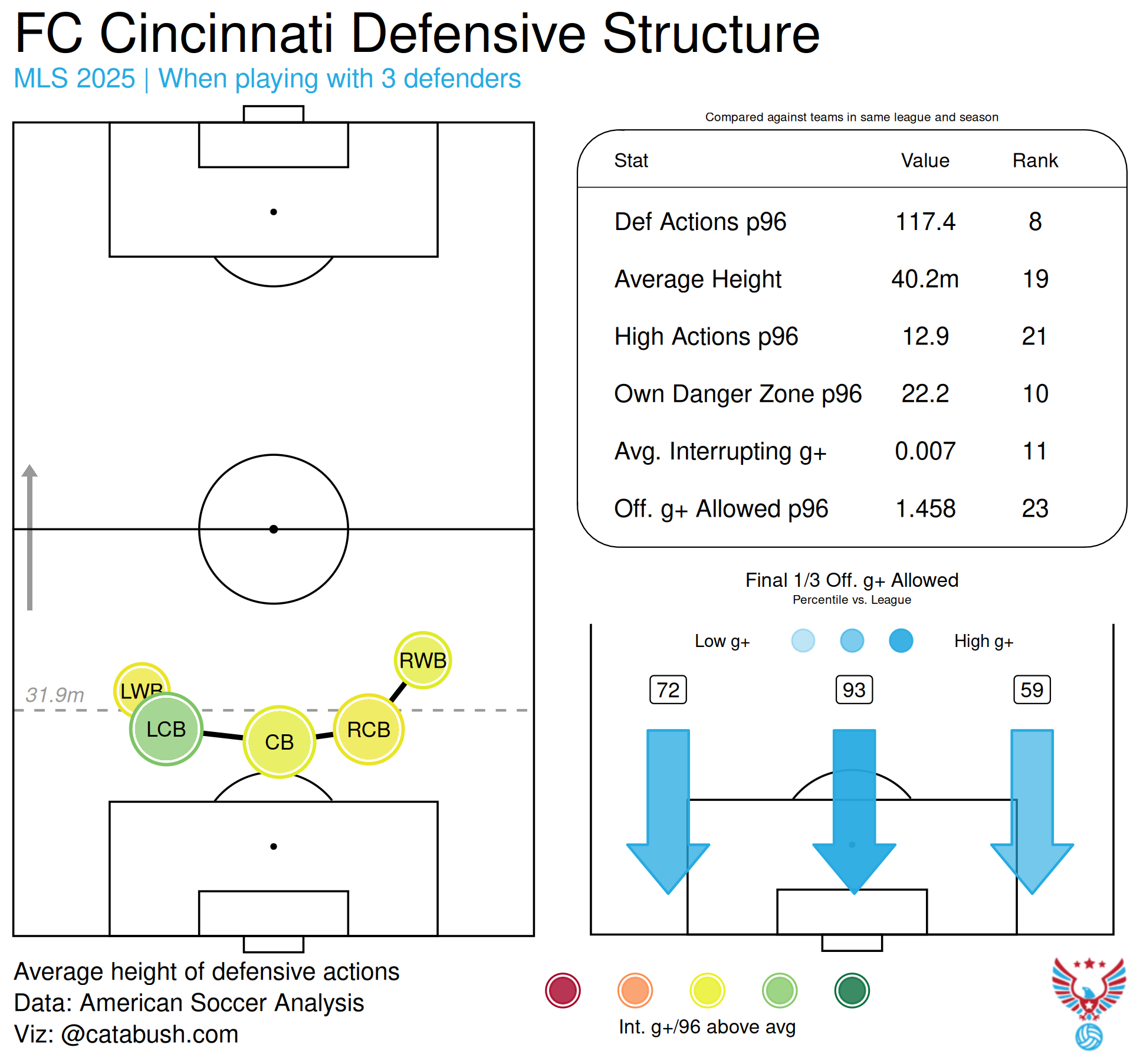
The Orange and Blue’s defenders went from not to do much defending in 2024 to having to do a lot of defending in 2025. When it comes to G+’s Interrupting metric, the best defenders aren’t always the ones with the highest number, it’s more of an indicator of opportunity. That’s evident at the bottom of the 2024 and 2025 visualizations. Defenders who have to do a lot of defending don’t usually play on the best defensive teams.
Where on the field matters, too. FCC conceded some of the most dangerous possession through the middle of the field, the worst place to allow that, in addition to allowing more than an average amount of danger on the wings in 2025.
There’s also some evidence that FCC’s press was less effective in 2025, which also matches the eye test.
- Average Height of Defensive Actions: 19th highest in 2025 (40.2m from goal), 7th highest in 2024 (43.6m from goal)
- High Actions: 21st in 2025 (12.9 per 96), 11th in 2024 (14.9 per 96 minutes)
The Orange and Blue defended closer to its goal and did fewer defensive actions higher up the field in 2025 than in 2024. Winning the ball less higher up the field meant fewer attacking opportunities in attacking positions.
And yet, the Orange and Blue somehow allowed fewer goals in 2025 than in 2024. Much of last season felt unsustainable as a regular watcher and the advanced numbers agree.
The TLDR of this is pretty simple: FCC got away with allowing its opponents too many opportunities in the most dangerous areas of the field. It might have worked out in 2025 but there’s little evidence to suggest that the defensive structure of the team at this point is on solid footing without offseason changes.
A Bright Spot: Shot Stopping
There’s one bright spot in FCC’s defensive performance in 2025: its goalkeepers’ shot stopping. Buoyed by solid shot stopping from Roman Celentano (and Evan Louro), FCC was able to mitigate some of opponents’ newfound attacking menace. The Orange and Blue’s keepers combined to save 4.7 post-shot expected goals more than they faced, good for 7th in the league.
Celentano’s shot stopping has improved every season in MLS and 2025 marked a career best 0.11 PSxG +/- per 90 minutes. Louro’s 0.38 PSxG +/- per 90 minutes over four starts was even better but on its own, Celentano’s shot stopping still would’ve been a top ten mark in the league.
Celentano and Louro’s shot stopping is reasonable explanation for a part of the Orange and Blue’s defensive overperformance. Good shot stopping can continue year-over-year, so if there’s one thing to be positive about heading into 2026, it’s the ability of FCC’s goalkeepers to keep the ball out of the net more effectively than some of their peers around MLS.
What’s Next
Soccer is a complicated game. Teams can defend with the ball, keeping it away from the opposition because, if the other team doesn’t have the ball, they’re not going to score very many goals. Or they can cede possession, drawing their opposition forward and attack in the vacated space. And lots of options in between. One of the reasons why the sport is great and interesting is exactly because there are so many ways to try to win. Whatever FCC set out to do to prevent its opponents from generating good chances didn’t work very well in 2025.
The Orange and Blue’s regression in limiting opponents’ chances can’t be overlooked. But that defensive record can’t easily be separated from what happened when the Orange and Blue had the ball. Throughout the season, consistent issues in possession put the team under pressure, asking more of the defense than in previous seasons.
So next week, I’ll try to understand what went wrong (and right) for FCC in possession. Prepare yourself for plenty of discussion of dribbly bois, ball progression, and what happens when the ball stops going in from distance. And then, looking ahead to 2026 begins in earnest.


