
Looking Back: What Happened (Generally)?
Part one of a series looking back at what went right, and wrong, for FC Cincinnati in 2025

All statistics courtesy of Fbref unless otherwise noted.
It’s been a while. Sorry about that. But I’m back in your inbox (or however you’re reading this) as I hope to be regularly over what’s shaping up to be an interesting, and important, offseason for FC Cincinnati.
Summarizing FCC’s 2025 season is not an easy thing. On one hand, the team finished second in the Supporter’s Shield, tying Philadelphia for most wins in the league with 20. And yes, despite a humbling exit from the playoffs at the hands of Inter Miami, the Orange and Blue exorcised past playoff demons in cathartic series win over the Columbus Crew in the first round. So the team must’ve been pretty good, right?
Maybe not? The story told by the final table and losing to the favorites to lift MLS Cup doesn’t match up with the performances I saw on the field or the team’s advanced numbers. We seemingly waited all season for something to click…and it just didn’t. The team improved after the summer transfer window, with Brenner and Ender Echenique providing attacking boosts, but FCC never really dominated games like you’d expect a team in contention for the Shield to dominate.
So this is the first in a series of postmortems about what went wrong (and right but there’s less of that) for the Orange and Blue in 2025. Despite the results, FCC didn’t really play like a good team in 2025; rather, it was lucky one. Deeper questions about roster construction and tactical approach need to be answered if the Orange and Blue are to go from paper lion 2025 to real one in 2026.
A Step Back
The 2025 season was FCC’s worst under Chris Albright and Pat Noonan in terms of the team’s expected goal difference. Yes, I know the game isn’t played on a spreadsheet but I think the eye test agrees. We’re not talking about a return to the Orange and Blue’s truly dire first few seasons in Major League Soccer but the team’s xGD in 2025 ranked 22nd in the league per American Soccer Analysis data. Expected goals remain the best predictor of future success in MLS1 and FCC allowed more than it created last season, and the disparity was a major step back from the first three seasons under Albright and Noonan.
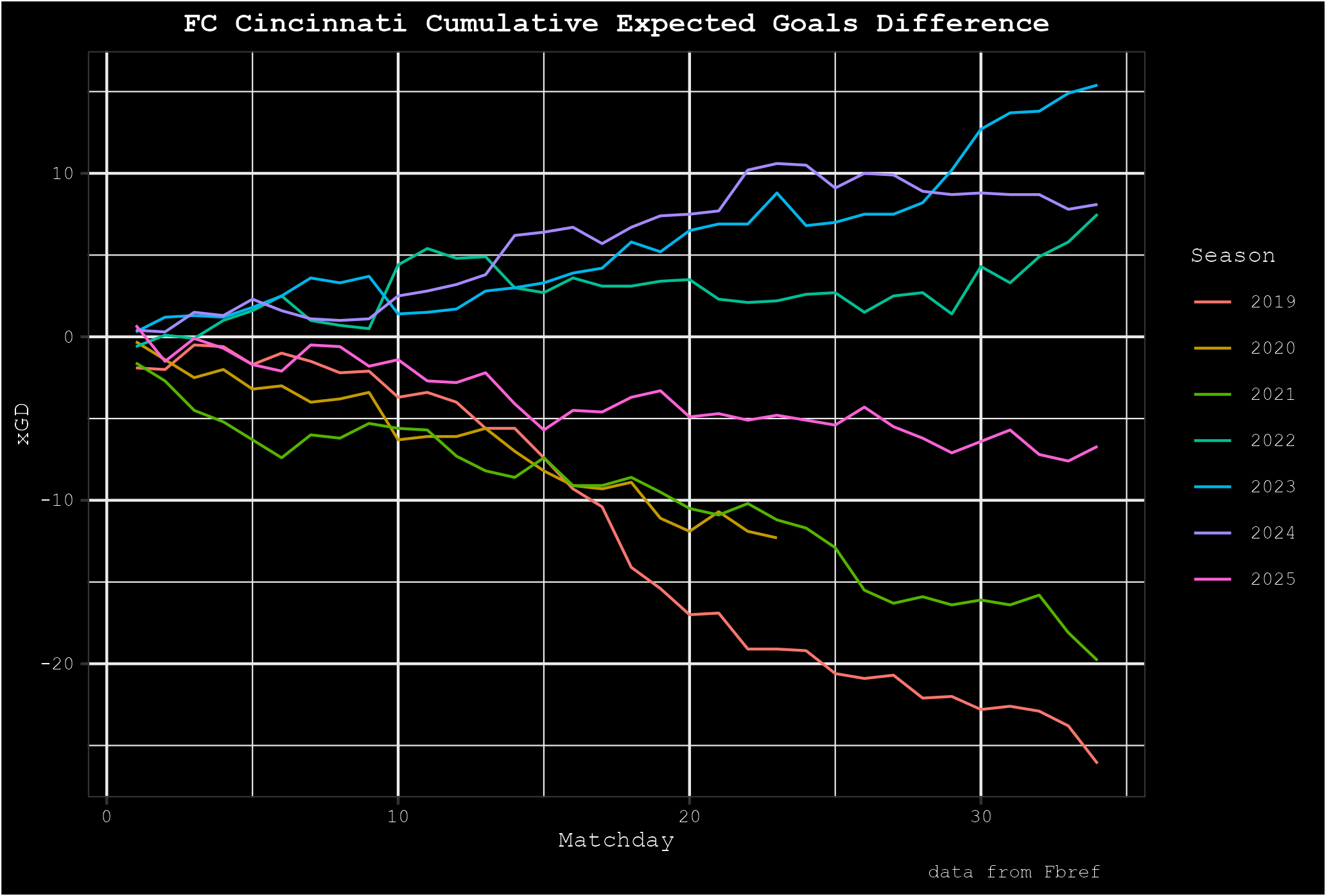
Very little of the Orange and Blue’s season-long success felt sustainable other than the fact that the team just kept winning. To loyal Orange and Blue watchers, after how many games did you think, “they were lucky to get away with the win there but a win’s a win”? Those victories were built on nights when the Orange and Blue capitalized on one its few chances but the opposition didn’t on its many more chances, or maybe when one of Evander’s long-range attempts went in and Roman Celentano’s shot-stopping or a last second block from a defender denied an equalizer. That is to say, a lot of coin flips kept coming up FCC’s way.
The top-end attacking talent was there but still FCC struggled to create consistently dangerous chances going forward while allowing too many high-quality chances to its opponents. Untangling attack and defense on a soccer field is hard to do, with attacking limitations feeding into defensive vulnerabilities and vice versa but whatever the Orange and Blue did, it didn’t really work.
Turns Out, FCC Wasn’t Built Different
Good teams find ways to win games when they’re not at their best. In 2025, with few exceptions, FCC was in that position pretty much every week. That’s not the norm for good teams. The Orange and Blue cobbled together a frankly astounding number of narrow wins in 2025 (18 of its 22 wins in the regular season and playoffs). In those 22 wins, FCC created more xG than it conceded in 14 games and put up more than one expected goal more than its opponents just twice all season.
When looking at game state, FCC’s issues are even clearer. For the bulk of the season, the Orange and Blue created slightly better opportunities than its opposition when the score was tied but opponents had the advantage when FCC was both leading and trailing.
As of September 28, the Orange and Blue were the worst team in MLS in terms of expected goal differential when trailing, with a xGD of -0.69 per 90 minutes. We saw those issues manifest in the playoffs, as one goal deficits turned into routs in game two against Columbus and in the conference semifinal against Miami.
When ahead, the team struggled to defend its advantage, with a -0.26 xGD per 90 minutes. FCC was able to hold on more than times than not but there were real moments of vulnerability across the season when the team looked to sit deep and protect a lead.
Ultimately, FCC wasn’t somehow built different and it hadn’t figured out the one weird secret to winning close games. Evander stopped scoring at an all-time clip from outside of the box, and though the aforementioned summer additions breathed some life into the attack, the offense was never better than just fine and the defense wasn’t better than below average.
Again, being able to ways to win games when you aren’t playing well is something good teams have to do across seasons to win silverware. But if that’s the only thing you do, your margins of winning are much, much smaller. Faced with a higher level of competition in the playoffs, FCC just couldn’t hang. Though the team ended up three wins away from lifting MLS Cup, hoping the same amount of luck will go FCC’s way in 2026 is a viable approach to next season. The results were there for the Orange and Blue in 2025 but a repeatable process for future success was not.
Next Up
In the coming weeks, I’ll be digging deep, trying to figure out why the Orange and Blue struggled in 2025 on both sides of the ball and then, in later installments, float some ideas on how to get things back on track in 2026. Stay tuned.
Though not to the same degree as in Europe, it’s still the best predictor we’ve got. ↩


