
Is there more to come from Roman Celentano?
Assessing FC Cincinnati's shot stopper going into 2025

All data from Fbref unless otherwise noted
Roman Celentano’s tenure in Cincinnati is nearly impossible to separate from Chris Albright and Pat Noonan’s. Albright made Celentano his first SuperDraft pick, #2 overall in 2022. Thrust into goal after an injury to Alec Kann in April 2022, Celentano never relinquished the starting spot. Heading into 2025, Celentano has played more than 9,000 Major League Soccer minutes in goal for FC Cincinnati and has established himself as the franchise’s best ever goalkeeper.
That doesn’t mean he’s an elite goalkeeper. He’s capable of the spectacular but mostly provides a consistent level of play in goal that isn’t much different than many of his peers around the league. Vitally for the Orange and Blue’s recent success, Celentano has proven to be a huge step up from his shot stopping predecessors.
As FCC prepare for the 2025 season, it’s worth considering what Celentano brings to the table.
Keeping the ball out of the net
The most important aspect of goalkeeping is pretty simple and straightforward: keeping the ball out of the goal. Sure, there are other considerations to weigh when analyzing goalkeepers but the ability to stop shots is paramount.
Through his first three seasons in Orange and Blue, Celentano has been a fine shot stopper according to both American Soccer Analysis’ post-shot expected goals model as well as Opta’s on Fbref. He hasn’t been elite but he also certainly has not been bad.
A quick post-shot expected goals (PSxG) detour: As its name indicates, PSxG is a post-shot model that utilizes additional data points to assess the quality of shots. Where xG models use all shots, a PSxG model only includes on-target shots and factors in the location where a shot ended up on goal.1
Going a step further, looking at goals divided by post-shot expected goals (G/PSxG) can be a useful way to understand shot stopping. Simply put, if a goalkeeper is allowing less than one G/PSxG, they are preventing more goals than would be expected, a G/PSxG higher than one, the opposite. This measure isn’t the be-all and end-all but it can be a useful way to compare players, so long as there’s some minimum threshold of minutes played.
Goalkeepers who played at least 3,000 minutes between 2018 and 2024 in MLS had an average G/PSxG of 1.018. Celentano’s 1.03 G/PSxG is a little bit worse than that average but the average is driven down by some otherworldly seasons by Matt Turner, Đorđe Petrović, and Andre Blake while excluding minutes from keepers who were worse than average but still played substantial, but not enough, minutes. Opta data on FBref has a higher view of Celentano’s 2024 but still ranks him as the 15th best shot stopper in the league based on PSxG.
G/PSxG gives us a view into how Celentano has played but as a forward looking metric, like so many things in soccer, it’s lacking because goalkeepers just don’t face enough shots to give us confidence. According an American Soccer Analysis piece on shot stopping, Celentano’s 382 shots faced would be enough to determine his quality if he was a performing as a 99th percentile shot stopper. Because he hasn’t been at that level, statistically determining how much above average, if at all, Celentano is will take a lot more shots faced. This is a long way of saying that we don’t really know how good of a shot stopper Celentano is yet.
There should still be hope that Celentano can continue to improve at keeping the ball out of his goal. He’s just 24-years-old playing a position where the age curve is significantly gentler than others. It’s certainly possible that Celentano hasn’t reached his peak and that the best is yet to come but the error bars around any prediction of future shot stopping should be pretty wide.
Changing Passing Profile
Though shot stopping is the biggest component of goalkeeping, it isn’t the only one. As the Orange and Blue’s shifted to playing more in possession in 2024, Celentano’s role as a passer changed significantly.
In 2022 and 2023, Celentano “launched” passes (a pass attempt traveling more than 40 yards) more than 50% of the time in 2022 and more than 40% of the time in 2023. On goal kicks those numbers were even higher, 70% in 2022 and 50% in 2023. In 2024 however, Celentano went long with just about 28% of his passes and 32% of goal kicks, a substantial reduction. At the same time, Celentano was asked to play significantly more passes, 662, than in 2022 or 2023.
Though his pass completion numbers are impressive2, Celentano didn’t really provide a consistent option to break opposition pressure in FCC’s defensive half. Throughout the season, Celentano struggled to connect on chipped diagonal passes to open wingbacks near the sideline when centerback and midfield options were covered. Considering that the Orange and Blue’s ball progression plan heavily relied on wingbacks carrying or passing the ball forward, those misses hurt considerably.
Through the middle of the field, Celentano’s passing range, when paired with Obi Nwobodo’s lack of ball progression and seeming discomfort receiving the ball with his back to the opponents’ goal in central midfield, limited the Orange and Blue’s options to break pressure. Playing with just two central midfielders also limited available options and Celentano seemed wary to put the ball in harm’s way in the middle of the field.
Realistically no goalkeeper in MLS is going to be Ederson (or personal favorite Aro Muric) with the ball at his feet. However, if FCC continue to emphasize building out of the back, Celentano will have to be at least a little more comfortable connecting line-breaking passes up the field. FCC demonstrated an ability to play through pressure, mostly through its centerbacks, but the languid pace of doing so allowed opponents to recover their defensive shape at the other end of the field after pressure was broken.
Could there be play-style changes coming in 2025 that put Celentano in better positions to succeed with the ball at his feet? Kévin Denkey could provide a more solid option to play long to and that’s not even mentioning a potential total overhaul coming if Lucho Acosta isn’t on the roster. Early in the season, it will be worth watching to see if Noonan looks to take some things off Celentano’s plate in possession to emphasize his strengths rather than exacerbating his weaknesses.
Good Enough?
The Supporters’ Shield is evidence enough that Celentano is good enough to be a starting goalkeeper on a championship winning team. However, no assessment of a player is complete without a larger discussion within the context of the salary cap - and Celentano’s role in the roster build has changed considerably since he entered the league.
In 2022, Celentano joined FCC on a Generation Adidas (GA) contract following the SuperDraft. With that designation, Celentano represented huge surplus value because his contract didn’t count against the cap and he occupied a supplemental roster spot. FCC was able to get solid goalkeeper play essentially for free from a team building perspective.
However, in 2023, Celentano signed a contract extension meaning his new salary would count against the cap and he would have to occupy a senior roster spot, two obviously limited resources that must be carefully balanced in building a successful roster.
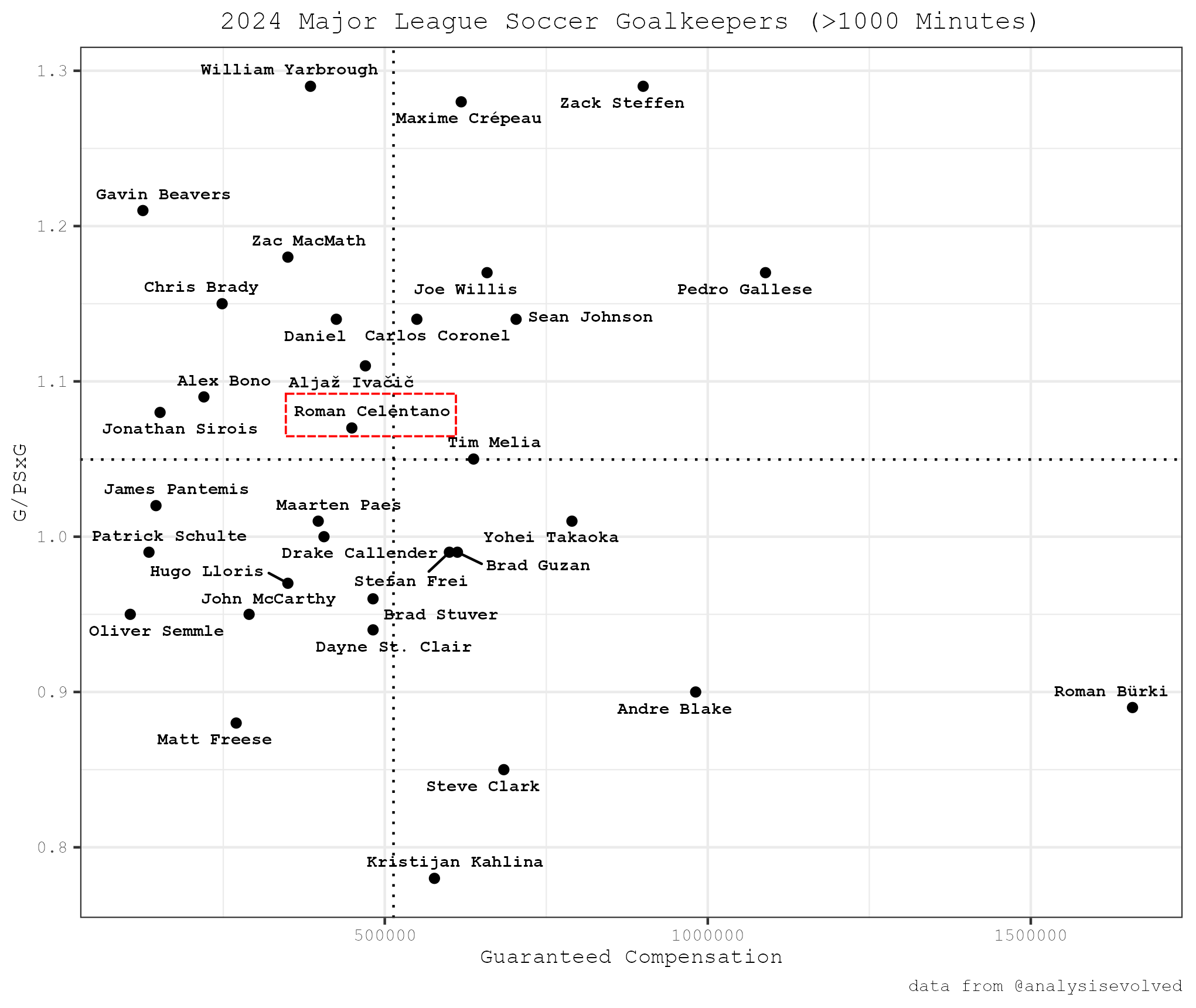
Even when factoring in his cap impact, Celentano remains a fine enough option in goal. Though the Philadelphia Union and St. Louis CITY SC got better shot-stopping from Andre Blake and Roman Bürki respectively in 2024, those teams pay a significant tradeoff in the form of higher salaries, limiting options to address other roster issues.
Though a Kristijan Kahlina-esque 2024 season seems unlikely for Celentano, a return to his 2023 shot-stopping would place him firmly in the lower left quadrant of the above graphic giving FCC above average production on a below average cap hit. The level of play we’ve seen from Celentano previously certainly worked out for LA Galaxy in 2024 with John McCarthy en route to winning MLS Cup.
Trying to understand the tradeoffs that MLS front offices have to make is something that makes this league so interesting to me. As Albright and the rest of the front office work to fill out the roster, goalkeeper isn’t a need. Celentano might not be the best keeper in the league across a full season but he should be good enough to win with.
Anunga Arrives
The Orange and Blue announced the signing of midfielder Tah Brian Anunga earlier in the week. My first reaction is that he’ll be a perfectly adequate backup for Nwobodo in midfield.
Look out for a post about new signings, re-signings, and any other departures in one big update later in the month. Unless of course there’s some sort of closure on the Lucho situtation, one way or the other, which will merit a dedicated post (or five).
Something Interesting I Read This Week About Soccer (Or Not)
- Paul Harvey’s awesome look at trying to measure team cohesion at American Soccer Analysis. It’s a really cool idea and execution of it and it leaves a lot to think about in terms of team building and squad management.
- Mark Carey in The Athletic about the importance of attacking runs stretching opposing defenses. In a FCC context, this could be a major area of improvement in 2025 with the arrival of Denkey.


