
Half-Way: Orange and Blue Glasses
A midseason review of FC Cincinnati's 2025 so far

All stats courtesy of Fbref unless otherwise noted.
Halfway through the 2025 Major League Soccer season, FC Cincinnati sits second in the Eastern Conference and fourth in the Supporters’ Shield with 30 points. That doesn’t sound like there’s much cause for concern, right? Well…
After rough performances against DC United, FC Dallas, and Atlanta United recently, all might not be well with the Orange and Blue. Unfortunately those games weren’t just blips - FCC has rarely been the better team on the field in 2025.
So, after a needed weekend off, let’s take a step back and assess what went right and more importantly what went wrong for FCC in the first 17 games of the season.
The Elephant in the Room
Let’s not waste any time: is FCC actually a good team? The points on the board would answer that with an unequivocal yes. However, anyone who has watched the team with any regularity or dug into the advanced numbers, would likely agree that FCC hasn’t been nearly as good as its record.
The Orange and Blue’s 2025 campaign features the worst underlying numbers - by far - during Pat Noonan’s time in charge in the West End. We’re not nearly at the level of previous FCC teams but the contrast is pretty stark between Noonan’s first three seasons in charge and this one.
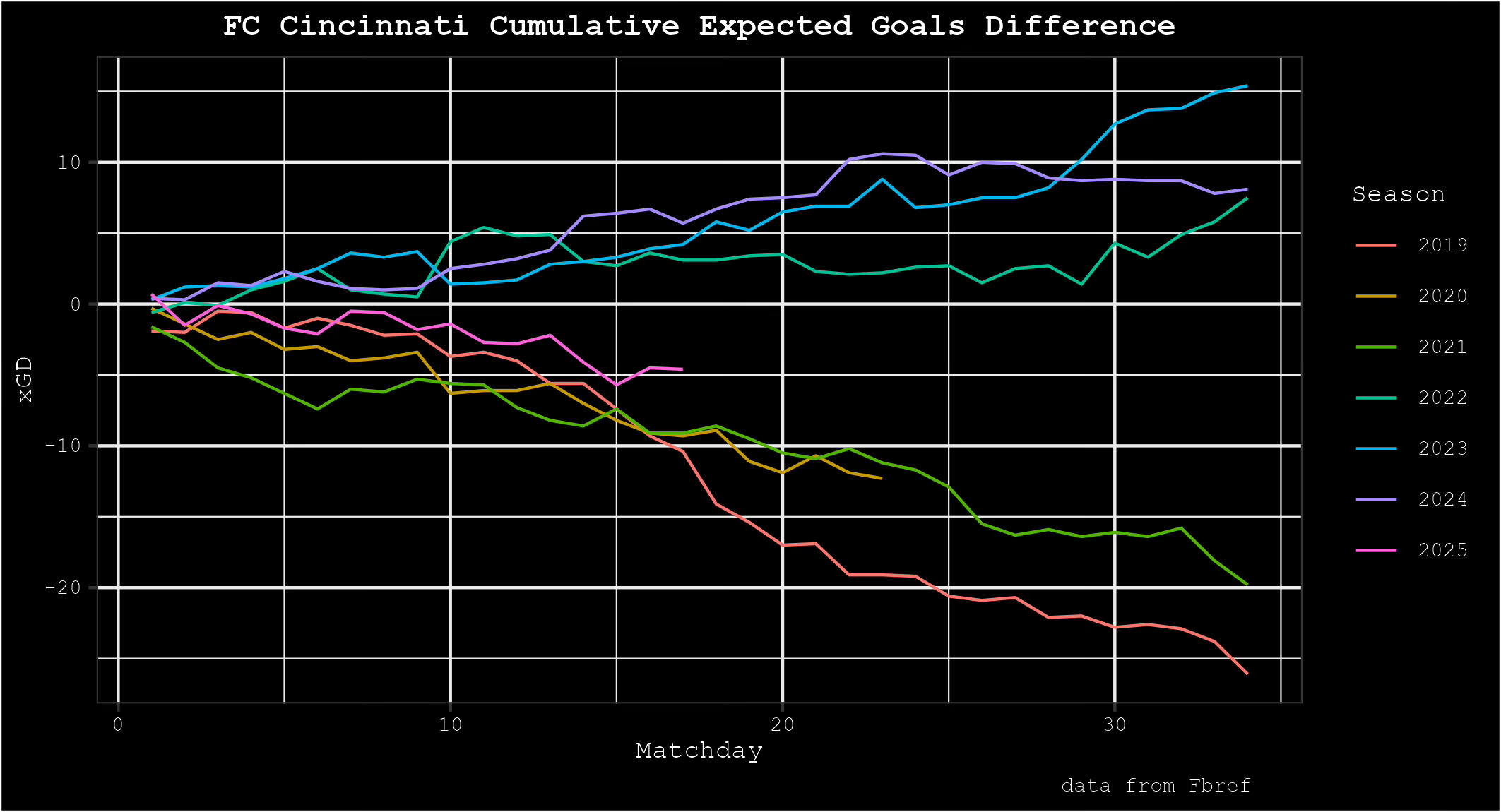
Unfortunately for the Orange and Blue, we’re past the time where expected goals difference (xGD) is no longer just a descriptive statistic. We have enough of a sample size where it’s predictive of future performance, too.
If xG isn’t your thing, I’d argue the eye test matches up with the advanced statistics, too. Throughout the season, FCC has struggled to great chances going forward while allowing its opposition great opportunities on a regular basis. Winning games when not being the better team is something good teams can, and need, to do. But when that becomes a hallmark of nearly every win, alarm bells should be ringing.
So what’s gone wrong?
Defensive Issues
Given the amount of money spent on attacking talent in the offseason, an offense that hasn’t lived up to expectations draws most of the attention in any analysis of FCC. However, the bigger problem is on the other side of the ball.
According to American Soccer Analysis data, the Orange and Blue conceded 1.75 expected goals against (xGA) per 90 minutes, fifth most in MLS. For a team that relied on a stout defense last season, co-leading MLS in xGA, this season has been a huge step back.
Catalina Bush’s extremely useful shot-map tool illustrates FCC’s defensive struggles. So far in 2025, FCC conceded nearly double the Great xG shots (11.6%) compared to the league average of 6%.
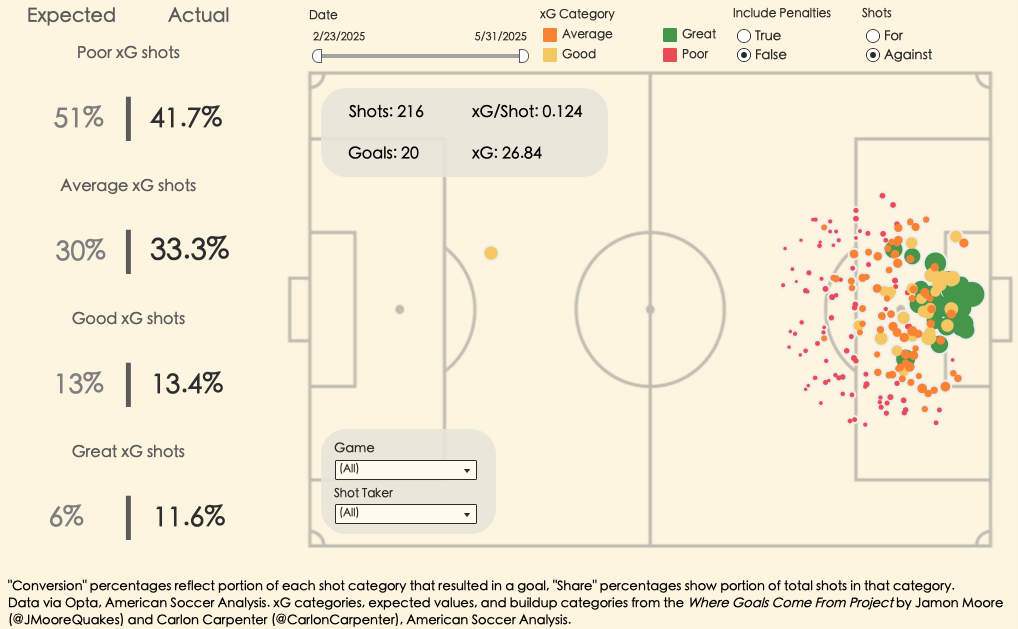
It could be worse, too. Roman Celentano’s plus shot-stopping has papered over some defensive cracks in the first half of the season but, given Celentano’s previous seasons, banking on that to continue is no sure bet.
Why FCC is conceding so much more danger than last season is trickier to answer. One explanation is relatively straightforward and should be the easiest to correct: set pieces. So far in 2025, FCC has conceded five goals (on 5.72 xG) from 48 shots on non-penalty set pieces. However, disentangling how much a stagnant offense leads to better chances for the opposition isn’t an easy thing to do.
The team is set up to be solid at the back with Noonan continuing to opt for three center back setups. Even so, the defense has been anything but solid. As with most pieces that aren’t quite clicking on the team, there are logical explanations: Matt Miazga’s return from injury, more recently Nick Hagglund’s injury, an unexpected, though out of his control, absence from Teenage Hadebe. We’ll see if everything comes together and FCC’s defense is able to recapture some of the heights from last season but at some point, a team is what it is.
Noonan’s defensive setup has had knock on effects going forward. Which is as good a jumping off point to talking about an attack that has been fine, which is to say not good enough.
Attacking Mediocrity
FCC hasn’t clicked in attack and plans for a front three featuring Kévin Denkey, Evander, and Luca Orellano failed to coalesce. Far too many possessions are ending with shots from distance as the Orange and Blue are unable to break down opponents’ defensive blocks. As evidenced by the team’s shot map, FCC has struggled to create great chances though the team has slightly underperformed its non-penalty xG on the season.
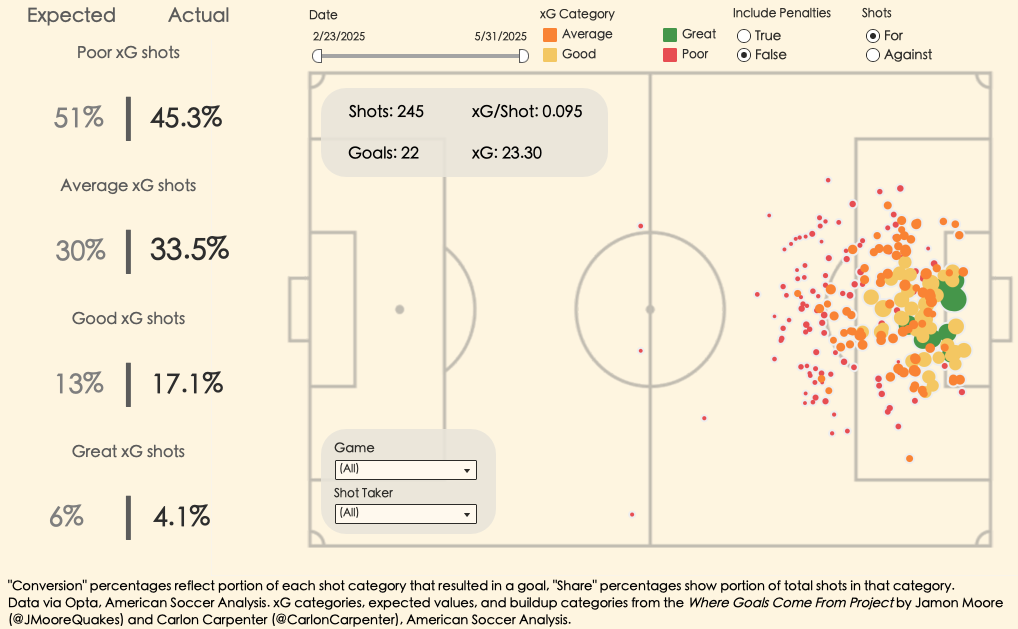
Though Evander and Denkey have combined for 17 goals, those goals have largely come from individual brilliance as opposed to repeatable patterns of attacking play. To my eye, part of that issue comes from the three center back lineup that is supposed to provide defensive solidity. The addition of a third center back means both wingbacks need to be attacking presences in the final third. So far, Lukas Engel and DeAndre Yedlin have struggled to have much of an impact in attacking roles, increasing pressure on the team’s pure attacking talent.
With the presence of Obi Nwobodo and Tah Brian Anunga, Pavel Bucha’s usual partners in midfield, FCC has been heavily reliant on four players in the final third to break down set defensive units. In those situations, the numbers are so heavily tilted towards defense it’s little surprise that the Orange and Blue have been underwhelming offensively.
Orellano’s move back to wingback should add a valuable threat - and in the couple of games he’s already played there he’s had moments - to FCC’s attacking play. However, as long as Noonan relies on three center backs with a purely defensive midfielder ahead of them, the Orange and Blue are likely to struggle to consistently create chances - at least in possession.
Coming Next:
What can FCC do about these issues? How can the Orange and Blue improve in the second half of the season?


