
Downstream Effects
It's time to talk about the self-imposed constraints from FC Cincinnati's three center back system.

The vibes surrounding FC Cincinnati are pretty bad right now. In Major League Soccer play, it's been a lackluster (to say the least) start to 2026, though probably not as bad as the results indicate. Crashing out of the CONCACAF Champions Cup, and in the way it happened at El Volcán, doesn't help matters. After an offseason hearing about a refresh, things don't look all that different than last year. So what's going on?
To answer that question, I think you have to go way back to the end of 2021. Chris Albright had just been appointed as the Orange and Blue’s General Manager and Pat Noonan installed as Manager. Both came from the Philadelphia Union, a consistently good team with a defined, though prone-to-rock-fights style. But FCC needed stability after a terrible first few seasons in MLS and Albright and Noonan raised the floor to a previously unimaginable level of competence almost immediately.
The first game of the 2022 season was a nightmare, losing 5-0 on the road in Austin. Out was the 4-4-2 diamond as Noonan switched to a three center back system seeking defensive solidity. Rónald Matarrita got hurt opening the door for Álvaro Barreal to go from depth piece to Best XI wing back. Lucho Acosta did Lucho Acosta things. The Orange and Blue started winning. It’s a little more complicated but that's the gist.
And 2022 wasn't a one off. The results speak for themselves over the intervening seasons. FCC won 70 regular season games between 2022 and 2025, a Supporters’ Shield, and had multiple deep runs in cup competitions and the MLS Cup playoffs.
But FCC hasn't really evolved. The team's recipe for future success seems to maintaining the same tactical and stylistic approach that produced the team's first MLS playoff win. It requires a different approach to roster building than most other teams in the league. Assembling a team to play like that requires very specific profiles at certain, key positions.
Last year's string of success in at best coin flips buoyed by Evander's hot steak from outside the box papered over a lot of cracks in how the Orange and Blue can play. But in 2026 we're faced with the possibility that chasing the successes of the early Albright/Noonan tenure might not be the best direction for the team moving forward.
Defensive Minded Constraints
So much of this starts with center backs. Going to three central defenders from two in 2022 proved to be a masterstroke by Noonan, turning a perennial Wooden Spoon contender into a genuine contender.
However, there are very real effects of playing that way. My friend Kieran, ironically in the post below talking about Toronto FC's lineup against FCC earlier in the season, gets to the tactical heart of the matter of why playing with three center backs can be so limiting.
The TLDR dumb version is 1 less player who is a + with the ball and 1 less player who can press high up the field, both which are virtually prerequisites at this point
— Kieran Doyle (@kierdoyle.bsky.social) 2026-03-08T23:29:04.822Z
It's simple math. An extra center back on the field means one fewer attacking option up the field. More of the burden of moving the ball up the field falls at the feet of the three center backs and the group, as currently assembled, is pretty unconvincing as passers. Add in a pure defensive midfielder like Obi Nwobodo or, at this point, Samuel Gidi, and that's 40% of FCC's outfield players who are basically zeroes in the attack. Even when the ball gets into the final third, there are fewer options to do something with it.
Then there's the cost. According to the MLSPA in 2025, three of FCC's top six earners were center backs: Miles Robinson, Matt Miazga, and Teenage Hadebe. Though Robinson's new contract as a Designated Player dramatically lessens his cap hit, Miazga and Hadebe still account for big chunks of allocation money.
On Robinson's DP deal, there are plenty of ways to build a winning roster in MLS. I don't think a DP center back is necessarily the optimal way to approach it but it isn't a move that immediately makes a team DOA, either. But devoting significant resources to the position on top of the already used DP slot seems suboptimal. Even more limiting is choosing to play two
The math is pretty simple on this, too: more money and roster resources used on the center back position means less to spend elsewhere on the team.
Wing Backs' Importance
Playing with three center backs is always going to ask more of a team's wing backs, and FCC's reliance on wing backs to create on the ball, both in ball progression and in the final third, has been a common theme in this publication. Finding players with those profiles is not easy. Barreal's winger-to-wing back transition and Albright's success running the same playbook with Luca Orellano might have given the front office the idea that they'd never miss at the position. But finding players who can do what FCC needs its wing backs to do is difficult (and expensive!).
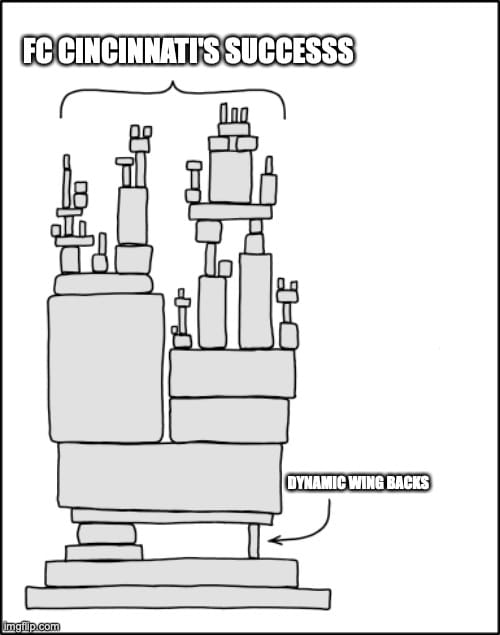
Last year, when Albright missed on rebuilding the wing back room the team was still paying a premium at the position. DeAndre Yedlin and Lukas Engel were miscast in their attacking roles but were still paid like elite players at the position. Many of the Orange and Blue's stagnant attacking play last year can be traced back to the issues out wide.
FCC's wing back play has been more dynamic and consistent with Ender Echenique and Bryan Ramírez in 2026 but neither player is close to what we saw from Barreal at his best. Echenique, a U22 initiative player, and Ramírez, who was brought in on a transfer fee, require significant resources from a roster building perspective. Where lots of MLS treat fullback as pretty far down the positional spectrum, it's one of the most important for the Orange and Blue.
This also means that if Ramírez or Echenique were to miss an extended period of time, the Orange and Blue don't really have a viable Plan B. Alvas Powell and Kyle Smith are solid MLS players, but they're not going to provide the attacking juice FCC relies on in the final third from its starters at the position.
The impact of FCC's self-imposed three center back system plus one defense first (only?) central midfielder means the wing backs need to a lot, and if they aren't for whatever reason, the whole thing kind of grinds to a halt.
Attacking Impact
The combined more than $30 million price tag of FCC's highest profile attacker, Kévin Denkey and Evander, takes up most of the oxygen in any conversation about FCC's goal scoring or lack thereof.
It's still too soon to make a judgment about Ayoub Jabbari and whether he'll slot in as an effective partner up top for Denkey. However, with FCC's roster resources allocated where they are, the Orange and Blue are certainly too dependent on contributions from Tom Barlow, on the team's Supplemental Roster. Dado Valenzuela has flashed as a striker and maybe Kristian Fletcher can be another contributor when he's fully healthy, but given the spending further back on the field, the Orange and Blue are limited in how much more money can be spent in the attack. Soccer teams all over the world have to spend money for goals and FCC has kind of taken the opposite approach, with the exception of Denkey and Evander.
Denkey and Evander deserve scrutiny but they can't do everything themselves. Echenique and Ramírez are upgrades out wide, and Pavel Bucha is a nice player, but, choosing to play a player down in the final third really constrains things. Again, the math is pretty simple.
Where Do We Go From Here?
It's certainly possible, now that the team's focus is fully back on league play, that the Orange and Blue will play good soccer and make this post look ridiculous in just a few weeks. I'd be fine with that!
However, we might be reaching a point where this roster as currently constructed just doesn't measure up to expectations. There aren't a ton of tactical directions the team could go, either. There's just too much depth at certain positions to change things too dramatically. If it doesn't end up working, deeper questions about the identity of FC Cincinnati need to be asked.


