
Counter Punching: Monday Takeaways (4/21/25)
Defensive solidity, a promising night from the front three, and thinking about what comes next

All stats courtesy of FBref unless otherwise noted
FC Cincinnati’s 3-2 win at Solider Field over an improved Chicago Fire team showcased a slightly different game plan than what we’ve seen so far over the course of 2025. Instead of looking to build up in possession, the Orange and Blue played more direct, getting the ball to its attacking players in space to run at defenders. FCC still didn’t play great. The Fire created just about the same quality of chances in open play as the Orange and Blue and won a penalty to make the game a little close for comfort. However, FCC found a way to win despite not playing its best and, importantly, there are some positive takeaways to be had.
1. Counter Punching
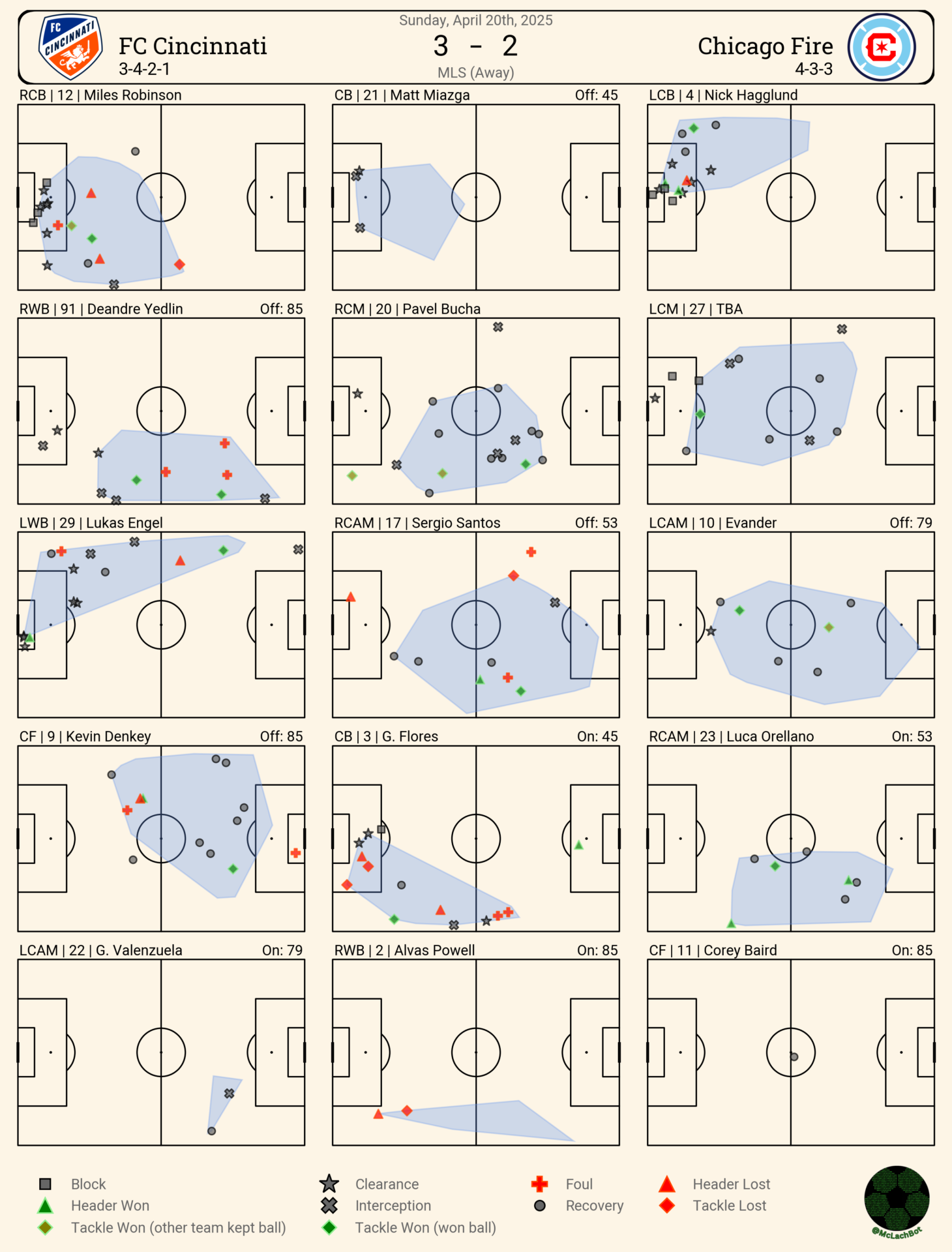
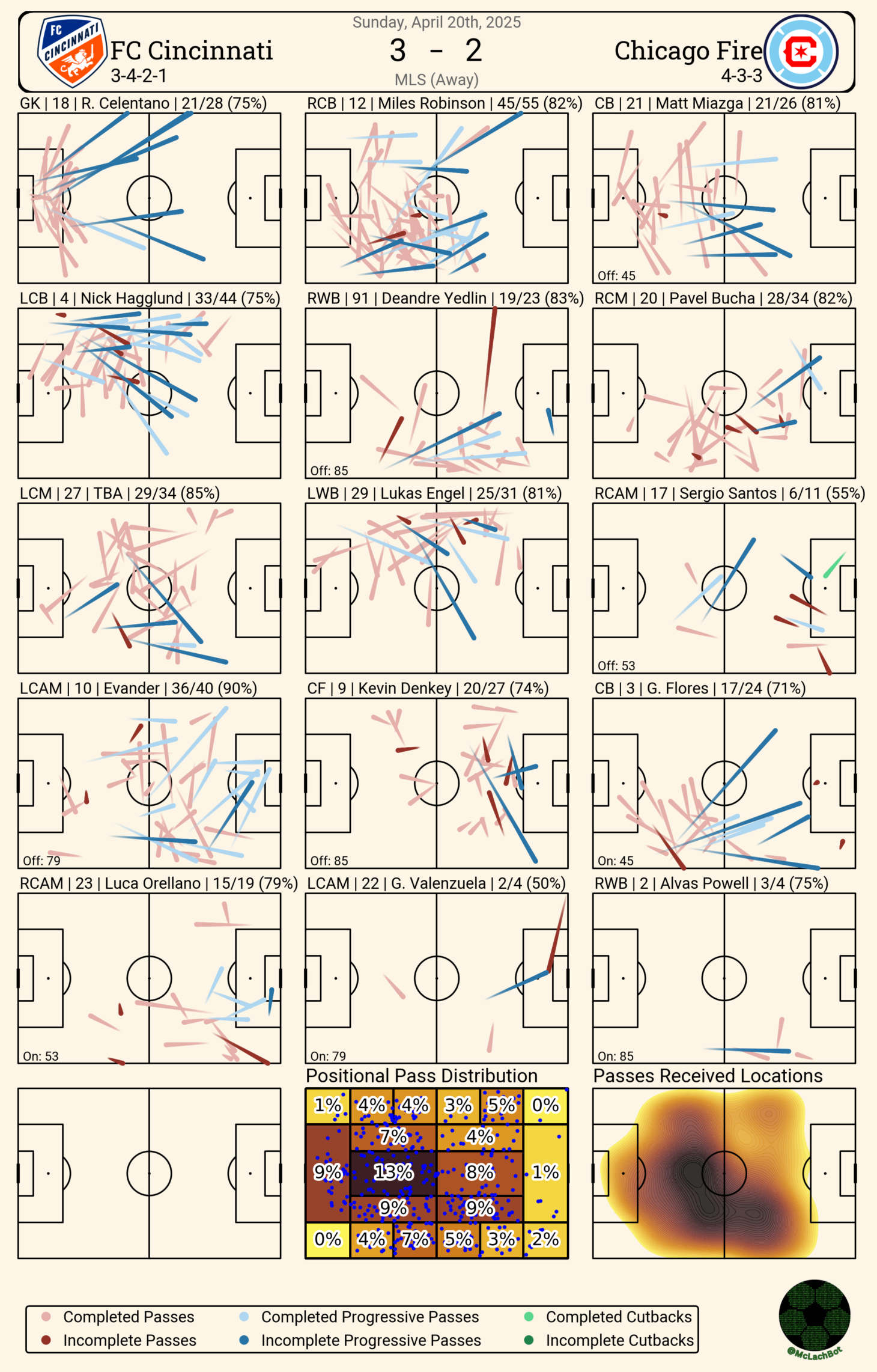
For large stretches of the game, the Orange and Blue pressed the Fire in its half, then retreated and defended deep. In possession, FCC looked to play direct, both when playing out of the back or after open play turnovers, no matter where they occurred on the field.
FCC’s press was successful in winning the ball in dangerous areas, either through tackles and interceptions or forcing bad passes by the home team. All three of the Orange and Blue’s goals came shortly after a loss of possession by the Fire or pressure from FCC. Multiple other chances - whether or not they led to shots - came from defensive pressure turning into quick attacks the other direction.
However, the Fire were also able to break through on a few occasions, creating dangerous opportunities the other way. So it goes with that style of play. Mostly though, FCC was able to navigate many of those transition periods and get back to its lower block and defend effectively.
When asked about seeing out the last ten minutes of the game, FCC manager Pat Noonan said, “But it’s getting, you know, control the ball and being comfortable enough to not just kick the ball up the field and say, okay, this is how we can break this pressure, or this is how we have to move ahead of the ball to be able to be an option to then relieve that pressure and move up the field with space. And so those are some of the things that we’ll talk about. But there was also some really good moments when we did get that right, and we had a lot of space to attack in transition.”
Noonan continued, “So, we protect a one goal lead in in a stressful, I would say, couple minutes, 10 minute stretch, but that’s something these guys have been pretty good about all year.”
Defending against a team piling on pressure is something you’d expect FCC’s defense-heavy lineup to be pretty good at doing. Matt Miazga’s first start of 2025 helped matters. Though his hopefully-still-recovering pace was exposed on Hugo Cuypers’ opening goal, FCC’s three centerback structure proved very difficult to break down over the course of 90 minutes. It wasn’t always pretty but it worked.
There were certainly moments throughout the game where FCC’s emphasis on playing direct led to sustained Chicago pressure. However, the good mostly outweighed the bad.
The Orange and Blue attempted its most long passes of the season, completing 48 of 84 (57%). FCC relied on its centerbacks to advance the ball up the field, and it paid off as they combined to complete 20 of 34 (59%) of their passes traveling more than 30 yards. Crucially, that direct passing opened up space for attackers to run into, putting them in positions to succeed.
2. Attacking Signs Of Life
As Chicago looked to break down a deep-sitting FCC defense, Evander, Kévin Denkey, Sergio Santos, and later Luca Orellano, found space to exploit. The Orange and Blue’s successful pressure led to opportunities through the game but, even when the ball was in its half, effective direct passing from defenders to the front line also put FCC’s attackers in space to thrive.
Pavel Bucha and Tah Brian Anunga didn’t have big days moving the ball up the field but they didn’t need to. Freed of some ball progression responsibilities both players found success in the middle of the field winning second balls. The two combined for 14 recoveries, with Bucha’s nine leading the Orange and Blue on the night. DeAndre Yedlin still had a lot of touches in the final third but FCC’s offense didn’t require him to play the key pass.
Luca Orellano immediately made an impact after replacing Sergio Santos in the 53rd minute. The state of the game helped. With the Fire pushing for an equalizer, Orellano found even more space to attack. However, FCC’s focus on playing in transition is a more ideal situation for Orellano than trying to attack a set defense. His ability to dribble past pretty much defender in the league - even if they know what’s coming - allows FCC to attack unsettled defenders.
Not every attack was successful. There were a number throughout the game just missing the final ball. However, Denkey and Evander looked like they were much more on the same page and Orellano made the Orange and Blue even more dangerous. So much so that I’d be curious to see this emphasis on absorbing pressure before releasing attackers into space become a central focus of the attack.
3. Evolving Identity?
It’s probably a little overdramatic to say that FCC might be changing its identity on the field based on the results of one game, especially a game against a team that likes to play in a very particular way. However, given the construction of the roster, pressing when possible, absorbing pressure when that doesn’t work, and attacking in transition might be the best way forward for the Orange and Blue for the rest of 2025.
It’s certainly higher variance way to play and can expose you against teams with the quality to pick apart a deep-sitting defense. However, it would allow Noonan to keep three centerbacks on the field, not ask the team’s wingbacks to play huge roles in attack, while also getting the team’s three attackers in space to attack.
At the very least, Noonan’s willingness to tweak how the Orange and Blue attack is promising. Whether this change sticks remains to be seen but at the very least it’s another club in the bag or arrow in the quiver or whatever your preferred analogy may be. FCC is going to have to win in a variety of ways to end the year with silverware and there are a number of options available. Now to figure out what’s best.


