
FC Cincinnati's Possession Balancing Act
Looking back at the Orange and Blue's shift to playing with the ball in 2024

All data from FBref unless otherwise noted.
Happy New Year to everyone and welcome back. I don’t know about you but the start of the season feels a whole lot closer now that we’re in 2025.
I figured the New Year would be a good time for a bit of an introduction (or reintroduction) to what you can expect from me.
I’ll start with the name. Most Major League Soccer teams are stingy about access to preseason games, leaving fans largely in the dark about players who are impressing or any stylistic or tactical shifts that a new season will bring. A stream of a preseason game might answer some of those questions (or at least give supporters more to analyze and debate). That’s what I’ll be trying to do here on a weekly (sometimes more often) basis.
You can expect deep dives and breakdowns about FC Cincinnati (mostly) using data and tactical analysis of things that I find interesting or am trying to understand. Whether that’s something that happened in the last game, or something a player is doing, or larger trends, I’ll do my best to write about things that will make watching the Orange and Blue a little more interesting.
To everyone who has already subscribed, I very much appreciate it. If you haven’t subscribed but this sounds like something that will provide some amount of welcome distraction on a weekly basis, please sign up anyways.
Now to start 2025 in a soccer nerdy way, join me in looking back at FCC’s shift to a more possession-heavy game model during the 2024 season.
Even though the 2025 season kicks off in just over two months, FC Cincinnati’s roster is full of question marks. There are questions about play style, too.
The 2024 season brought a fairly significant on-the-field change for Pat Noonan’s FC Cincinnati team. That idea, distilled into its most basic, was the team tried to play with the ball more instead of against it.
The best version of this makes a lot of sense. A team that maintains possession limits its opponents’ opportunities to score simply because, you know, the other team can’t score if they don’t have the ball. The Orange and Blue aren’t, and never will be, a defensive possession juggernaut, but limiting opponents’ chances by denying them the ball is a tried and true strategy on the soccer field.
Also, previous iterations of FCC struggled to break down opponents that chose to sit deep. So the idea to build a possession-based system that could consistently create quality chances out of sustained possession in the final third made a lot sense as FCC looked to evolve.
Did that new approach make the team better, though? Or will we see Noonan twisting the dial, one way or the other, looking for something different in 2025?
Emphasis on Possession
By the most basic standard of evaluation, FCC succeeded in shifting to a more possession-focused style simply because the team had the ball more. In 25 of 34 regular season games, the Orange and Blue out-possessed its opposition. Answering whether that increased possession made the team better, however, is a more complicated thing.
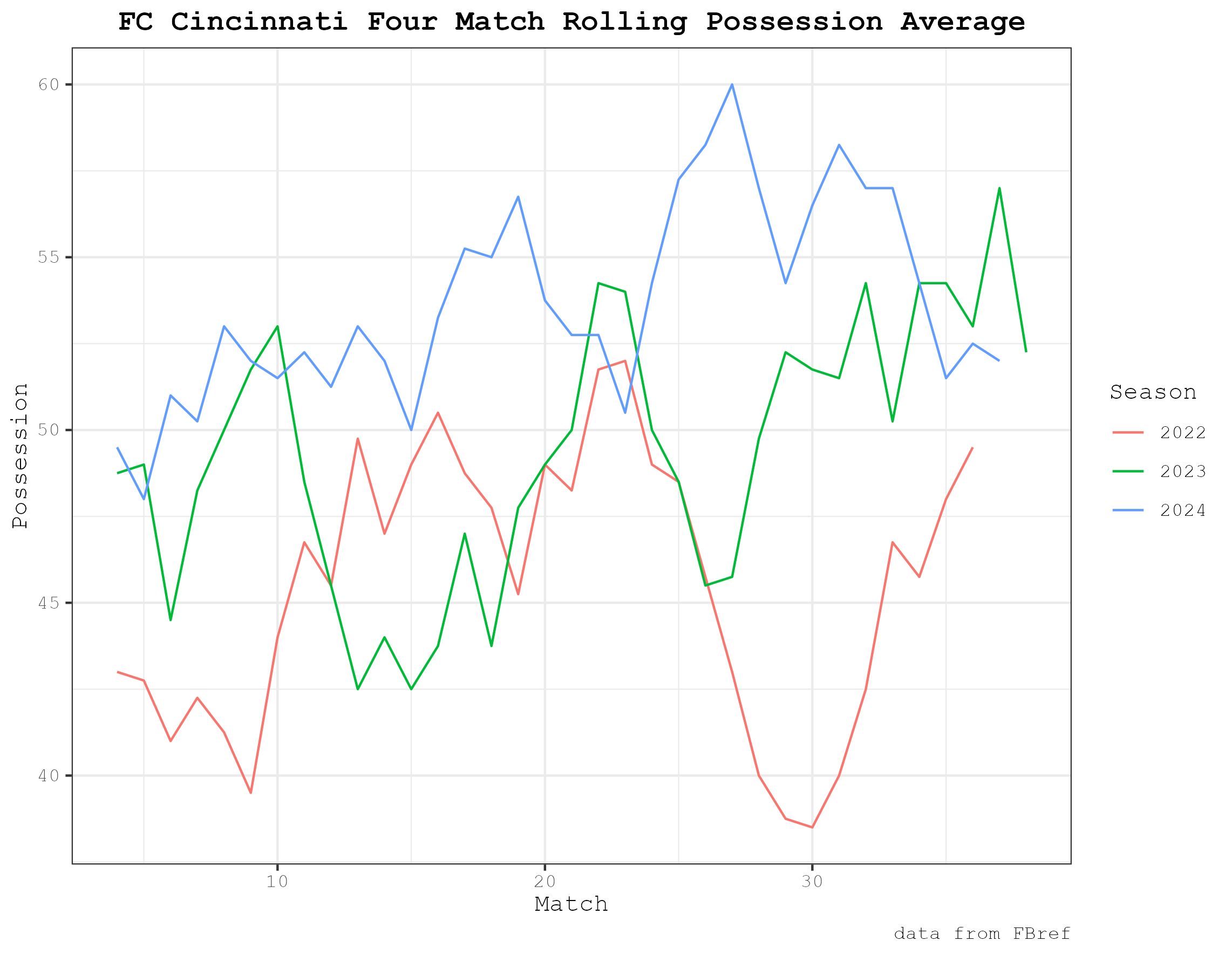
Just looking at results, more possession didn’t necessarily lead to better results. The Orange and Blue had more than 60% possession in five matches in 2024. The team’s record in those games? 0-3-2. Granted, there are often game state considerations in matches where possession is so tilted one way or the other, but if a team makes playing with the ball a point of emphasis, that team should, you know, be better in those games.
Digging deeper, more possession seemingly didn’t lead to more dangerous outcomes. Yes, FCC had the ball in the attacking final third more in 2024 but those touches didn’t really translate to having the ball more in places where goals typically come from. Despite averaging nearly 25 more touches in the final third per game in the regular season, the Orange and Blue generated just 1.2 more touches in the opposition penalty area per match.
The same trend is reflected for FCC’s shots over the course of the season. Though FCC managed the take 25 more shots over the course of the season in regular possession situations compared to 2023, those shots were from less dangerous positions according to American Soccer Analysis’ expected goals model.
For avid FCC watchers, just think back to how many final third possessions ended in relatively low-percentage shots from the top of the 18-yard-box rather than more dangerous looks from cutbacks or other incisive actions into the penalty area.
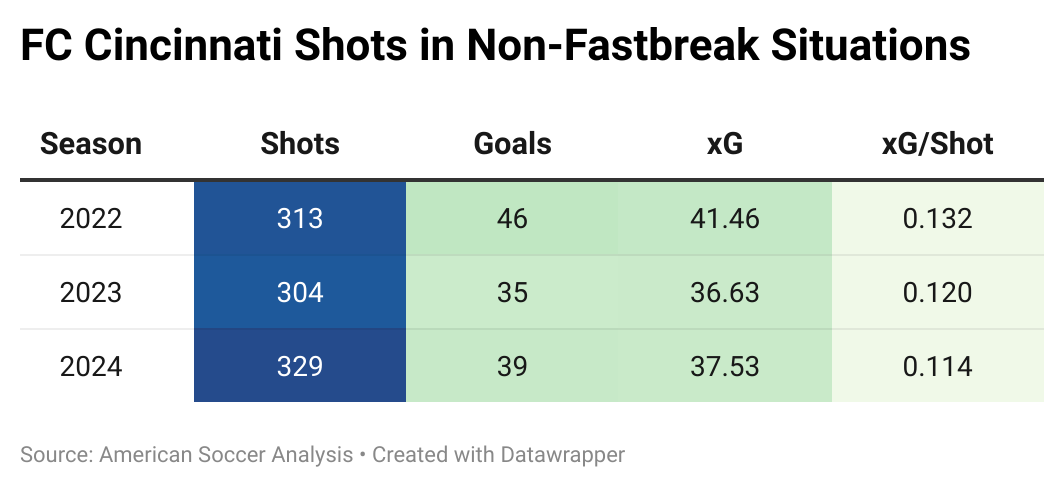
Having the ball in the final third is all well and good but something actually needs to happen when its there that translates to good opportunities. The numbers (and the eye test, largely) suggest that FCC’s expanded possession didn’t result in more dangerous possession. In fact, the team’s structure allowing it patiently to move the ball from defensive to attacking thirds created a situation that opponents exploited on the break.
Transition Liabilities
The Orange and Blue’s emphasis on possession left it vulnerable after turnovers. Relying on centerbacks to play a bigger role moving the ball into the final third as well as in it created opportunities for opponents to find space in behind, either by quick combinations of passes or just going over-the-top.
American Soccer Analysis (using Opta’s tags) distinguishes between regular possession and fastbreaks in its xGoals database. Last season in fastbreak situations, FCC conceded 29 shots and six goals on nearly six expected goals - a huge increase compared to both 2022 and 2023.
There’s one factor that seems to explain some of these issues: Matt Miazga’s injury in June. Though the Orange and Blue’s defensive record wasn’t significantly worse without Miazga, it certainly was in transition situations. Without Miazga anchoring FCC’s centerback trio, fastbreak shots went from slight-above-average chances (0.14 xG/shot) by expected goals to really, really high quality chances for opponents (0.26 xG/shot). For context, across the full season, FCC conceded 0.09 non-penalty xG per shot.
Without Miazga on the field, opponents were able to get shots from better positions in transition. Miazga’s ability to read the game and win the ball in the air limited the opponents’ opportunities to play direct on the counter. Even when Miazga was beaten, more often than not, he was able to recover and force opponents to take worse shots. His replacements in the lineup weren’t able to consistently do the same.
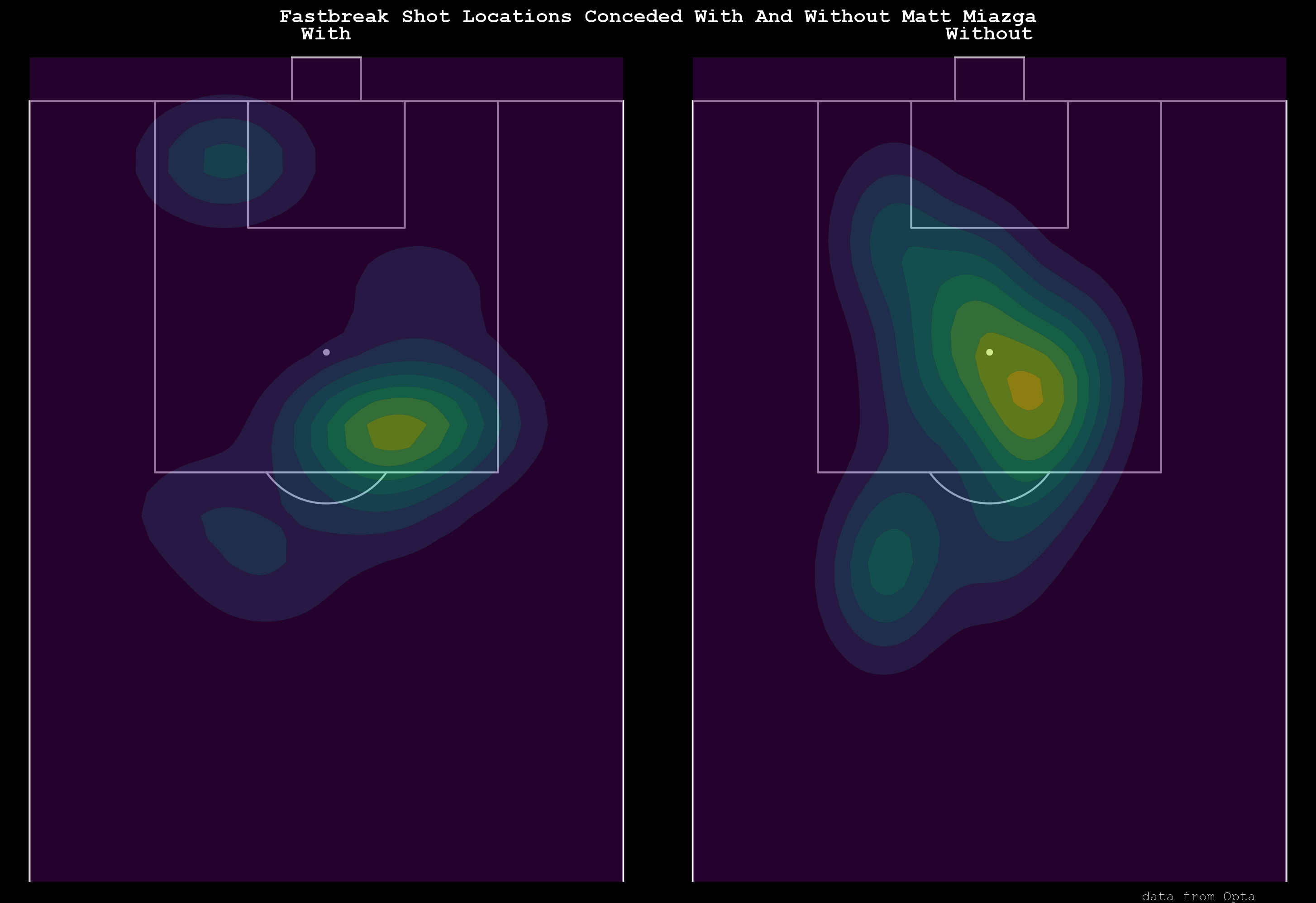
Miazga’s absence, again lines up with the data and the eye test. However, it doesn’t explain everything. Even with a health Miazga, FCC conceded more fastbreak shots (12) than in both 2022 and 2023 (11 in each season). Granted, those shots came from less dangerous positions on the field but his absence wasn’t solely responsible for the Orange and Blue’s defense struggles in transition. Some portion of the blame must be attributed to FCC’s more aggressive efforts to control the ball higher up the field.
The Hard Part And What’s Next
Balancing the risk and reward of pushing players forward to control the ball in the final third is a tricky balancing act. For FCC in 2024, the downside seemingly outweighed the upside. Conceding more shots, and more dangerous chances doesn’t seem to justify settling for more, low-quality chances.
Understanding why FCC struggled to consistently create out of possession probably deserves its own post. Contributing explanations include but are not limited to a lack of width from wingbacks in the final third, no true striker making decisive runs in the box, and limited offensive contributions from deeper lying midfielders.
Emphasizing possession also asked key cogs in FCC’s best eleven, like Roman Celentano and Obi Nwobodo, to do more with the ball at their feet, which isn’t the strengths of their respective games.
Ultimately, the success of too many final third possessions came down to Lucho Acosta’s ability to beat a defender off the dribble. To be fair, when that plan works, it really works. But Lucho can’t win every dribble or make a perfect pass in every situation - and turnovers in those situations contributed to FCC’s aforementioned issues in transition.
Conceding more chances in transition is fine as a trade off for having the ball more, but to make it worthwhile, a team has to see some sort of improvement from possession. The Orange and Blue were on the wrong side of that calculation in 2024.
Acosta’s still-unresolved presence in Orange and Blue complicates any discussion about how Noonan might tweak the team’s on-field style in 2025. But there’s reason for optimism in how the Orange and Blue can be more dangerous with the ball.
Kévin Denkey’s arrival should fill the striker-shaped hole in FCC’s starting eleven but outstanding questions at left wingback remain. Obinna Nwobodo isn’t likely to become less of a passenger in the final third but if he can clamp down on opponent’s in transition more, the balance tilts back in FCC’s favor a little bit. Pavel Bucha had success in Europe as a midfielder who got into the box, perhaps he can provide another option, either to receiving the ball or making the final pass. Luca Orellano playing higher up the field could be one of the most dangerous attackers in the league, providing an attacking counterweight to Acosta or shouldering a bigger load by himself.
Whether Noonan and his coaching staff remain committed to playing with the ball will be something to watch in the early part of this season. We might get some clues based on how Chris Albright fills out the roster but we won’t really know until
Where Noonan and his coaching staff find a sweet spot between playing with or against the ball will be worth keeping a close eye on early in 2025. How Chris Albright and the front office fill out the rest of the roster over the next two months could provide some clues but we likely won’t know for sure until mid-February when the actual games start. Here’s to hoping for some preseason streams though…
Cool Stuff I read recently soccer related (or not)
- Mark Thompson’s The Four Quadrants of Football got me thinking about what became this post.
- Also, just in case you missed it (and if you take in much MLS content or found your way through here from him, you probably didn’t), Matt Doyle launched TACTICS FREE ZONE. He’s the best in the business covering MLS and always worth reading.


