
As Luca Goes
Luca Orellano's return to an old role might be the catalyst FC Cincinnati's attack needs in the second half of the season

All stats courtesy of FBref unless otherwise noted.
After a much-enjoyed vacation, I’m happy to be back in your inbox (or however you’re reading this) as there’s been plenty to talk about in FC Cincinnati land over the last month or so.
First of all, some housekeeping: for the time being, I’m going to be moving away game-by-game reviews early in the week. Instead, I’ll be digging into some bigger topics. We have a lot of context so far in the 2025 season and there’s plenty to consider. Also, if there’s anything you’re curious about, leave a comment and if it piques my interest as well, I’ll dig in.
So, here are some thoughts on Luca Orellano’s return playing left wingback.
Since I wrote in June that the Orange and Blue might not be as good as its position in the table, the team has won six of seven games. FCC isn’t dominating teams but its advanced numbers have improved somewhat, especially defensively.
Since the start of June, FCC has done a pretty good job limiting opponents to low-percentage chances. In that time frame, the team has conceded more than 1.1 expected goals (xG) to its opposition just twice.1
The Orange and Blue’s offense is still looking for answers, however. Through the first 24 games of the 2025 season, FCC’s 1.22 xG per 90 minutes ranks 27th (out of 32) in Major League Soccer.
Luca Orellano’s return to wingback is one of the best, and maybe last, outstanding hopes for the Orange and Blue’s attack to finally reach the level that just about everyone agrees it’s capable of paying.
Unlocking Luca
Luca Orellano arrived in the Queen City in February 2024 as the next player up in FCC’s “let’s just play an Argentinian winger as a very attacking wingback” experiment. Much like Álvaro Barreal before him, Orellano provided a rare level of attacking threat from at least a nominal defender on the left side. Orellano’s game differed from Barreal’s, however. Where Barreal provided more width, Orellano preferred to operate from more central positions. However, both proved to be valuable partners with Lucho Acosta in the final third, helping to create danger in the final third.
Due to a confluence of factors, including a thinner depth chart in the attack and a revitalized Yamil Asad, Pat Noonan and company pushed Orellano higher up the field, to play as either an attacking midfielder or an out-and-out striker. And it actually worked pretty well! Orellano put up 2.0 xG and 0.7 xAG across the final four games of the 2024 season when he was playing as a forward.
So, in the offseason, when Chris Albright talked about entering the 2025 season with Orellano as a full-time attacker, it made a whole lot of sense. Orellano proved to be an elite dribbler - something that should lead to more attacking danger if he could get more touches closer to opposing the goal.
What Didn’t Work
However, Orellano’s switch to being a full-time attacker didn’t work out how the front office and coaching staff might have hoped. Orellano struggled playing in the right half-space, where he mostly lined up in the Orange and Blue’s possession structure. Some of those struggles were a result of having to play with his mostly with his back to goal while often being defended by opposing team’s center backs.
Even when Orellano was able to successfully spin out of pressure or receive a pass facing the opposing goal, he often looked to push the ball centrally on his favored left foot - a space Evander gravitated towards as well. With two of the Orange and Blue’s most dangerous on-ball creators occupying the same central part of the field, opposing defenders’ tasks was much easier.
Neither player is shy about shooting from outside the 18-yard-box and given the congestion at the top box with Orellano, Evander, and Kévin Denkey in the same general vicinity, a speculative effort from distance was the outcome of too many attacking possessions.
In his time playing as an attacker (and as a right wingback), Orellano’s 35 shots generated just 1.97 xG. There were plenty of situations where an attempt from outside the box was the best look but a big part of the Orange and Blue’s attacking struggles so far this season come down to stagnation in the final third.
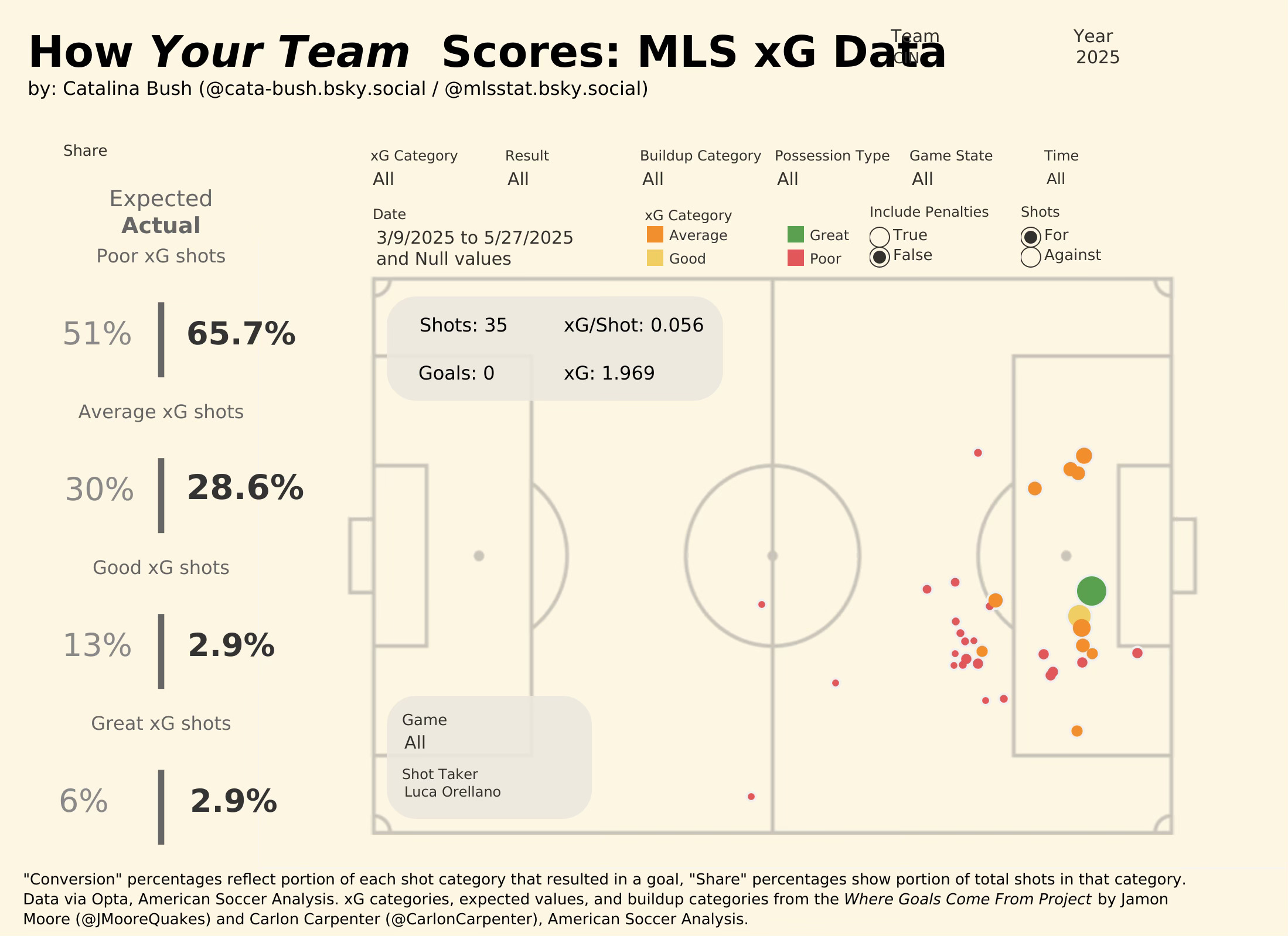
Orellano’s return to left wingback helps to break that log jam and has the potential to push FCC’s attack to new highs.2
Returning To The Left
In late May, Orellano returned to a full-time role at left wingback against FC Dallas. As a wingback, Orellano has been able to produce in the final third at a similar level to when he was operating as an attacker, despite having fewer touches in the attacking third.
Orellano remains a reliable outlet for teammates’ passes, despite his nominal position. Similarly, he’s demonstrated an ability to get on the ball in opponent’s penalty box, an obvious but key indicator of offensive production.
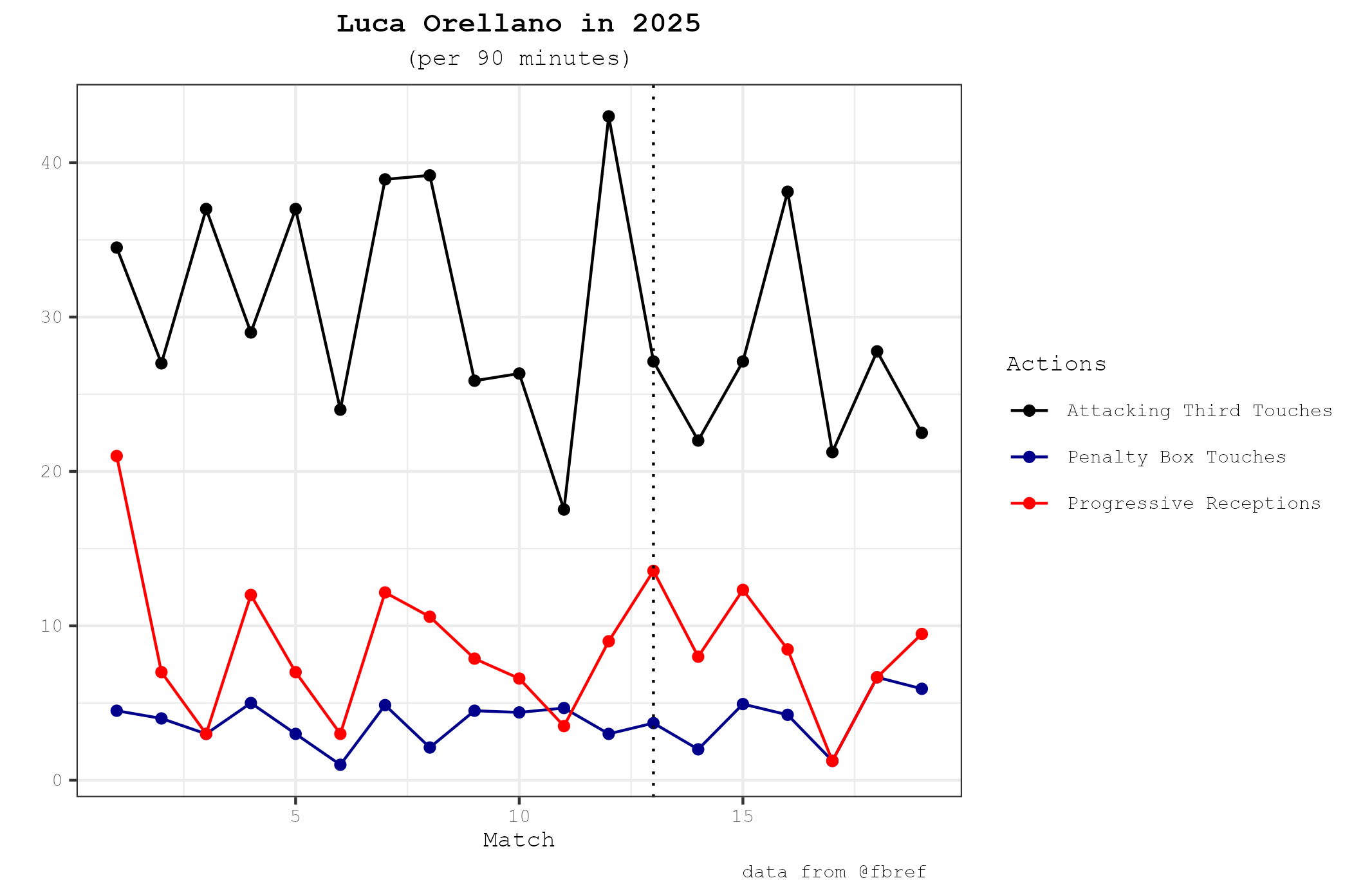
Consistent offensive success comes down to a teams ability to create high quality scoring chances over and over and over again. There are a variety of tactical ways to create those opportunities. Playing on the left, Orellano opens up additional possibilities for the Orange and Blue.
Take this example of a pattern of play we’ve seen across the last few games. With the ball at the feet of FCC’s right center back, Orellano and Evander put pressure on an opponents’ left back. With Miles Robinsons’ ability3 to hit a diagonal pass to Orellano on the sideline, FCC can switch the point of attack and put its two most dangerous players in a 2-v-1 situation against a retreating defender.
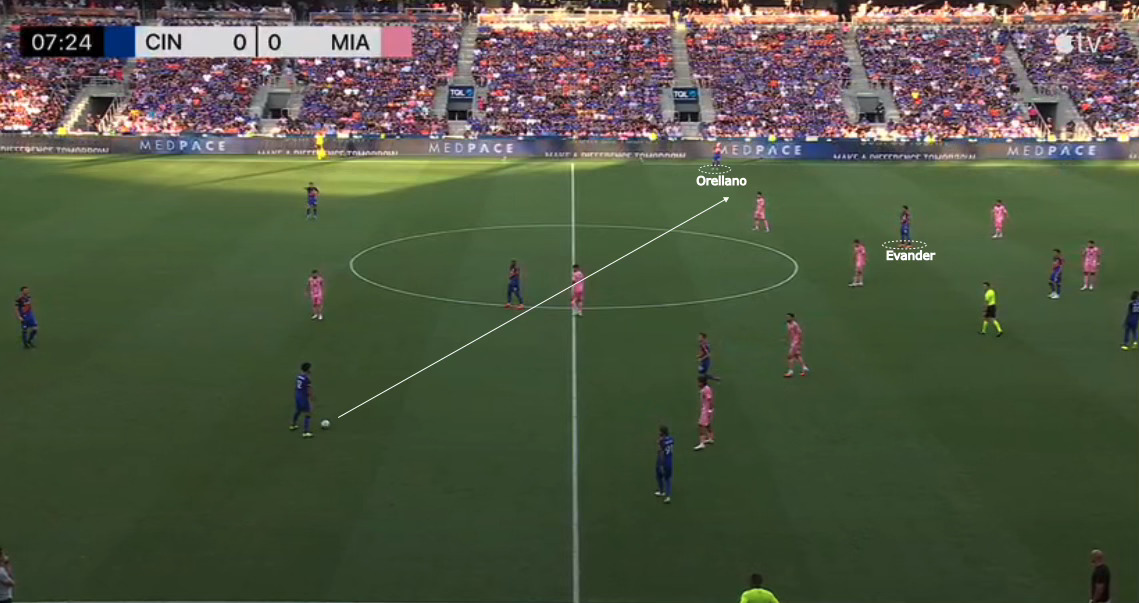
With Orellano, a bonafide threat to hit low crosses and cutbacks across the box, and Evander staying centrally, the Orange and Blue can put defenders on the weak side in no win situations. FCC watchers will recognize similar patterns of play from previous seasons when Acosta combined with wingbacks on the left side to create overloads.
FCC has struggled to create easy chances for its strikers this year, and regardless of how many goals Denkey, making a striker’s life easier is always a good thing. Creating situations where the team’s two most dangerous on-ball attackers can cooperate with space to attack rather than step on each other’s toes should greatly improve the Orange and Blue’s attacking prospects.
Creating consistent, advantageous situations for Orellano on the ball should correlate to better attack for the team. The Orange and Blue would also benefit from Orellano winning more take ons in the final third, something he demonstrated an ability to do last season.
According to American Soccer Analysis data, Orellano’s goals added above average derived from dribbling is still at an elite level in 2025. However, it’s driven almost entirely by carries towards the opposing goal. On the season so far, Orellano ranks slightly below average on G+ from take ons in the final third. Last season, for context, Orellano was in the 99% for G+ generated from take ons in the final third.
If Orellano’s take ons regress to the mean, FCC’s strikers should expect some more cutbacks and low crosses into the danger area at the front post. And that will, hopefully, lead to more consistent scoring chances for the team’s attackers as the Orange and Blue gear up in the chase for silverware.


